

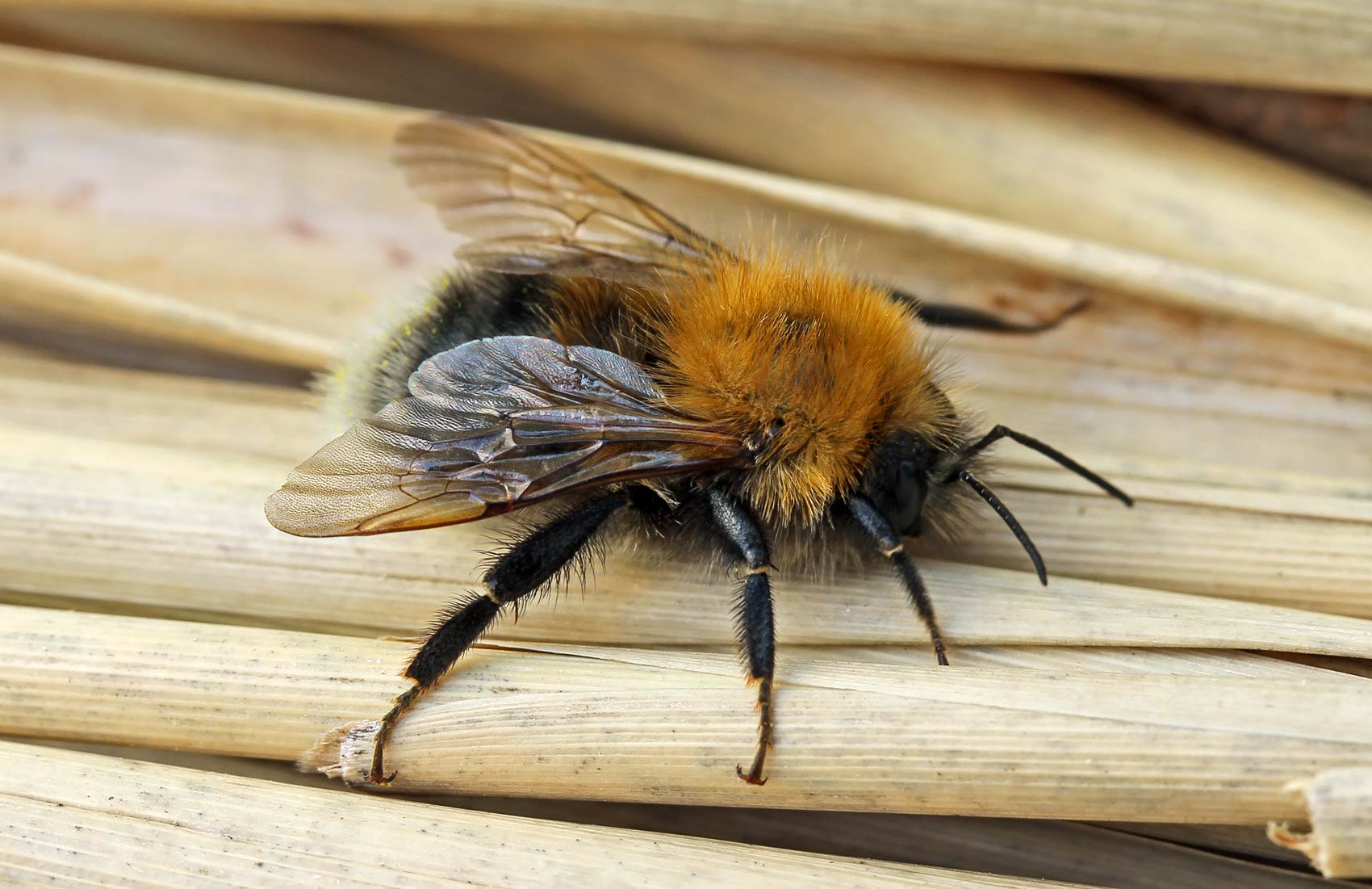
© entomart, Attribution licence, via Wikimedia Commons
Tree Bumblebee
Bombus hypnorum
Linnaeus, 1758 • Apidae • Pyrobombus
Bombus hypnorum Linnaeus, 1758, the tree bumblebee, is one of Britain's most remarkable conservation success stories. First recorded in the UK in 2001, it has spread across England and Wales and into Scotland within two decades, one of the fastest range expansions of any British insect. It is instantly recognisable by its three-colour pattern, shared by queens, workers and males alike: a chestnut-brown thorax, a jet-black abdomen and a clean white tail. Unlike most British bumblebees, which nest underground, the tree bumblebee nests above ground in tree cavities, roof spaces and, most famously, garden bird boxes, which is how most people first meet it. See where it fits among Britain's wild bees on the UK Native Bee Species Map, or explore the wider genus in the World Bee Atlas.
Quick Facts
Taxonomy and Classification
Carl Linnaeus described the tree bumblebee in 1758 in the tenth edition of Systema Naturae.[1] It belongs to the family Apidae, genus Bombus, and the subgenus Pyrobombus, the "fiery-tailed" bumblebees, of which B. hypnorum is the type species.[2] Pyrobombus is a large and successful subgenus accounting for nearly a fifth of all bumblebee species, with centres of diversity in Central Asia and North America. In Britain its close relatives include the early bumblebee (Bombus pratorum), with which it shares the pratorum-group.
| Kingdom | Animalia |
| Phylum | Arthropoda |
| Class | Insecta |
| Order | Hymenoptera |
| Family | Apidae |
| Subfamily | Apinae |
| Tribe | Bombini Latreille, 1802 |
| Genus | Bombus Latreille, 1802 |
| Subgenus | Pyrobombus Dalla Torre, 1880 |
| Species | Bombus hypnorum Linnaeus, 1758 |
How many species are in the hypnorum complex?
The British tree bumblebee is unambiguously B. hypnorum, but the wider species complex is under active revision. A 2022 study by Williams and colleagues, examining the hypnorum-complex worldwide, described two new near-cryptic species and clarified boundaries that earlier work had blurred.[3] None of this affects the identity of the UK population, which remains the nominate B. hypnorum, but it is a reminder that even a familiar garden bee can sit within an unsettled global taxonomy.
Physical Description
The tree bumblebee is one of the easiest British bumblebees to identify because all three castes, queens, workers and males, share the same distinctive three-band pattern: a chestnut or ginger-brown thorax, a black abdomen, and a pure white tail.[4] The combination is unique among British bumblebees. The white tail is the clinching feature, separating it instantly from the all-ginger common carder bee (Bombus pascuorum), with which a faded individual might otherwise be confused.
Queens are roughly the size of a buff-tailed or white-tailed bumblebee queen, while workers are often noticeably small and males fall in between. There is natural variation: the brown of the thorax can darken from the centre outward, and in extreme cases a bee can appear almost entirely black except for the white tail. Males often carry a tuft of chestnut hairs on the top of the head and may show ginger hairs mixed into the abdomen. The species has a short proboscis and a characteristically rounded head.[4]
A New Arrival: The UK Range Expansion
The tree bumblebee is genuinely new to Britain. The first confirmed British record came in 2001 from near Southampton in Hampshire.[5] From that single foothold it has undergone one of the most rapid range expansions ever documented for a British insect, spreading across most of England and Wales, reaching Scotland by 2013, and being added to the Irish list in 2017. Within roughly two decades it went from absent to one of the commonest bumblebees in many gardens.
Its success runs against the grain of the wider bumblebee story, which is largely one of decline. The reason lies in its ecology. The tree bumblebee is a species of open woodland and woodland edge, and the modern suburban garden, with its mix of trees, shrubs, flowers and cavity nesting sites, mimics that habitat almost perfectly.[6] Research on the colonising UK population found its density was positively associated with both urban and woodland cover, a combination unique among the bumblebees studied, which helps explain why it has thrived where others struggle. You can see how its spreading range overlaps with Britain's resident bees on the UK Native Bee Species Map.
Nesting: Bird Boxes and the Buzz at the Entrance
The single most distinctive thing about the tree bumblebee is where it nests. While most British bumblebees nest underground in old mammal burrows, the tree bumblebee nests above ground, in tree cavities, roof eaves, behind soffit boards, in cavity walls, and very commonly in garden bird boxes, frequently reusing old birds' nests as a foundation.[5] Queens have even been recorded evicting blue tits to take over an occupied box. This habit, more than anything else, is what brings the species to public attention.
Most homeowners first notice a nest because of the bees hovering and darting around the entrance hole. These are almost always males engaged in what is called nest surveillance: groups of males patrol outside the nest waiting for new queens to emerge so they can mate. It can look alarming, like a swarm, but it is harmless. Male bumblebees have no sting at all.[5] The behaviour fades once the new queens have left and the colony naturally winds down.
Found a tree bumblebee nest? Leave it be
Tree bumblebee colonies are annual and short-lived, active for only a few months before dying out naturally in late summer, and they will not reuse the same box next year. The bees are not aggressive, the males cannot sting, and the colony is a free pollination service for your garden. The simplest and best response is to enjoy it and let it run its course.
Behaviour and Life Cycle
Queens emerge from hibernation early, in late February or March, and begin searching for an aerial nest site. About six weeks after a queen establishes her nest, the first workers emerge and take over foraging. Colonies are larger than those of most related Pyrobombus species, typically reaching around 150 workers at their peak and occasionally up to 300 or 400.[5] In the south of England the species can sometimes fit two generations into a single year. New queens and males are produced as the colony matures, after which the founding colony dies and only the mated new queens survive the winter.
As a forager the tree bumblebee is polylectic, visiting a very wide range of flowers, but it has clear favourites. It is strongly drawn to soft fruit blossom such as raspberry and bramble, along with comfrey, cotoneaster, fruit trees and garden shrubs, while showing little interest in the legume flowers favoured by many other bumblebees.[4] Strikingly, it forages over very short distances: a genetic study of a UK population estimated a mean worker foraging distance of only about 104 metres from the nest, far shorter than most bumblebees, which suits a bee that nests in flower-rich gardens.[7]
Conservation Status
The tree bumblebee is assessed as Least Concern and is one of the few bumblebees whose range and numbers are increasing rather than falling.[2] In an era of widespread pollinator decline it is a genuine bright spot, demonstrating that some species can adapt to and even benefit from human-altered landscapes when the right nesting and foraging resources are present. As an effective pollinator of soft fruit and garden plants, its spread brings a useful new pollination service to British gardens and allotments.
Its arrival has prompted some discussion about possible competition with resident bumblebees for nest sites and forage, but to date there is no clear evidence that the tree bumblebee has harmed native species, and its preference for aerial nest sites means it largely avoids competing for the underground cavities that most native bumblebees use.
Relationship to Honey and Pollination
Like all bumblebees, the tree bumblebee does not produce harvestable honey. Its colonies are annual and store only small quantities of nectar to ride out poor weather, so there is no surplus to collect. Its contribution is pollination, and as an early-emerging, soft-fruit-loving garden specialist it is a particularly valuable one for raspberries, blackberries, currants and orchard fruit.
For us as a honey company, the tree bumblebee is a reminder that a healthy garden supports many kinds of bee at once. The honey in our jars comes from managed Apis mellifera colonies, but those hives share gardens and hedgerows with bumblebees like B. hypnorum, and all of them depend on continuous flowering forage. Our British Wildflower Honey, gathered in the Midlands from bramble, clover, hawthorn and other native blossom, comes from the same kind of mixed forage that tree bumblebees thrive on. To understand what a world with fewer pollinators would look like, visit Your Plate Without Bees.
Source Conflicts and Open Questions
Is the tree bumblebee native, introduced, or a natural colonist?
Sources disagree on the label. Some, including The Wildlife Trusts, describe the tree bumblebee as an introduced, non-native species. Others, including the peer-reviewed research on its UK spread and the BWARS species account, describe it as a natural colonist that reached Britain under its own power as part of a broader northward and westward range expansion across Europe.[6]
The distinction matters. "Introduced" usually implies human transport, while the evidence points to natural dispersal across the Channel rather than accidental importation. The most accurate description is a natural colonist or natural range expansion, which is the term used in the scientific literature and the one we use here.
How big do colonies really get?
Figures vary. The frequently quoted peak is around 150 workers, but Von Hagen (1994) suggested colonies may reach up to 400, and other accounts cite 300 to 400. Loken noted that B. hypnorum has larger colonies than most members of its subgenus. The true figure depends on nest site, season and forage, so a single number understates the natural range; "around 150 at peak, occasionally far more" is the fairest summary.
Frequently Asked Questions
How do I identify a tree bumblebee?
Look for a three-colour pattern: a chestnut or ginger-brown thorax, a black abdomen, and a pure white tail. This combination is unique among British bumblebees and is shared by queens, workers and males. The white tail separates it from the all-ginger common carder bee. The bee also has a short tongue and a rounded head.
Why are there bees flying around my bird box?
You almost certainly have a tree bumblebee nest. The bees darting and hovering around the entrance are males on "nest surveillance," waiting for new queens to emerge so they can mate. It can look like a swarm, but it is completely harmless: male bumblebees have no sting. The activity settles down once the new queens have left and the colony winds down naturally.
Are tree bumblebees aggressive or dangerous?
No. Tree bumblebees are generally non-aggressive and pose little threat to people or pets. Only females can sting, and they do so only if the nest is seriously disturbed or a bee is handled. The males clustering around a nest box entrance cannot sting at all. A nest near your home is best left alone to run its short natural course.
Should I remove a tree bumblebee nest?
It is best not to. Tree bumblebee colonies are annual and short-lived, active for only a few months before dying out naturally in late summer, and they do not reuse the same box the following year. They are valuable garden pollinators and the simplest, kindest and most effective approach is to leave the nest undisturbed until it ends on its own.
When did tree bumblebees arrive in the UK?
The first confirmed British record was in 2001, near Southampton. The species then spread rapidly, reaching Scotland by 2013 and being added to the Irish list in 2017. It is now one of the commonest garden bumblebees across much of England and Wales, representing one of the fastest range expansions of any British insect.
Where do tree bumblebees nest?
Unlike most British bumblebees, which nest underground, tree bumblebees nest above ground in cavities. Favourite sites include garden bird boxes, holes in trees, roof eaves, behind soffit boards and in cavity walls, and they will often build on top of an old bird's nest. Their preference for aerial sites is reflected in the common name.
Do tree bumblebees make honey?
No. Like all bumblebees, they store only small amounts of nectar to survive bad weather, with no harvestable surplus. Their value is as pollinators, especially of soft fruit such as raspberries and blackberries. All harvestable honey, including ours, comes from managed honeybee (Apis mellifera) colonies.
Are tree bumblebees good or bad for native bees?
The current evidence suggests they are not harmful. The tree bumblebee is a natural colonist whose preference for aerial nest sites means it largely avoids competing for the underground cavities most native bumblebees use. There is no clear evidence it has harmed resident species, and as an effective pollinator it adds a useful service to gardens and allotments.
Sources and References
- Linnaeus, C. (1758). Systema Naturae (10th ed.). Stockholm: Laurentius Salvius. Original description of Apis hypnorum. Taxonomic record via GBIF. gbif.org
- Williams, P.H. et al. Subgenus Pyrobombus (Dalla Torre, 1880), type species Bombus hypnorum; conservation status Least Concern. Natural History Museum bumblebee resources and EUNIS species record. eunis.eea.europa.eu
- Williams, P.H., Dorji, P., Ren, Z., Xie, Z. & Orr, M. (2022). Bumblebees of the hypnorum-complex world-wide including two new near-cryptic species (Hymenoptera: Apidae). European Journal of Taxonomy, 847, 46–72. doi.org/10.5852/ejt.2022.847.1981
- Falk, S. & Lewington, R. (2015). Field Guide to the Bees of Great Britain and Ireland. London: British Wildlife Publishing; with species notes via the associated photographic collection. flickr.com
- Bees, Wasps and Ants Recording Society (BWARS). Bombus hypnorum species account: arrival, distribution, nesting and phenology. bwars.com
- Crowther, L.P., Hein, P.-L. & Bourke, A.F.G. (2014). Habitat and forage associations of a naturally colonising insect pollinator, the tree bumblebee Bombus hypnorum. PLOS ONE, 9(9), e107568. doi.org/10.1371/journal.pone.0107568
- Crowther, L.P. et al. (2019). Spatial ecology of a range-expanding bumble bee pollinator. Ecology and Evolution. Mean worker foraging distance estimated at 103.6 m. ncbi.nlm.nih.gov