

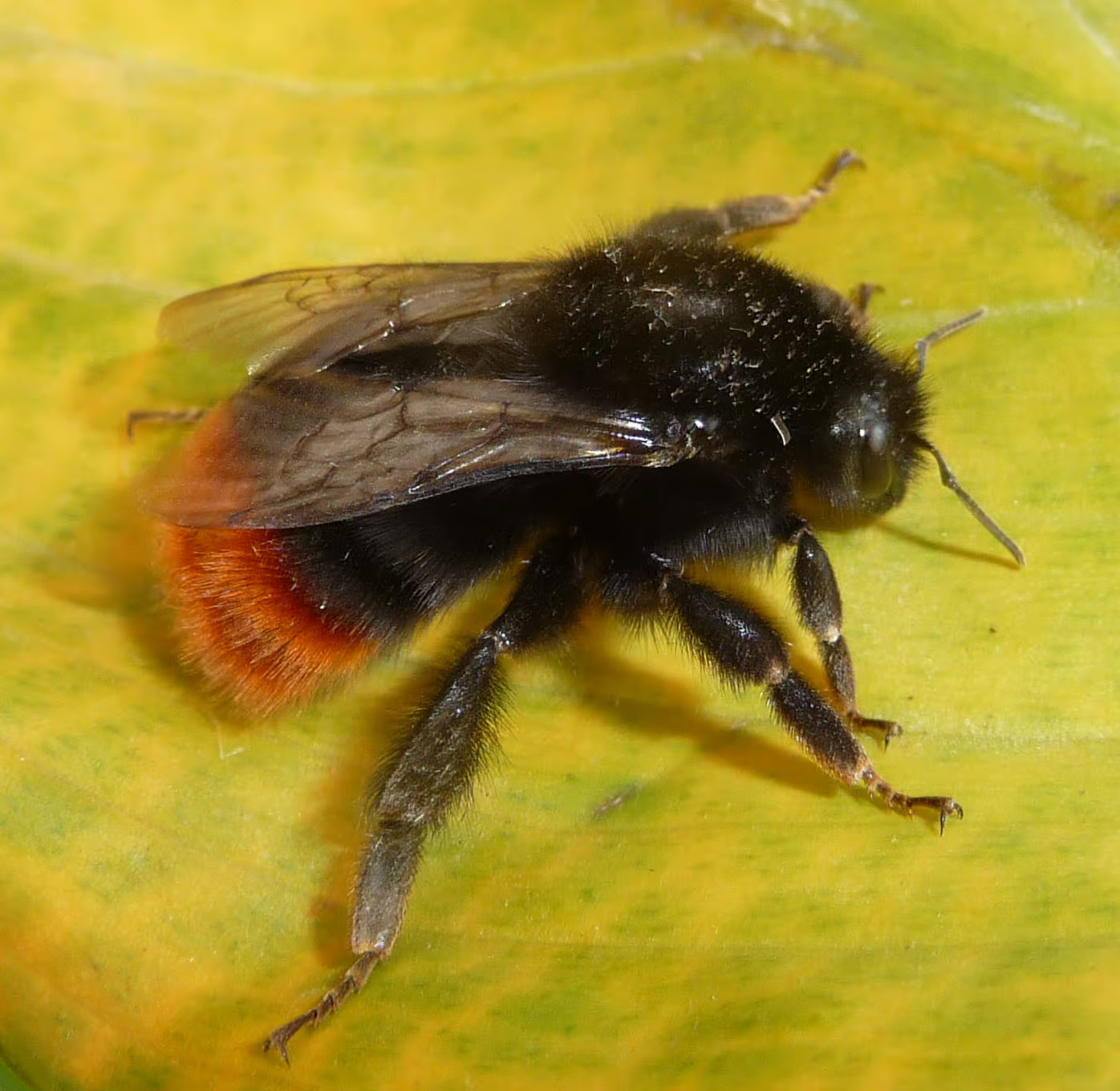
Red-tailed Bumblebee
Bombus lapidarius
Linnaeus, 1758 • Apidae • Melanobombus
Bombus lapidarius Linnaeus, 1758, the red-tailed bumblebee, is one of Britain's most familiar and easily recognised bumblebees: a large, velvety jet-black bee with a vivid red-orange tail. Queens reach 20 to 22 mm in length, making this one of the larger British bumblebees, and the species is among the first to appear each spring. It belongs to the subgenus Melanobombus, the black bumblebees, and is a social, ground-nesting species found across most of the UK in gardens, grassland, farmland and roadside verges. As an abundant generalist pollinator of clovers, knapweeds and thistles, it is one of the country's most important wild bees. See where it lives alongside Britain's other wild bees on the UK Native Bee Species Map, or explore the wider genus in the World Bee Atlas.
Quick Facts
Taxonomy and Classification
Carl Linnaeus described the red-tailed bumblebee in 1758 in the tenth edition of Systema Naturae, the founding work of modern zoological naming.[1] It sits within the family Apidae, genus Bombus, and the subgenus Melanobombus, a group of predominantly black bumblebees that also includes several alpine and Asian species. The species name lapidarius means "of stone", a reference to the bee's habit of nesting in cavities such as those at the base of dry stone walls. The same idea survives in other European languages: the German Steinhummel and Swedish stenhumla both translate as "stone bumblebee".
| Kingdom | Animalia |
| Phylum | Arthropoda |
| Class | Insecta |
| Order | Hymenoptera |
| Family | Apidae |
| Subfamily | Apinae |
| Tribe | Bombini Latreille, 1802 |
| Genus | Bombus Latreille, 1802 |
| Subgenus | Melanobombus Dalla Torre, 1880 |
| Species | Bombus lapidarius Linnaeus, 1758 |
Is the lapidarius complex one species or several?
At species level the taxonomy is settled, but the boundaries within the wider lapidarius group are not. Several southern European subspecies have been named, and a 2019 integrative study by Lecocq and colleagues reassessed the complex, questioning whether some named forms warrant subspecies rank at all.[2] For the British population the debate is largely academic: the bee found across the UK is the nominate form, B. lapidarius lapidarius. This article treats B. lapidarius sensu stricto.
Physical Description
The red-tailed bumblebee is among the simplest British bumblebees to identify, at least in the case of queens and workers. Both are entirely velvety black except for the rear of the abdomen, which is covered in dense, deep red to orange-red hair. Queens are large and robust, measuring 20 to 22 mm in length, while workers are far more variable, ranging from 11 to 16 mm; the smallest early-season workers can be no larger than a housefly.[3] A useful field detail is the pollen basket on the hind leg of females, which is fringed with black hairs.
Males look quite different from the females and are a common source of confusion. They share the black body and red tail but add a yellow collar across the front of the thorax, yellow facial hair, and often orange hairs on the hind legs.[4] Worn or sun-bleached individuals of both sexes can lose colour over the season, with tails fading toward whitish and bodies turning brownish-black, which complicates late-summer identification.
Distribution and Habitat
Bombus lapidarius is one of the most widespread bumblebees in Britain, distributed across most of the British Isles and becoming scarcer only in the uplands and the far north.[4] Across continental Europe its range extends from northern Morocco, southern Spain and Greece in the south to northern Sweden in the north, and eastward to the Ural Mountains.[2] In Britain the species has been expanding its range northwards over recent decades; observers in Aberdeen, where it was once absent, now report it as one of the commonest bumblebees seen.[3]
It is a bee of open, flower-rich country and is one of the bumblebees most regularly encountered in gardens, alongside grassland, farmland, heathland, woodland edges and coastal habitats.[5] It generally avoids dense woodland, preferring open terrain where forage is abundant. You can see how its UK range overlaps with the country's other wild bees on the UK Native Bee Species Map.
Behaviour and Life Cycle
Colony cycle
The red-tailed bumblebee is eusocial, living in annual colonies founded each year by a single overwintered queen. Queens emerge from hibernation early, typically in March, though in mild years and warmer parts of the country they can appear as early as mid-February.[4] After feeding and searching for a nest site, the queen establishes a colony underground, often in an abandoned mammal burrow, beneath stones, or at the base of a wall. Workers appear from April onwards, and males and new queens are produced from July into early October.[5] Colonies are moderately sized, usually containing between 100 and 300 workers, and the full life cycle runs for around five to six months.
Hibernation and foraging
One of the species' more remarkable behaviours is its use of traditional hibernation sites: large numbers of queens return to the same north-facing banks, often within open woodland, year after year.[5] As a forager the red-tailed bumblebee has a short to medium tongue, which makes it a generalist visitor to open and shallow flowers rather than deep tubular ones. Workers show a strong preference for legumes such as white clover and bird's-foot trefoil, along with yellow composites, knapweeds and thistles.[4] Individual bees can range considerable distances when foraging: mark-recapture studies found workers typically foraging within around 500 metres of the nest, with some individuals recorded up to 1,500 metres away.[1]
A colony in numbers
A single overwintered queen founds the nest in spring. Across a five to six month season the colony grows to roughly 100 to 300 workers before producing the next generation of males and queens in late summer. Only the new mated queens survive the winter to begin the cycle again.
Conservation Status
At the European scale, Bombus lapidarius is assessed as Least Concern on the IUCN European Red List of Bees, published in 2015.[2] It remains common and widespread across much of its range, and in Britain its northward expansion suggests a species that is, for now, faring better than many of its relatives. That said, "common" is not the same as "safe". Like all bumblebees it depends on a continuous supply of flowers from spring to autumn and on undisturbed ground for nesting and hibernation, both of which have declined sharply with intensive agriculture and habitat loss.
Least Concern or Near Threatened?
It depends on the scale of assessment. The IUCN European Red List of Bees (2015) lists B. lapidarius as Least Concern across Europe as a whole. However, the Regional Red List of Irish Bees (2006) classified it as Near Threatened in Ireland, citing declines in unimproved grassland and dune habitats.[6]
Both can be correct at once: a species can be abundant continent-wide while declining in a particular region. We cite the European assessment as the headline status because it is the most recent and broadest, but the Irish figure shows why local monitoring matters.
Relationship to Honey and Pollination
Unlike the honeybee, the red-tailed bumblebee does not produce stored honey that can be harvested. Bumblebee colonies are annual and store only small amounts of nectar to see them through poor weather, so there is no surplus to collect. Their value lies entirely in pollination. As abundant, generalist foragers active from early spring to autumn, red-tailed bumblebees are significant pollinators of wildflowers and of crops including clovers, oilseed rape and soft fruit.
That distinction sits at the heart of why we care about wild bees as a honey company. The honey in our jars comes from managed Apis mellifera colonies, but those hives share the landscape with bumblebees like B. lapidarius, and both depend on the same flower-rich habitats. Our British Wildflower Honey, harvested in the Midlands from clover, bramble, hawthorn and other native blossom, comes from exactly the kind of mixed forage that red-tailed bumblebees rely on too. Supporting diverse flowering habitat helps the honeybee and the bumblebee alike. For a broader look at what bee populations mean for food systems, visit Your Plate Without Bees.

Source Conflicts and Open Questions
Which similar species cause the most confusion?
Three are routinely mistaken for the red-tailed bumblebee. Its own cuckoo, the red-tailed cuckoo bumblebee (Bombus rupestris), is also black with a red tail but has darker, smoky wings, a shinier body and, crucially, no pollen baskets on the hind legs. The red-shanked carder bee (Bombus ruderarius) is smaller and fluffier, with orange rather than black hairs fringing the pollen basket. The bilberry bumblebee (Bombus monticola) has far more extensive red on the abdomen.
Reliable separation often comes down to leg and wing detail rather than the tail colour alone, which is why field guides treat the red-tailed group with care.
How many workers does a colony really hold?
Sources differ. BWARS reports populations of 100 to 300 workers, while some accounts cite a lower average of around 100 to 200, and nest sizes recorded in the field range from under 100 to several hundred. The variation is genuine: colony size depends on the season, the quality of local forage and the success of the founding queen, so any single figure is an approximation rather than a fixed number.
Frequently Asked Questions
How do I identify a red-tailed bumblebee?
Look for a large, velvety jet-black bee with a bright red to orange-red tail. Queens and workers are entirely black apart from the red tail, while males add a yellow collar and yellow facial hair. The black-fringed pollen baskets on the hind legs of females help separate it from similar red-tailed species.
When are red-tailed bumblebees active?
Queens emerge from hibernation in March, sometimes as early as mid-February in mild years. Workers follow from April, and males and new queens appear from July into early October. Overall the species is on the wing from roughly March to October.
Where do red-tailed bumblebees nest?
They nest underground, usually in abandoned mammal burrows, under stones, or in cavities such as the base of dry stone walls. Their Latin name lapidarius, meaning "of stone", reflects this habit. Colonies typically contain between 100 and 300 workers.
Are red-tailed bumblebees aggressive or do they sting?
No. Like other bumblebees they are placid and rarely sting unless directly handled or their nest is threatened. They are not a danger in gardens and are valuable pollinators well worth encouraging with flower-rich planting.
Do red-tailed bumblebees make honey?
Not in any harvestable sense. Bumblebee colonies are annual and store only small quantities of nectar to survive bad weather, so there is no surplus to collect. All harvestable honey, including ours, comes from managed honeybee (Apis mellifera) colonies.
What is the difference between a red-tailed bumblebee and a red-tailed cuckoo bumblebee?
The red-tailed cuckoo bumblebee (Bombus rupestris) is a brood parasite that invades red-tailed bumblebee nests. It looks similar but has darker, smoky wings, a shinier body and no pollen baskets on the hind legs, because cuckoo females never collect pollen for a colony of their own.
Is the red-tailed bumblebee endangered?
Not at the European level. It is assessed as Least Concern on the IUCN European Red List of Bees (2015) and remains common and widespread, even expanding northwards in Britain. Some regional assessments are more cautious; the 2006 Irish Red List rated it Near Threatened due to local habitat loss.
Is the red-tailed bumblebee found in the UK?
Yes. It is one of the most widespread bumblebees in Britain, common in gardens, grassland and farmland across most of the country, and expanding its range northwards into Scotland. See our UK Native Bee Species Map for a full picture of Britain's bee fauna.
Sources and References
- Linnaeus, C. (1758). Systema Naturae (10th ed.). Stockholm: Laurentius Salvius. Original description of Apis lapidaria. Foraging-range data from Walther-Hellwig, K. & Frankl, R. (2000). Foraging distances of Bombus muscorum, Bombus lapidarius, and Bombus terrestris. Journal of Insect Behavior, 13, 239–246. doi.org/10.1023/A:1007740315207
- Rasmont, P., Roberts, S., Cederberg, B., Radchenko, V. & Michez, D. (2015). Bombus lapidarius, European Red List of Bees. IUCN. See also Lecocq, T., Biella, P., Martinet, B. & Rasmont, P. (2019). Integrative taxonomic assessment of the Bombus lapidarius complex. Zoologica Scripta, 48(1). gbif.org
- Bumblebee.org. Bombus lapidarius, the red-tailed bumblebee: identification, sizes and range notes. bumblebee.org
- Falk, S. & Lewington, R. (2015). Field Guide to the Bees of Great Britain and Ireland. London: British Wildlife Publishing; with species notes via the associated photographic collection. flickr.com
- Bees, Wasps and Ants Recording Society (BWARS). Bombus lapidarius species account: phenology, nesting and colony size. bwars.com
- Fitzpatrick, U., Murray, T.E., Byrne, A., Paxton, R.J. & Brown, M.J.F. (2006). Regional Red List of Irish Bees. Report to the National Parks and Wildlife Service (Ireland) and the Environment and Heritage Service (Northern Ireland). npws.ie