

 English (UK)
  Italiano
  Français
  简体中文
简体中文  한국어
한국어 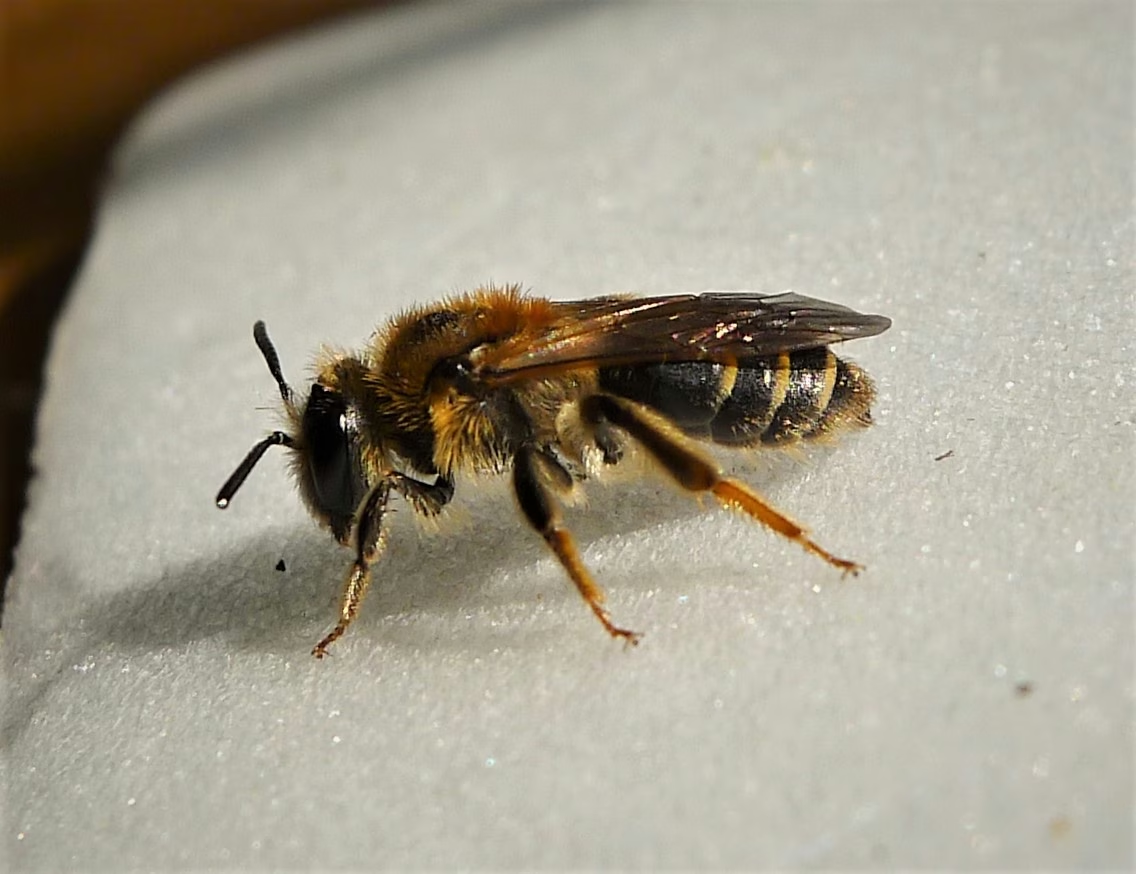
UK Bee Species
Short-fringed Mining Bee (Andrena dorsata)
Andrena dorsata (Kirby, 1802) · subgenus Simandrena · family Andrenidae
The short-fringed mining bee is a medium-sized, ground-nesting solitary bee that has become one of the most familiar Andrena in southern Britain. Its name comes from a single quiet detail on the female: a broad hind leg carrying only a very short fringe of hairs. Once a scarce insect, it now flies in two generations from spring to early autumn and is steadily spreading north. See where it sits among Britain's bees on the UK Native Bee Species Map, or among the world's bees in the World Bee Atlas.
Quick Facts
| Kingdom | Animalia |
| Phylum | Arthropoda |
| Class | Insecta |
| Order | Hymenoptera |
| Family | Andrenidae |
| Genus | Andrena |
| Subgenus | Simandrena |
| Species | Andrena dorsata |
How to identify a short-fringed mining bee
The short-fringed mining bee is a medium Andrena, roughly 9 to 10 mm long, and at its best it is a smart-looking bee. A freshly emerged female has warm foxy-brown hairs across the thorax and a shining dark abdomen crossed by thin bands of white hair along the rear edge of the segments, the bands often broken in the middle on the front of the abdomen.[1][4] Males are slimmer and plainer, and like many spring bees they fade quickly with wear, so worn individuals lose much of their colour.[1]
The feature that gives the bee both its English name and its surest identification is on the female's hind leg. The hind tibia is broad and widens noticeably towards its tip, and it carries only a very short fringe of hairs on its upper edge, in place of the longer pollen-carrying fringe seen on close relatives.[2][4] Combined with the largely bare, shining abdomen, that short-fringed, club-shaped hind leg is the diagnostic the field guides return to.[2]
Telling it from look-alikes
Several medium brown mining bees can be confused with it, and a hand-lens view of the female's hind leg usually settles them. The closely related species in the ovatula group, such as Andrena ovatula, Andrena wilkella and Andrena similis, have the hind tibia orange rather than dark, slimmer, and with a longer upper fringe.[2] Andrena congruens is superficially similar but again has a slimmer hind tibia and a much longer fringe, and the very rare Andrena lepida needs specialist separation.[2] In males, the dark hind tibiae and the long hind tarsi, about one and a half times the length of the tibia, are useful pointers.[2]
Two generations in a single year
Unlike the many British mining bees that fly for only a few weeks each spring, the short-fringed mining bee is bivoltine, raising two broods a year.[2][3] The spring generation is on the wing from March to May and feeds heavily on spring-blossoming shrubs and early umbellifers. The summer generation flies from July to September and favours brambles, summer umbellifers, thistles and ragworts.[2] The result is a bee that can be met across most of the warmer half of the year, a long season that makes it a steady garden and hedgerow visitor.
Two full generations a year, spring and summer, let the short-fringed mining bee pollinate across a much longer season than most of its single-brooded relatives.[2]
From scarce to common: a range on the move
The short-fringed mining bee is one of British entomology's quiet success stories. When recorders first took a close interest in the solitary bees in the 1970s it was a fairly scarce insect, but it has since become one of the commonest mining bees across the southern half of England.[1] It has expanded markedly through central England in recent decades and continues to spread north, with records reaching Anglesey and Lincolnshire.[2] It is absent from Ireland but present on several of the Channel Islands, and it is widely distributed across southern and central Europe.[1][3] National recording schemes do not regard it as scarce or threatened, and it carries no special habitat restrictions.[1][5]
Where it nests and what follows it
Like all mining bees, the short-fringed mining bee is solitary: each female digs and provisions her own burrow in the ground, with no queen and no worker caste.[3] It nests in bare or sparsely vegetated soil and is a broad generalist, or polylectic, taking pollen and nectar from a wide range of flowers across its long season rather than specialising on one plant.[2] That flexibility is a large part of why it has prospered where fussier bees have declined.
Where a host bee thrives, its cuckoo usually follows. The short-fringed mining bee is the chief host of the variable nomad bee (Nomada zonata), a wasp-like cuckoo bee and recent arrival in Britain that has spread in step with its host.[2] Nomad bees build no nest of their own; the female slips into the host's burrow and lays in a provisioned cell, where her larva destroys the host egg and eats the stored food.[6] A patrol of these slim black-and-yellow cuckoos flying low over bare ground is often the first sign that a mining bee colony is near. You can meet more of these brood parasites in our guide to the painted nomad bee.
The short-fringed mining bee is the main host of the variable nomad bee, whose own spread across Britain has tracked the rise of this single mining bee.[2]
Why the short-fringed mining bee matters
An unshowy, common bee can still be quietly important. Because it raises two generations, the short-fringed mining bee pollinates both the spring blossom of shrubs and orchards and the summer flowers of brambles, thistles and umbellifers, bridging a gap that single-brooded bees cannot.[2] Its generalist diet makes it a dependable visitor to gardens, allotments and hedgerows, and its nesting banks support the cuckoo bees and other associates that depend on them. Keeping patches of open, sunny, sparsely vegetated ground, and the blossom and wildflowers it feeds on, helps this adaptable native and the small web of life around it.
Bees like this turn blossom and wildflower into the nectar that becomes raw honey. Explore our full range of single-origin raw honeys in the HoneyBee & Co. shop.
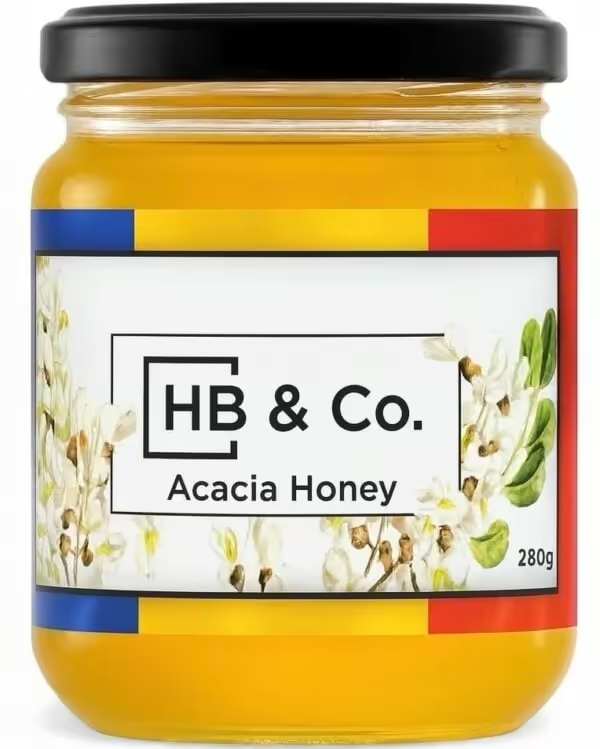
Raw Acacia Honey
Our flagship raw Acacia honey: pale, delicate and slow to crystallise. Drawn from the Nistor family's Transylvanian apiaries, with six generations of beekeeping heritage in every 280g jar. £10.99.
Shop Acacia Honey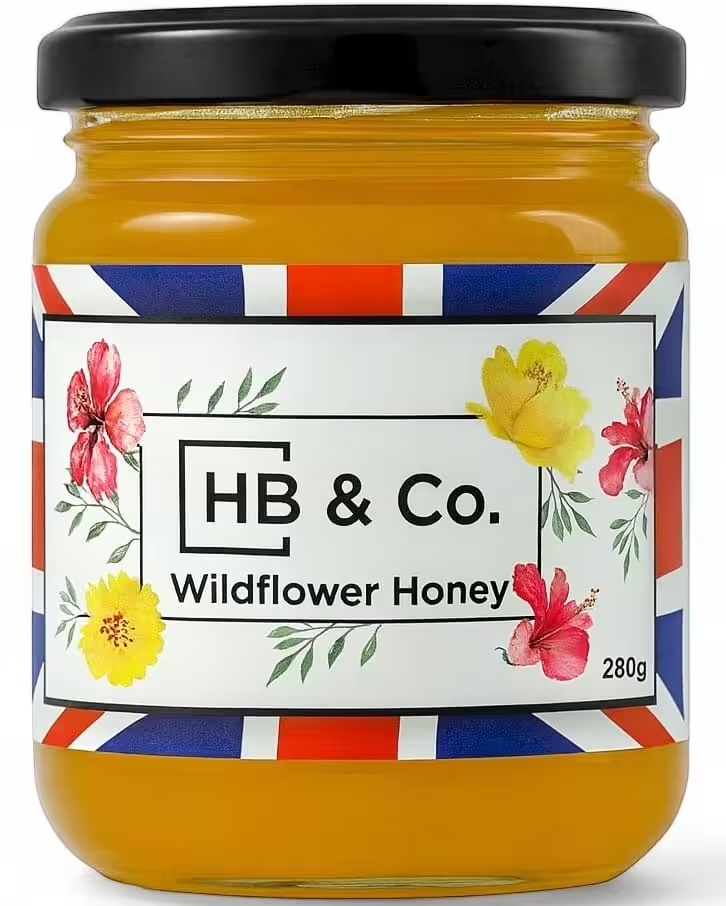
British Wildflower Honey
Raw honey from Midlands meadows and hedgerows, the same bramble and wildflower a short-fringed mining bee forages in summer. Our British honey supplier holds SALSA Certification. 280g. £10.99.
Shop Wildflower
Subscribe & Save 20%
Choose any single honey and save 20% on every delivery, with free UK delivery on every subscription order.
Start a SubscriptionFrequently asked questions
What is a short-fringed mining bee?
Why is it called the short-fringed mining bee?
How do I identify Andrena dorsata?
When are short-fringed mining bees active?
Is the short-fringed mining bee rare?
Do short-fringed mining bees sting?
Do mining bees damage lawns?
Does the short-fringed mining bee make honey?
Related species
Ashy Mining Bee
Andrena cinerariaRead more → Bivoltine relativeYellow-legged Mining Bee
Andrena flavipesRead more → Mining beeTawny Mining Bee
Andrena fulvaRead more →Sources & references
- BWARS (Bees, Wasps & Ants Recording Society). Species account: Andrena dorsata (description, change from scarce to common, distribution and status). bwars.com.
- Falk, S. Field Guide to the Bees of Great Britain and Ireland, Bloomsbury, and the Steven Falk Flickr collection: Andrena dorsata (female and male identification, look-alike separation, bivoltine phenology, forage, host Nomada zonata).
- Else, G.R. & Edwards, M. (2018). Handbook of the Bees of the British Isles. Ray Society (taxonomy, distribution and solitary mining-bee biology).
- Bénon, D. Andrena dorsata species portrait, Swiss Fauna Atlas, infofauna.ch (size, female pilosity, short combed scopa, hind tibia widened at apex, subgenus Simandrena).
- Nieto, A. et al. (2014). European Red List of Bees. IUCN / Publications Office of the European Union (conservation status context for widespread Andrena).
- BWARS. Britain's Bees, genus Nomada account: cleptoparasite biology, host-finding behaviour and larval habits. bwars.com.
Dragos Nistor
Founder, HoneyBee & Co. · Guest Lecturer, University of Greenwich
HoneyBee & Co. draws on six generations of family beekeeping heritage, with honey from the Nistor family apiaries and from carefully chosen British producers. Our British honey supplier holds SALSA Certification, and we offer a 15% NHS Discount. Every jar is raw, unfiltered and traceable to the hive.