
 English (UK)
  Italiano
  Français
  简体中文
简体中文  한국어
한국어 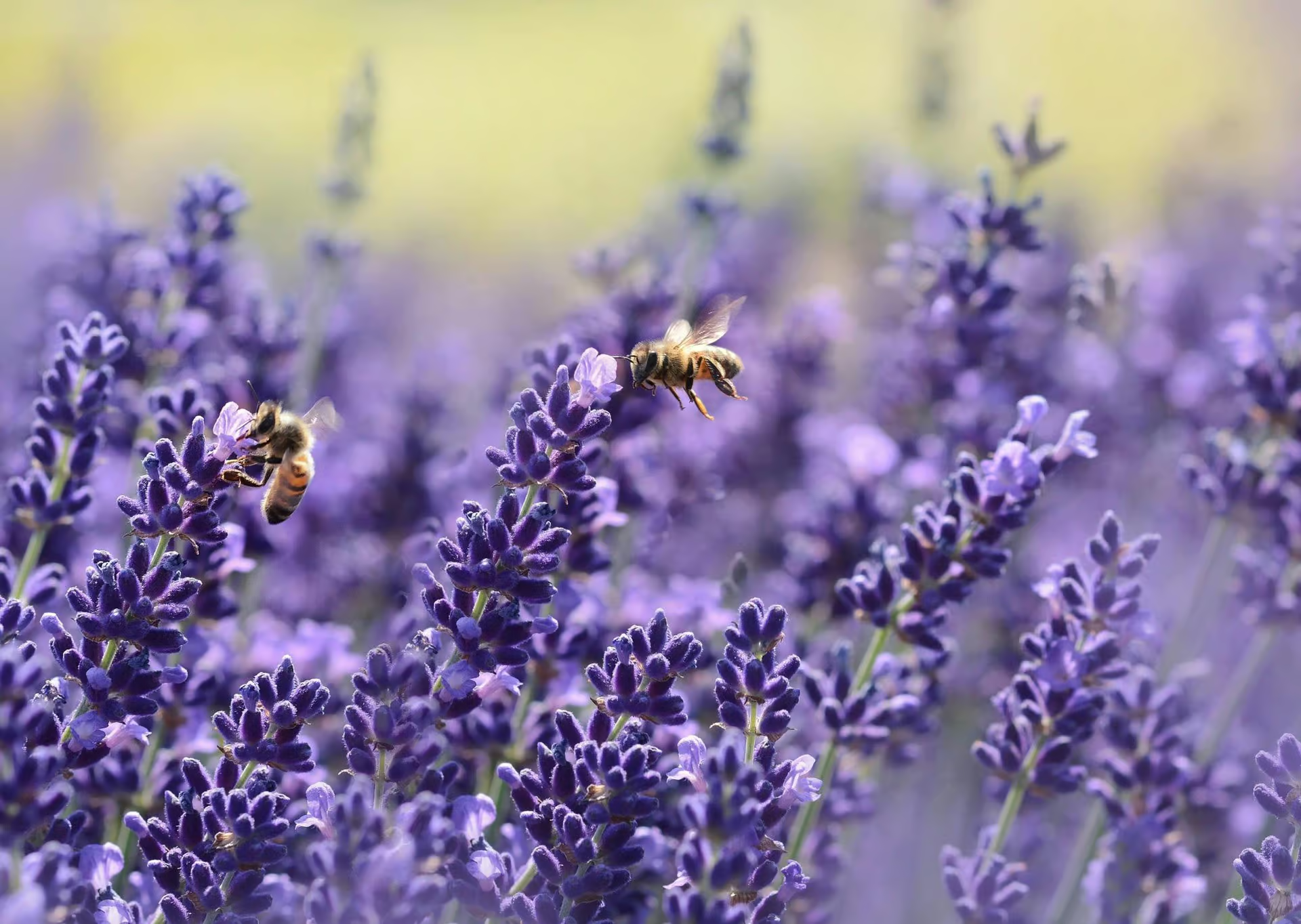
Few garden plants pull in pollinators like lavender. Its purple flower spikes hum with life from early summer onward, and the partnership between lavender and bees is a genuine two-way exchange: the plant feeds foraging bees a steady supply of nectar, and the bees carry pollen from flower to flower so the next generation of lavender can set seed. This guide explains why bees are so drawn to lavender, which varieties deliver the most forage, how that nectar can become honey, and exactly how to plant a lavender patch that works for bees rather than just looking pretty.
Key takeaways
- Bees love lavender for its abundant, easy-to-reach nectar and its long flowering season, which spans the mid-summer gap when other forage runs short.
- Both honeybees and bumblebees work lavender heavily. Long-tongued bumblebees reach the nectar most efficiently, while honeybees visit in huge numbers.
- Hybrid lavenders (Lavandula x intermedia, such as 'Grosso') flower longest and rated highest for bee visits in University of Sussex trials; English lavender is the hardiest choice for UK gardens.
- Lavender nectar can be turned into a delicate monofloral lavender honey, which is different from honey that is simply infused with lavender afterwards.
- Plant lavender in sunny, well-drained soil, skip the pesticides, and pair it with a succession of other nectar plants to support bees from spring to autumn.
- Why bees are drawn to lavender
- The best lavender varieties for bees
- Honeybees and bumblebees on lavender
- From lavender nectar to honey
- How to grow lavender for bees
- Building a bee-friendly garden around lavender
- Other pollinators that visit lavender
- Lavender and bee conservation
- Lavender beyond the hive
- Frequently asked questions
Why bees are drawn to lavender
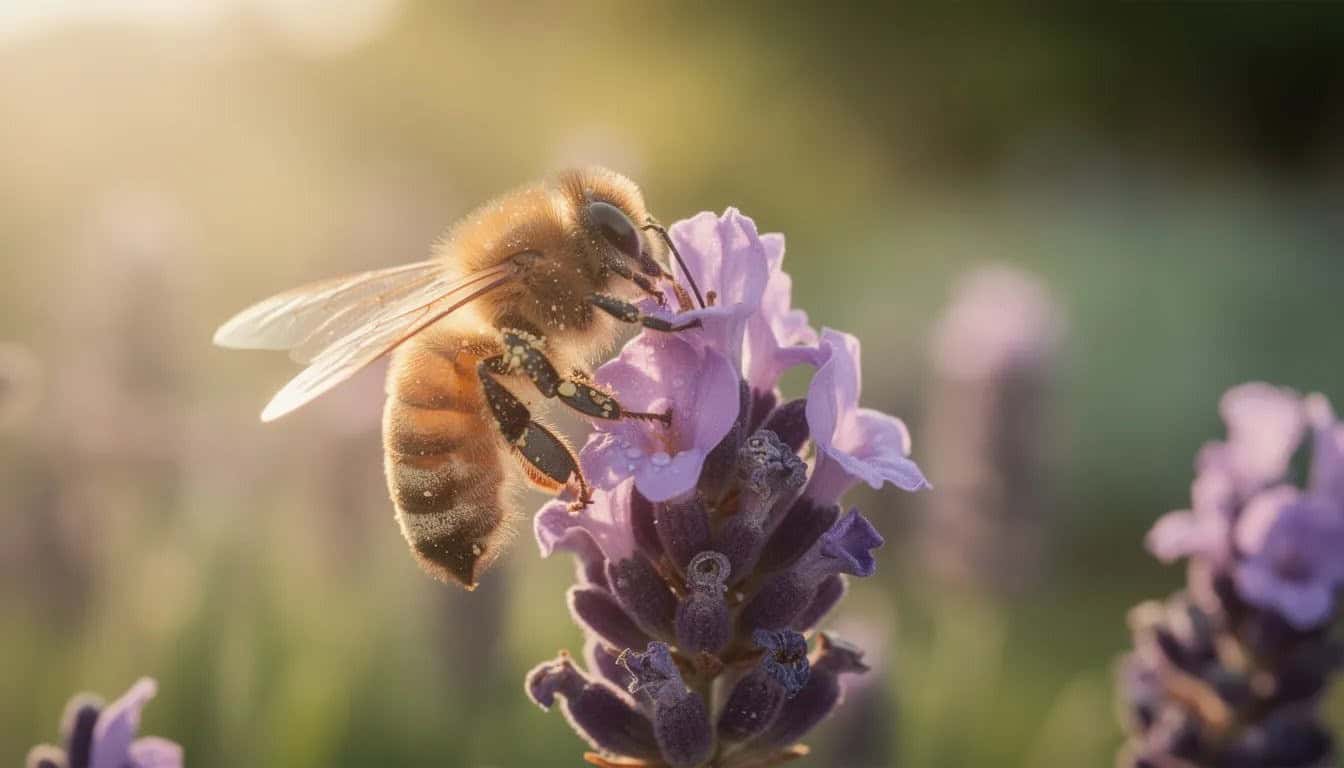
Bees forage on a simple economy: they want the most nectar and pollen for the least effort. Lavender scores well on both sides of that equation. Each flower spike carries dozens of small tubular florets, and each floret holds a reliable drop of sugar-rich nectar. A bee can land on a spike and work floret after floret without flying far, which makes lavender an efficient stop on any foraging trip.
Scent and colour do the advertising. Lavender's strong aroma carries on warm air, and bees see purple and violet hues clearly, so a flowering plant is easy for them to find. The flowers also produce nectar steadily through the day in warm, dry weather, which is exactly the kind of conditions that get bees flying. If you want the longer view of how blossoms and pollinators fit together, our guide to the relationship between flowers and bees sets out the basics.
Timing matters as much as quantity. In the UK, lavender flowers from roughly June into September depending on the type, which lands in the so-called June gap and the weeks after it, when spring blossom has finished and many gardens go quiet. A patch of lavender in full flower at that point is a genuine lifeline, not just a decoration.
of the world's leading food crops depend at least partly on animal pollination, and pollinators influence roughly 35% of global crop production by volume. Garden plants like lavender give those pollinators somewhere to feed (IPBES, 2016).
The best lavender varieties for bees
Not every lavender is equally useful to bees, and the differences are worth knowing before you plant. The biggest factors are how long a variety flowers, how much nectar it gives up, and how hardy it is in the British climate. Research from the University of Sussex, which counted insect visits across dozens of garden plants, found that lavender as a group is one of the most attractive plants you can grow, and that the hybrid lavenders pulled in the most bees of all.
| Variety | Botanical name | UK flowering | Bee appeal | Good to know |
|---|---|---|---|---|
| English lavender | Lavandula angustifolia ('Hidcote', 'Munstead') | June to August | High | The hardiest lavender for UK gardens. Compact, fragrant, reliable. The safe choice for colder or wetter sites. |
| Hybrid lavender (lavandin) | Lavandula x intermedia ('Grosso', 'Gros Bleu') | July to September | Very high | Larger plants, the longest flowering season, and the highest bee visits in Sussex trials. The standout bee magnet. |
| French lavender | Lavandula stoechas | April to July | Moderate to high | The early flowerer with showy "rabbit-ear" bracts. Less frost-hardy, so it often needs a sheltered spot or a pot. |
| Spanish / Portuguese lavender | Lavandula latifolia / pedunculata | Variable, mainly summer | Moderate | More tender. Best grown in containers that can be moved under cover over a hard winter. |
If your single goal is to feed bees for as many weeks as possible, plant a hybrid such as 'Grosso' alongside an English variety. The English lavender opens first, the hybrid carries the season on into September, and together they give bees a long, overlapping run of forage. For more on choosing nectar-rich plants generally, see our rundown of the types of flowers bees like most.
Honeybees and bumblebees on lavender
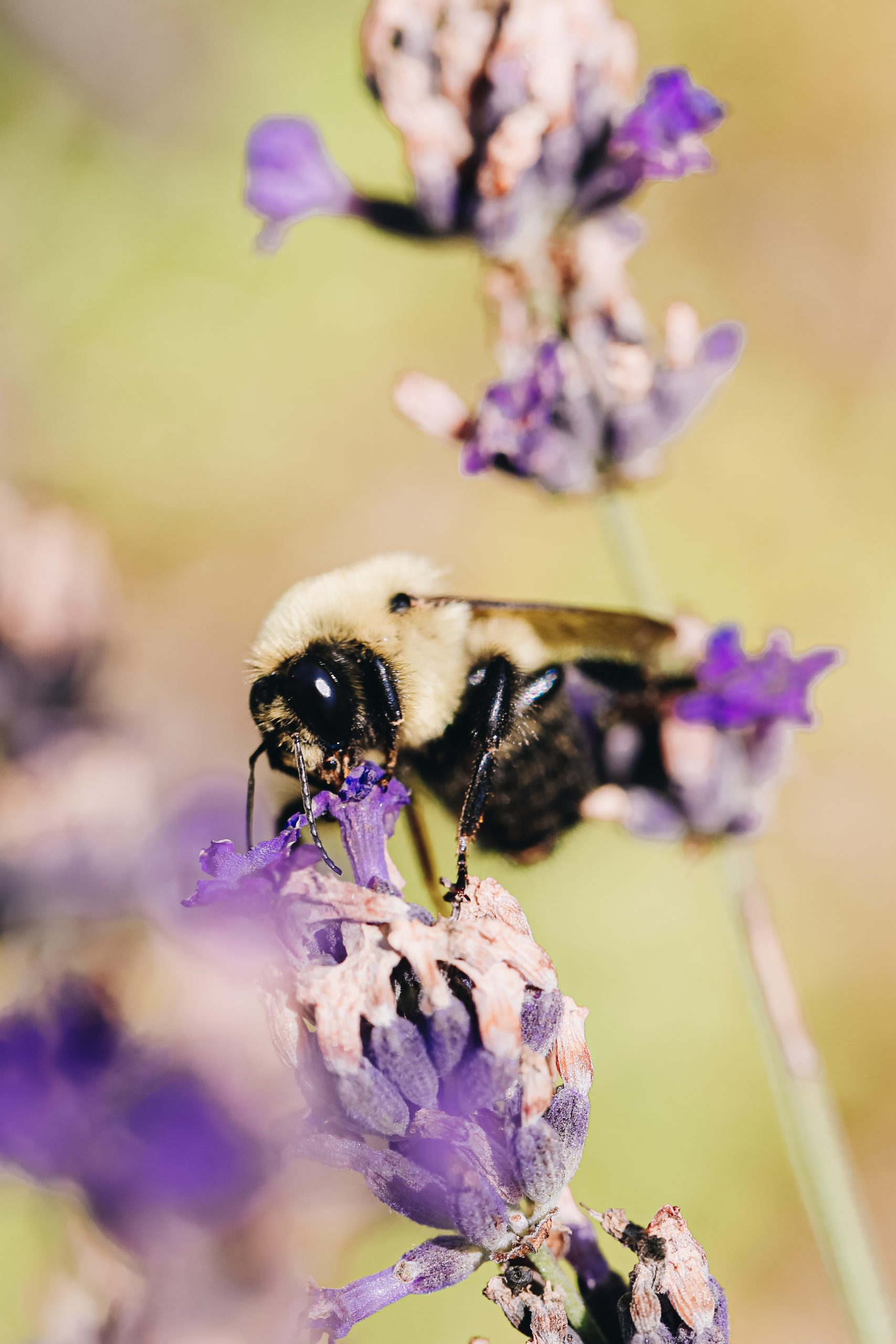
Watch a lavender bed on a warm afternoon and you will see at least two main visitors: honeybees and bumblebees. Both want the same nectar, but they reach it slightly differently, and that comes down to tongue length.
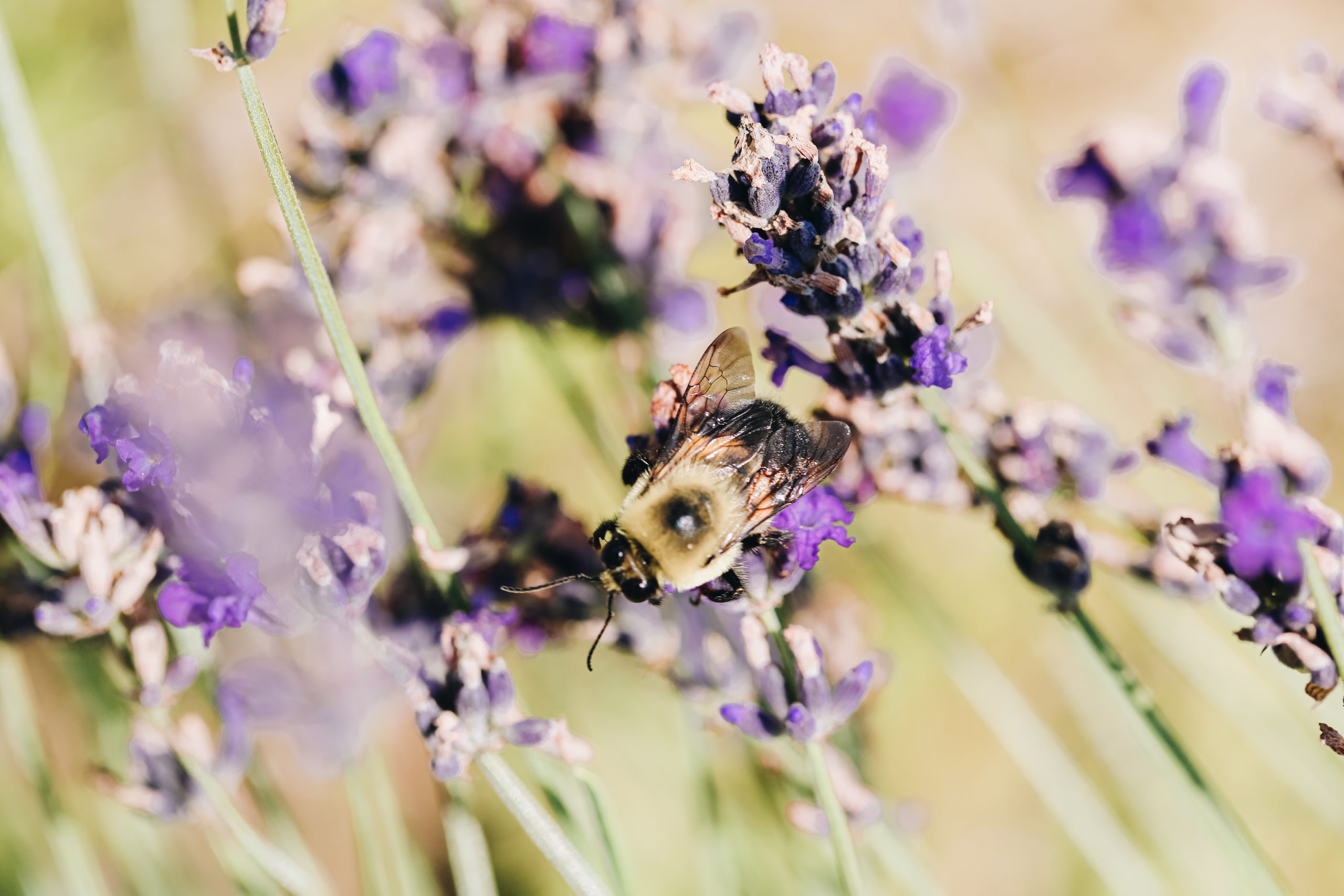
Bumblebees, especially long-tongued species, are built to probe deep, tubular flowers, so they extract lavender nectar with very little effort. Honeybees have shorter tongues, yet they still forage lavender intensively, partly because the florets are shallow enough to work and partly because lavender flowers in such dense numbers. The result is that lavender suits a broad mix of bees rather than favouring just one. If you are curious about how these two compare more widely, our guide to the differences between bumblebees and honeybees goes into detail, and you can read a full profile of the western honeybee (Apis mellifera), the species behind most of the honey on British tables.
This shared appeal is one reason lavender is recommended so often by conservation groups. It is not a specialist plant that only one insect can use. It is a generalist that feeds honeybees, several bumblebee species, solitary bees, and a long list of other pollinators from the same flowers.
From lavender nectar to honey
Once a bee has gathered lavender nectar, the journey to honey begins. Forager bees carry nectar back to the hive, pass it to house bees, and the colony reduces its water content and adds enzymes until it ripens into honey. We cover that process step by step in how bees make honey, and the wider story of nectar sources in how flower nectar becomes honey.
Where bees forage almost entirely on lavender, the result can be a monofloral lavender honey: pale, gently floral, and prized for its delicate aroma. This is genuine honey made from lavender nectar, and it is different from a honey that has simply been infused with lavender flowers or oil after extraction. Both can be lovely, but only one is made by the bees from the flower itself. To see where lavender sits among single-flower and mixed honeys, browse our explainer on the main types of raw honey.
At HoneyBee & Co. we offer a 100% Lavender Honey drawn from our family's Carpathian apiaries, where the Nistor family has kept bees across six generations. Like every jar in our range it is cold-extracted, never heated above hive temperature, and carries a unique GS1 barcode you can scan to confirm its origin and harvest window. Our British honey supplier holds SALSA Certification, an independently audited food-safety standard, and every variety is available on subscription at 20% off.
Taste lavender in the jar
Our 100% Lavender Honey is delicate, floral, and pale gold, a true expression of the flower bees love. 280g, from our Carpathian apiaries, available one-time or on subscription at 20% off.
Discover Lavender Honey →How to grow lavender for bees
Lavender is famously low-maintenance, which is good news for bees and gardeners alike. Get a few basics right and it will flower generously for years.
Sun and drainage come first. Lavender evolved on dry Mediterranean hillsides, so it wants full sun and free-draining soil. Heavy, wet ground is its main enemy. If your soil holds water, plant on a raised bed, add grit, or grow lavender in pots where you control the drainage.
Go easy on water and feed. Established lavender is drought-tolerant and resents being pampered. Overwatering and rich feeding produce soft, sappy growth and fewer flowers, which means less for bees. Water new plants while they settle, then mostly leave them alone.
Prune to keep it flowering. A light trim after flowering keeps plants compact and encourages a strong show the following year. Avoid cutting back hard into old, woody stems, which lavender struggles to regrow from.
Skip the pesticides. This is the single most important rule for any bee plant. Insecticides applied to flowering lavender can reach the very pollinators you are trying to help. A healthy, well-sited lavender rarely needs spraying at all. For a fuller planting plan, our guide to attracting bees to your garden walks through the steps.
Building a bee-friendly garden around lavender
Lavender is brilliant, but no single plant feeds bees all year. The most valuable gardens offer a succession of flowers so that something is always in bloom. Lavender covers high summer; the trick is to fill the months either side.
A simple seasonal plan looks like this: willow catkins and crocus in early spring, fruit-tree blossom in April and May, then clover, borage, catmint (Nepeta), and lavender through summer, heather in late summer, and ivy as a final lifeline in autumn. Built that way, your garden supports far more bee species than one relying on a couple of plants. Our piece on bee-friendly British planting lists more nectar-rich species worth adding.
Around lavender specifically, the best companions repeat the same nectar-rich, single-flowered theme: borage for its endlessly refilling blue flowers, catmint for its long season, marjoram and thyme for late summer, and phacelia as a fast-growing bee favourite. Wherever you can, choose single-flowered varieties over heavily doubled cultivars, where extra petals replace the nectar-producing parts and leave bees with little reward.
Other pollinators that visit lavender
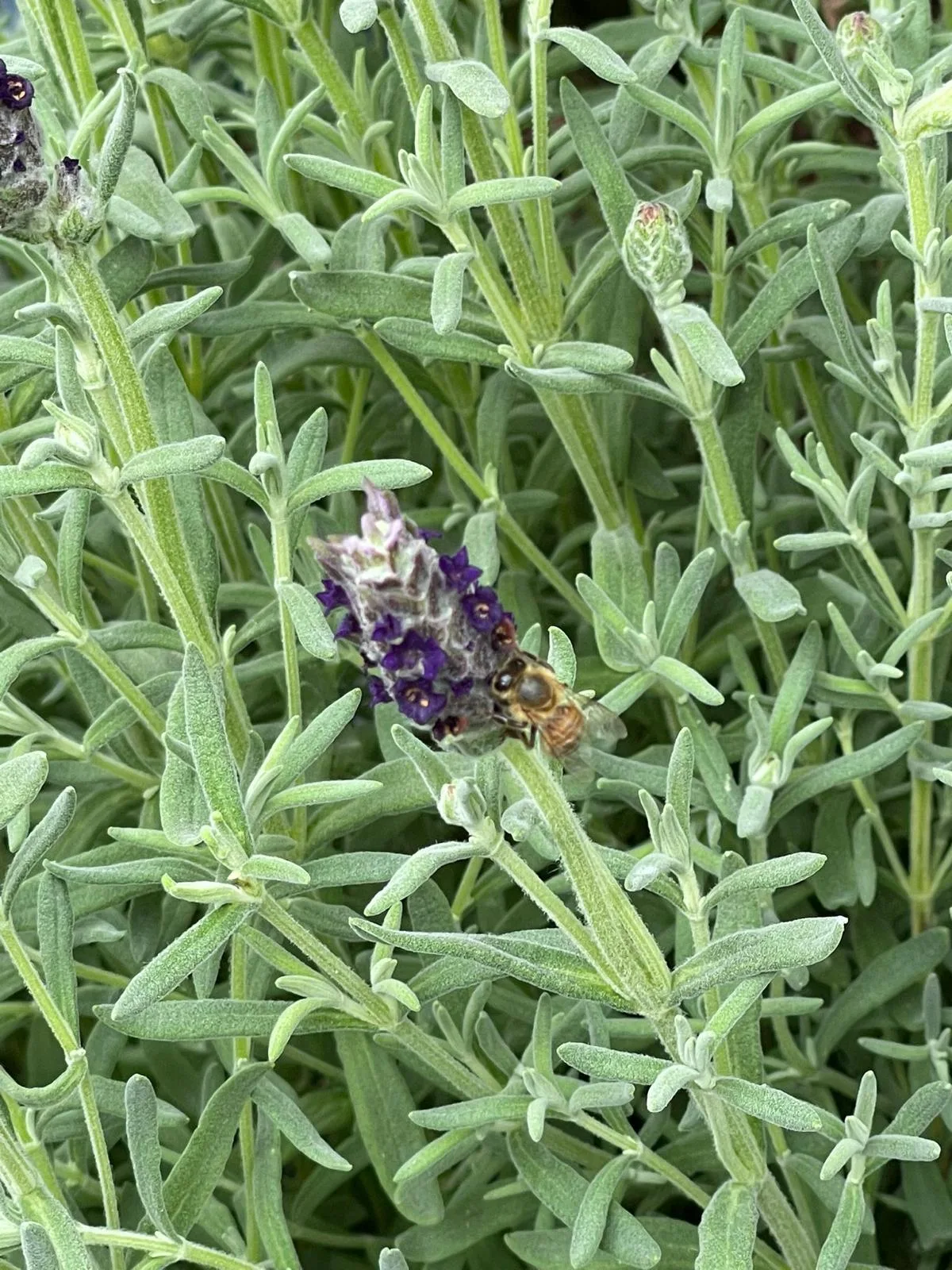
Bees get top billing, but lavender feeds a wider cast. On a warm day a single bed can host several different pollinators, each playing its part.
Butterflies are common visitors, drawn to the colour and the open landing platform the flower spikes provide. In UK gardens you might see painted ladies, common blues, and red admirals working a lavender patch alongside the bees.
Moths matter too, including the remarkable hummingbird hawk-moth (Macroglossum stellatarum). This day-flying migrant hovers in front of flowers and feeds on the wing through a long proboscis, and it is so fast and bird-like that people regularly mistake it for a hummingbird. It is worth being clear here: there are no wild hummingbirds in the UK or Europe, so any "hummingbird" you spot on British lavender is almost certainly this moth. Genuine hummingbirds only visit lavender in the Americas, where they do occur.
Hoverflies and solitary bees round out the list. Many of Britain's solitary bee species, which do not live in hives or make honey, rely on garden flowers like lavender for forage, and hoverflies add useful pollination while mimicking the look of bees and wasps.
Lavender and bee conservation
Bee populations have come under real pressure in recent decades, driven by habitat loss, intensive land use, pesticides, disease, and a changing climate. We look at the evidence in detail in why bee populations are declining, and at the parasites and predators bees face in bees and their natural enemies.
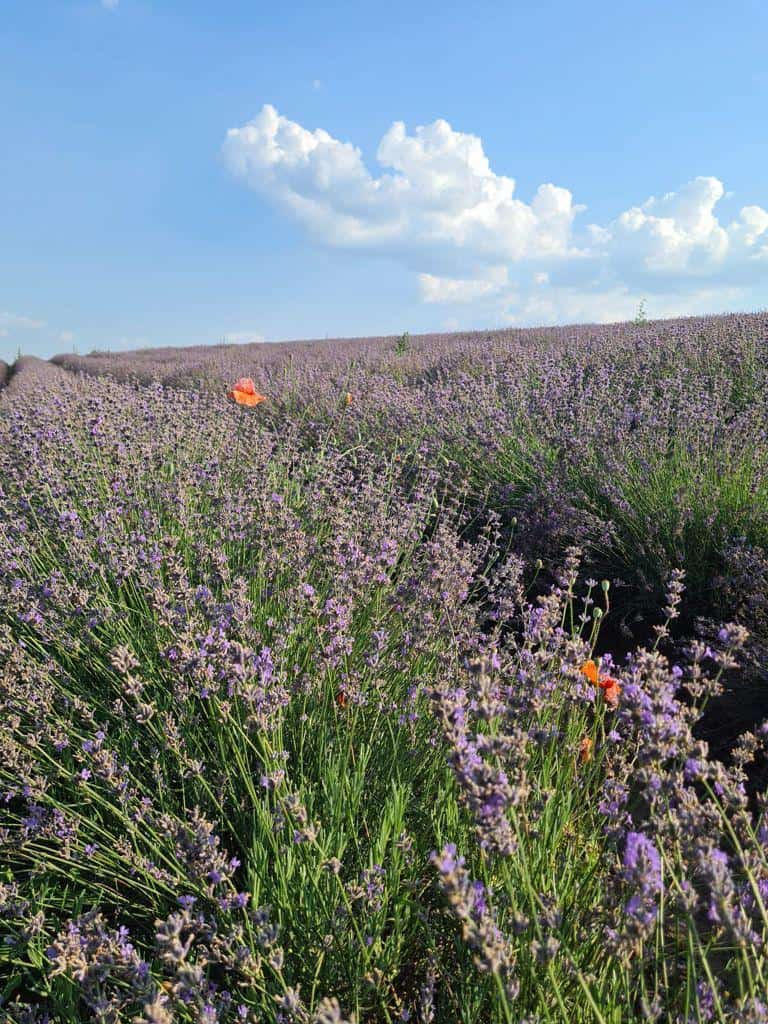
Planting lavender is one small, practical thing almost anyone can do in response. It needs little space, thrives in pots on a balcony, and provides reliable summer forage exactly when many bees need it. Multiply that across a street or a village and the gardens add up to a meaningful network of feeding stations. Research has found that residential gardens supply a large share of the floral resources available to pollinators in built-up areas, which makes individual planting choices genuinely worthwhile.
You will sometimes read that lavender's aromatic oils help protect bees from disease. The honest position is that scientists are still studying how compounds in some nectars affect bee health, and the evidence for lavender specifically is limited. The clearest benefit lavender offers bees is straightforward: abundant, accessible nectar at the right time of year, with no pesticides attached.
Lavender beyond the hive
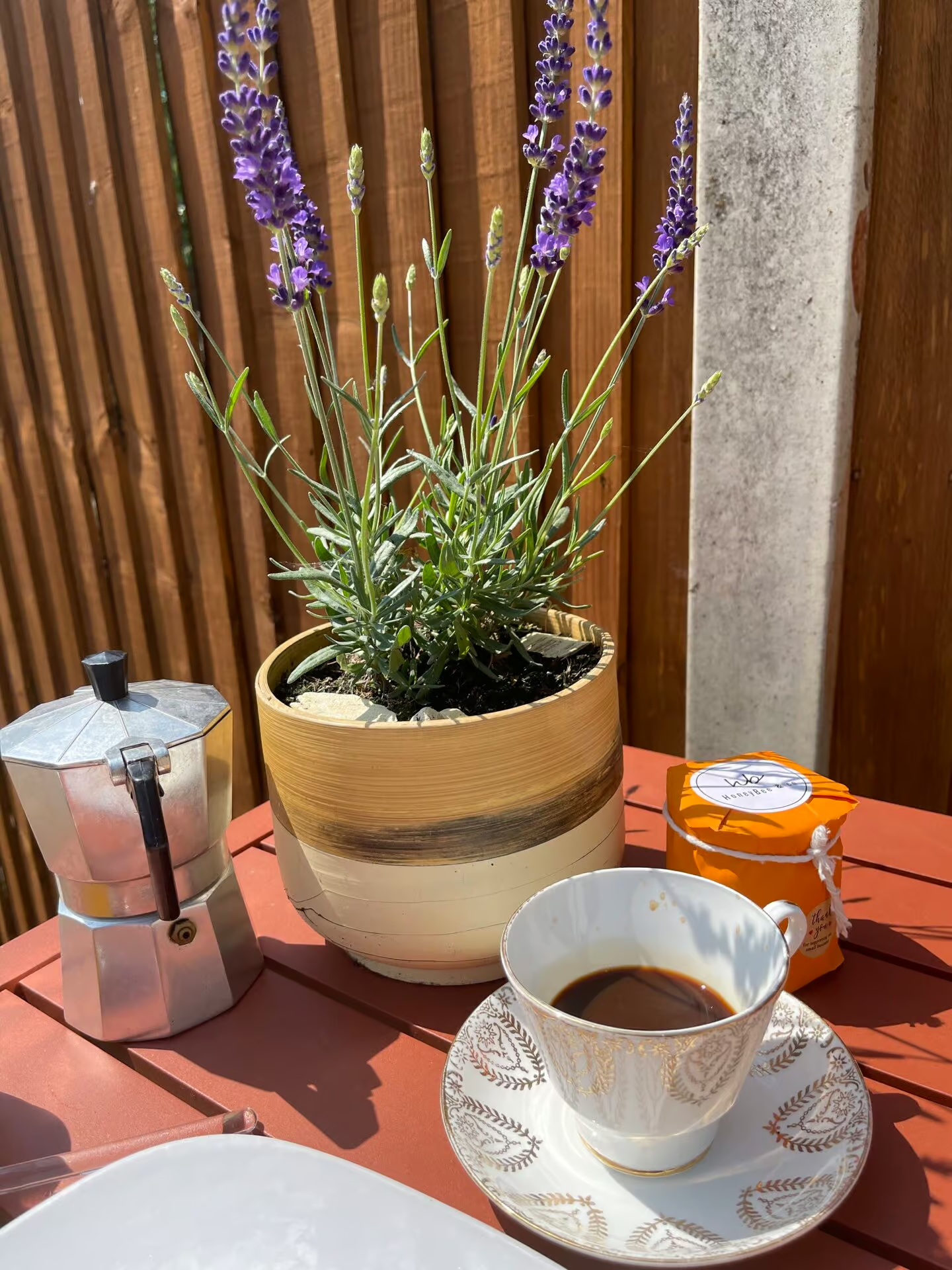
The same plant that feeds bees has a long history with people. Lavender has been used for centuries for its scent and its calming associations, and the modern story of lavender essential oil owes a great deal to the French chemist Rene-Maurice Gattefosse. We tell that tale in the story of lavender essential oil and Rene-Maurice Gattefosse.
If pure lavender oil is what you are after rather than honey, our sister brand Lavender Gold grows and bottles it field to bottle, pesticide-free and sustainably farmed. Two natural brands, one shared philosophy: look after the land and the pollinators, and the quality follows.
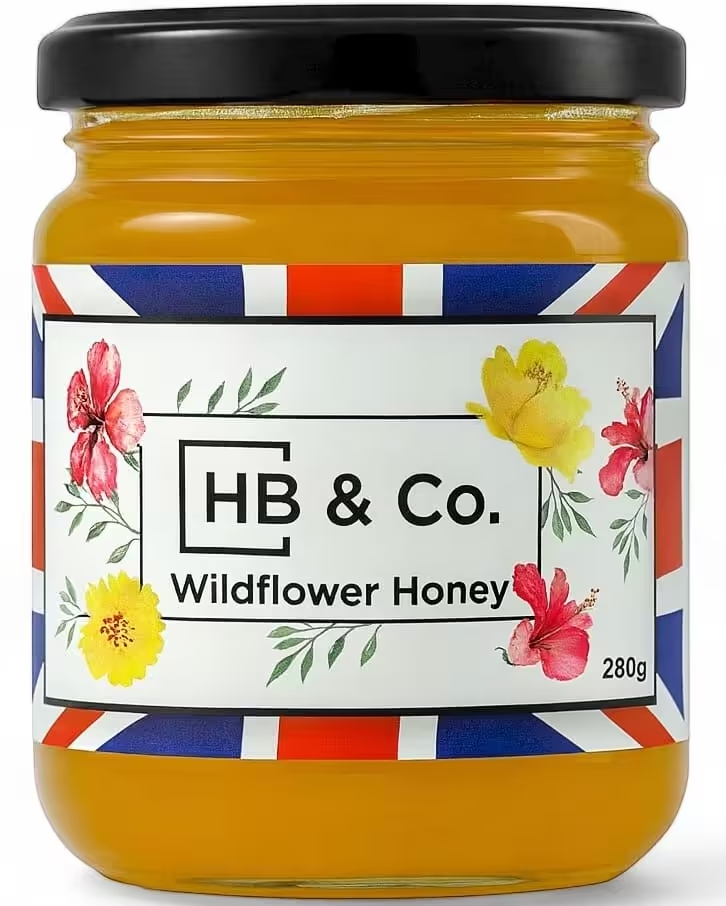
British Wildflower Honey
Lavender is one of many flowers that feed our polyfloral wildflower honey. Light, floral, and true to the British meadow, it is the natural place to start if this article has you thinking about nectar in the jar.
£10.99 or £8.79/jar on subscription
Shop Wildflower Honey →
British Honey Bundle
A ready-made trio of British favourites. Stock up for breakfast, baking, and entertaining, with free UK delivery on three or more jars.
View the bundle →Raw Honey Subscription
Pick your varieties and save 20% on every delivery, with free UK delivery on every subscription order. Easy to pause or change.
Start a subscription →Shop the HoneyBee & Co. range
Raw, cold-extracted, single-source British and Carpathian honey. Every variety is available one-time, on subscription, or in a bundle.
Single jars
- Acacia Honey · £10.99
- Wildflower Honey · £10.99
- Soft Set Honey · £10.99
- Sunflower Honey · £10.99
- Linden Honey · £10.99
- Heather Honey · £12.99
- Lavender Honey
Bundles & gifts
Frequently asked questions
Do bees actually like lavender?
Yes. Lavender is one of the most reliable bee plants you can grow. Its tubular flowers carry abundant, easy-to-reach nectar, it flowers for weeks through summer, and its scent and purple colour make it easy for bees to find. Honeybees, bumblebees, and solitary bees all forage on it.
What is the best lavender to plant for bees?
Hybrid lavender (Lavandula x intermedia, such as 'Grosso') flowers the longest and attracted the most bees in University of Sussex trials, so it is the top choice for forage. English lavender (Lavandula angustifolia) is the hardiest option for UK gardens. Planting both gives bees an overlapping run of flowers from June into September.
Do honeybees or bumblebees prefer lavender?
Both work it heavily. Long-tongued bumblebees reach the nectar most efficiently because lavender florets are tubular, but honeybees visit in very large numbers too. Lavender is a generalist plant that suits a wide mix of bees rather than favouring one species.
Is there such a thing as lavender honey?
Yes. Where bees forage mainly on lavender, the colony produces a delicate, pale, floral monofloral lavender honey. This is genuine honey made from lavender nectar, which is different from honey that has simply been infused with lavender flowers or oil after extraction. Our 100% Lavender Honey is the former.
When does lavender flower for bees in the UK?
Most lavender flowers between June and September. English lavender tends to open first (June to August), while hybrid lavenders carry on later (July to September). French lavender flowers earlier, from spring. This summer window is valuable because it covers the gap after spring blossom finishes.
Is lavender safe for bees?
Lavender itself is excellent for bees. The risk comes from pesticides. Insecticides sprayed on flowering plants can reach foraging bees, so avoid spraying lavender in bloom. A healthy, well-sited lavender plant rarely needs any chemical treatment.
Does lavender attract other pollinators besides bees?
Yes. Butterflies such as painted ladies and red admirals, day-flying moths including the hummingbird hawk-moth, hoverflies, and solitary bees all feed on lavender. It is one of the most useful all-round pollinator plants for a UK garden.
References
- IPBES (2016). Assessment Report on Pollinators, Pollination and Food Production. Intergovernmental Science-Policy Platform on Biodiversity and Ecosystem Services.
- Garbuzov, M. & Ratnieks, F. L. W. (2014). Quantifying variation among garden plants in attractiveness to bees and other flower-visiting insects. Functional Ecology, 28(2), 364 to 374.
- British Beekeepers Association (BBKA). Flowers and bees: lavender and bees.
- Royal Horticultural Society (RHS). Plants for Pollinators.

Dragos Nistor
Founder, HoneyBee & Co. and Guest Lecturer, University of Greenwich
Dragos founded HoneyBee & Co. to bring his family's beekeeping heritage to British tables. The Nistor family has kept bees across six generations at apiaries in the Carpathians, and the brand's British honey supplier holds SALSA Certification. HoneyBee & Co. offers a 15% NHS Discount and was featured in Vogue's Summer Hot List across three consecutive editions in summer 2024.