

 Français
 English (UK)
 Italiano
 简体中文
 한국어

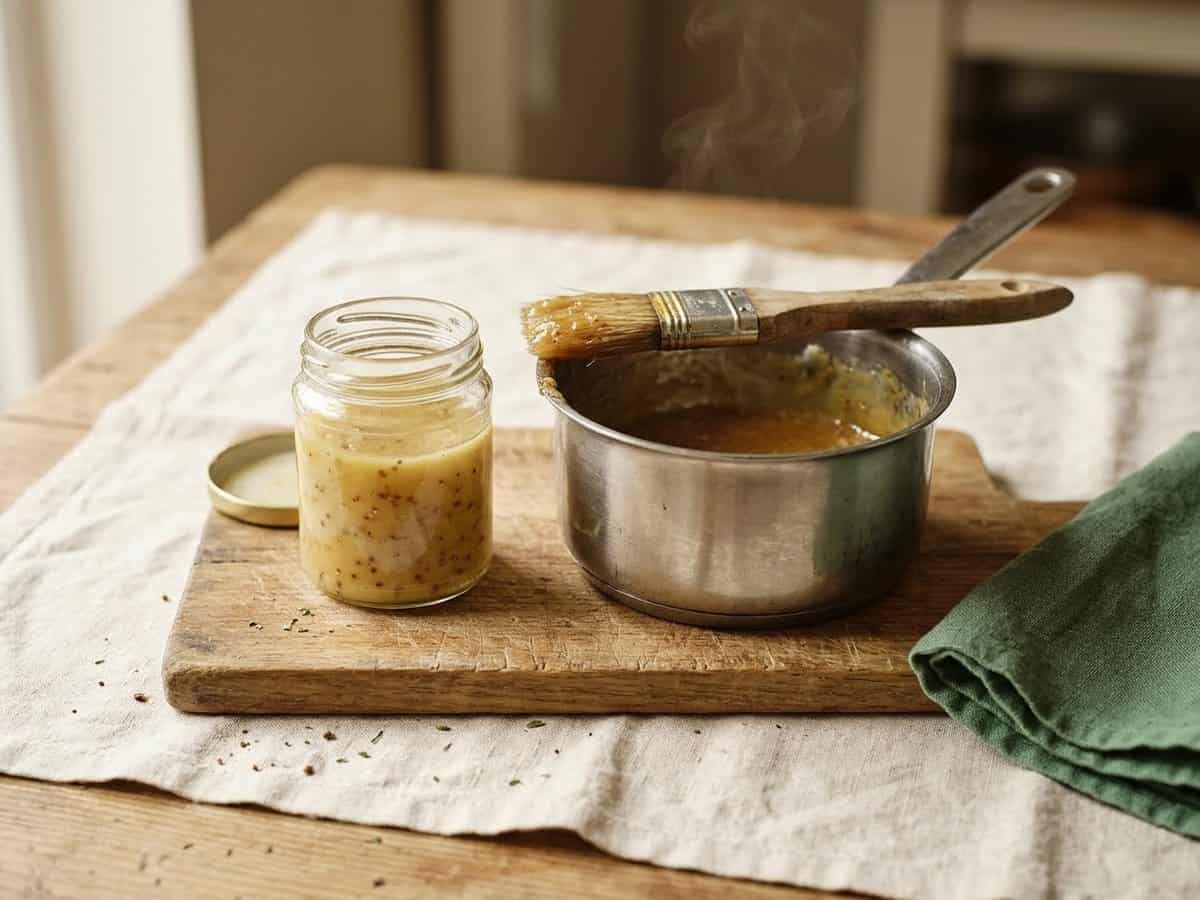
Same four ingredients, two jobs: the loose one dresses leaves, the thick one goes on the roast.
Recette
Honey Mustard Dressing and Glaze: One Ratio, Two Jobs
Honey mustard is one recipe with the oil left in or out. For a dressing, whisk 2 parts honey, 2 parts mustard and 2 parts vinegar, then beat in 6 parts oil. For a glaze, use 3 parts honey to 2 parts wholegrain mustard and 1 part vinegar, no oil, and brush it on in the last 10 to 15 minutes of cooking. Both take five minutes, both keep for a week in the fridge, and both are better with a raw honey that has some flavour of its own, which is why we make them with miel de tournesol from our own hives.
Habillage
2 : 2 : 2 : 6honey : mustard : vinegar : oil, by volume
Smooth Dijon, cider vinegar, a light olive or neutral oil. Whisk the first three, add the oil in a thin stream. Makes about 180 ml, enough for six salads. Keeps a week, chilled.
Glacis
3 : 2 : 1honey : wholegrain mustard : vinegar, no oil
Wholegrain for texture, a spoon of Dijon if you want heat. Warm until it loosens, brush on in the last 10 to 15 minutes, twice. Makes enough for a 1.5 kg gammon, eight chicken thighs or two sides of salmon.
On this page: Ingrédients Méthode Timings Pourquoi ça marche Which honey What to put it on Dépannage Questions
Ingrédients
Honey mustard dressing (makes about 180 ml)
- 2 tablespoons raw honey (sunflower or acacia)
- 2 tablespoons Dijon mustard
- 2 tablespoons cider vinegar
- 6 tablespoons light olive oil or a neutral oil
- 1 small garlic clove, crushed to a paste (optional)
- Half a teaspoon fine salt
- Poivre noir
Honey mustard glaze (enough for a 1.5 kg joint)
- 3 tablespoons raw honey (sunflower)
- 2 tablespoons wholegrain mustard
- 1 tablespoon cider vinegar
- 1 teaspoon Dijon mustard (optional, for heat)
- A pinch of fine salt
- A pinch of ground cloves or a few thyme leaves (optional, for ham or chicken)
Méthode
The dressing
- Put the honey, mustard, vinegar, garlic if using, salt and a few grinds of pepper in a bowl or a clean jam jar. Whisk or shake until the honey has dissolved into the vinegar; if the honey is set, stand the jar in warm water first, as we explain in Comment ramollir du miel cristallisé ?.
- Add the oil a tablespoon at a time, whisking between additions, or add it all to the jar and shake hard for 30 seconds. The mustard holds the oil and vinegar together, so you get a thick, glossy dressing rather than a split one.
- Taste on a leaf, not a spoon. Too sharp: add half a teaspoon more honey. Too sweet: a few drops more vinegar. Too thick: a teaspoon of water.
- Store in the jar in the fridge for up to a week. It firms up when cold; shake again before using.
Le glaçage
- Stir the honey, wholegrain mustard, vinegar, Dijon, salt and any spice together in a small pan. Warm gently for a minute until it loosens and looks glossy. Do not boil it; a glaze that has caught in the pan will catch again in the oven.
- Cook the meat or fish almost to done without the glaze. Brush half the glaze over in the last 10 to 15 minutes, then the rest 5 minutes before the end, so the honey browns rather than burns.
- Check the meat is cooked before it comes out. The Food Standards Agency’s Christmas advice is to “cut into the thickest part of the meat and check that none of the meat is pink and that any juices run clear”, which you can read on gov.uk. The glaze does not change that.
Timings and quantities
| Item | Habillage | Glacis |
|---|---|---|
| Preparation | 5 minutes | 5 minutes |
| Cuisine | Aucun | 1 minute warming, then the last 10 to 15 minutes of the roast |
| Fabrique | About 180 ml (6 salads) | About 90 ml (one 1.5 kg joint, 8 thighs or 2 salmon sides) |
| Keeps | 1 week in the fridge, shaken before use | 1 week in the fridge; warm before brushing |
| Freezes | No, it splits | Yes, up to 3 months |
Pourquoi ça marche
Three things are happening in that jar, and knowing them is what lets you fix a batch instead of starting again.
Mustard is the emulsifier
Oil and vinegar separate; mustard stops them. Researchers who characterised a mustard vinaigrette in the Journal of Food Science and Nutrition Research tested three oil-to-vinegar ratios and three mustard concentrations and reported that “the emulsifying capacity of the mustard was corroborated”, meaning the mustard, not the whisking, is what holds the dressing together; the paper is Lozano-Gendreau and Velez-Ruiz, 2019. That is why the method puts mustard and vinegar together before the oil, and why a dressing made with too little mustard splits however hard you shake it.
Heat tames the mustard, which is why the glaze is milder than the dressing
Mustard’s heat is made, not stored: an enzyme in the seed, myrosinase, converts a compound in the seed into the pungent one when the seed is crushed and wet. Heat deactivates the enzyme. A study of yellow mustard processing in the journal Food and Function reports that thermal treatment “deactivates the enzyme” and that the heat-treated mustard “has no pungency”; the paper is Marambe and colleagues, Royal Society of Chemistry. In practice, a glaze that tasted fierce in the pan comes out of the oven rounded and sweet, so make the glaze hotter than you think you want it, and keep the dressing raw.
Honey browns faster than sugar
Honey is mostly fructose and glucose with about a fifth of its weight as water, and fructose browns at a lower temperature than table sugar. That is the glaze’s advantage and its risk: it colours in ten minutes, and it blackens in twenty. Hence the two late brushings rather than one early one. The same chemistry is behind every honey glaze on this site, from the barbecue guide to the honey and soy wings.
“The emulsifying capacity of the mustard was corroborated.” Lozano-Gendreau and Velez-Ruiz, Physicochemical and Flow Characterization of a Mustard-Vinaigrette Salad Dressing, Journal of Food Science and Nutrition Research, 2019
Which honey
A supermarket blend disappears behind the mustard; the only thing it adds is sweetness, and sugar would do that. A single-origin honey with its own character changes the dressing. Our house choice is sunflower: bold, golden, slightly waxy on the tongue, with enough body to stand up to Dijon and to survive the oven. For a dressing on delicate leaves, acacia is the gentler option; it is slow to crystallise, so it dissolves into the vinegar without warming. For a glaze on gammon, heather is the dark, serious choice. All three, with their tasting notes, are in la boutique, et le Sélection de barbecues et de grillades boxes the three we reach for when cooking.
Our rule: taste the honey on its own before it goes in. If it tastes of nothing, the dressing will taste of mustard and the glaze will taste of sugar.
Sunflower Honey from our family hives
Harvested in late summer from the sunflower fields around our family’s apiaries in Transylvania, this is the honey we cook with at home, because it is the one the family always has most of. It sets quickly to a pale gold cream, which is normal for sunflower and reversible in warm water, and its flavour holds through heat better than any of our lighter honeys, which is why it leads the Baker’s Kitchen Selection too. Read the tasting notes on the Sunflower Honey page, or stock the kitchen with the three-jar pack; free UK delivery applies on 3 or more jars on any order type. The flavour is explained in detail in the sunflower honey taste explained.

What to put it on
Dépannage
| Problem | Cause | Fix |
|---|---|---|
| Dressing splits in the jar | Oil added too fast, or not enough mustard | Put a teaspoon of mustard in a clean bowl and whisk the split dressing into it a spoon at a time |
| Dressing tastes harsh | Raw garlic, or a sharp vinegar | Let it stand 20 minutes; add a teaspoon more honey; next time use cider rather than white wine vinegar |
| Glaze burns before the meat is done | Brushed on too early, or oven too hot | Scrape off the blackened layer, cover loosely with foil, and reglaze for the final 5 minutes only |
| Glaze slides off | Meat surface wet, or glaze too thin | Pat the meat dry; simmer the glaze one more minute to thicken; score fat so it grips |
| Honey is solid in the jar | Raw honey crystallises, especially sunflower | Stand the jar in warm water for 10 minutes; never microwave the jar |
| Dressing solid in the fridge | Olive oil sets cold | Twenty minutes on the counter and a shake |
A jar that never runs out
If honey mustard becomes a weekly habit, the cheapest way to keep raw honey in the cupboard is a abonnement: your chosen jar every month, two months or three, at 20 percent off. Pause or change the honey whenever you like. Sunflower for cooking and acacia for dressings is the pairing most of our subscribers settle on.
Questions
Can I use English mustard instead of Dijon?
Yes, at half the quantity. English mustard is much hotter, and in the raw dressing that heat stays. In the glaze it mellows in the oven, so you can be braver there.
Why is my honey mustard dressing bitter?
Usually the oil. Extra virgin olive oil can be peppery and bitter against honey; a light olive oil or a neutral oil keeps the honey and mustard in front. Raw garlic left to stand too long will do it too.
Can I make the glaze without vinegar?
Yes, but it will be flat and will burn faster, because there is less liquid. Lemon juice does the same job as vinegar.
Does cooking destroy what makes raw honey different?
Heat changes raw honey, which is why we never heat our jars above 40 degrees before they are sold. In a glaze you are choosing to cook it, and the flavour of a single-origin honey still comes through; what you lose is the texture and the aroma you would get from the jar. For the dressing, nothing is heated, so everything in the jar is in the dressing. Our baking guide covers how honey behaves in the oven.
How long does raw honey keep once opened?
Honey keeps very well and remains safe to eat well beyond its best-before date. Lid on, away from the kettle, and it will outlast the mustard. Our guide Le miel a-t-il une date de péremption ? has the detail.