
Ivy Bee
Colletes hederae
Schmidt & Westrich, 1993 • Colletidae • Colletinae
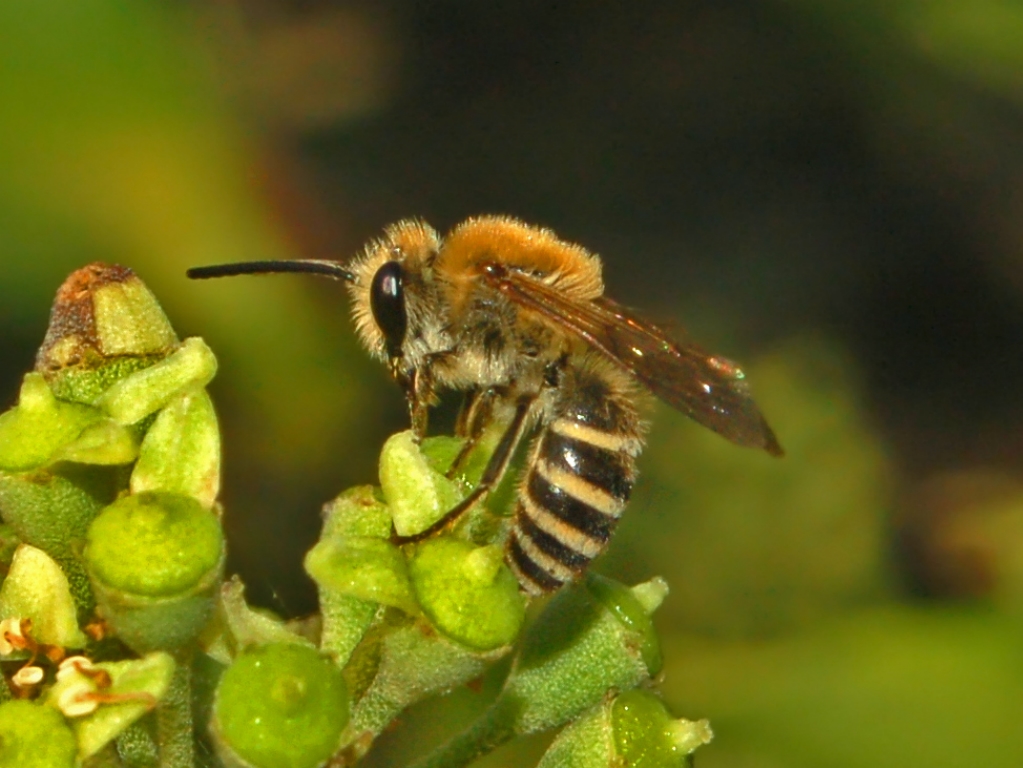
When ivy flowers open in September, Britain's newest wild bee appears alongside them. Colletes hederae, the ivy bee, was unknown to science until 1993 and unknown in Britain until 2001, yet it has since spread from a single Dorset site to cover most of England, Wales and beyond.[1] It is the largest of Britain's plasterer bees and one of the most distinctive: honeybee-sized, with a gingery-orange thorax and bold buff bands across the abdomen, and seen only in autumn when almost every other bee has finished for the year. Its entire life is timed around a single plant. Visit the UK Native Bee Species Map to see where it has reached so far, or explore related species in the World Bee Atlas.
Quick Facts
Taxonomy and Classification
The ivy bee was described as a new species by Konrad Schmidt and Paul Westrich in 1993, having long been confused with two close relatives: the sea aster bee (Colletes halophilus) and the heather colletes (Colletes succinctus).[2] All three belong to the succinctus group within the genus Colletes, and all are late-flying specialists tied to a single plant family in late summer and autumn. The genus name Colletes derives from the Greek for "one who glues," a reference to the cellophane-like secretion females use to line their brood cells. The family Colletidae is often called the plasterer bees for the same reason.
| Kingdom | Animalia |
| Phylum | Arthropoda |
| Class | Insecta |
| Order | Hymenoptera |
| Family | Colletidae |
| Subfamily | Colletinae |
| Genus | Colletes Latreille, 1802 |
| Species group | succinctus group |
| Species | Colletes hederae Schmidt & Westrich, 1993 |
Identification
The ivy bee is the largest of Britain's banded Colletes species, roughly the size of a honeybee or slightly larger, with females averaging around 13 mm and males around 10 mm.[3] Both sexes share the same pattern: a rich gingery-orange thorax and an abdomen with broad, clearly defined buff-orange bands across each segment. In a fresh specimen the banding has a distinctly warm orange tone; this fades to paler buff or whitish as individuals age. The thorax retains its orange hue throughout the flight period.
The ivy bee can be confused with the closely related heather colletes (C. succinctus) and sea aster bee (C. halophilus), but context makes identification straightforward: any large, strongly banded Colletes found in September or October foraging on ivy flowers is almost certainly this species.[1] The forewing of the female measures 9.5 to 10 mm, that of the male 8 to 8.5 mm, making it noticeably larger than the common Colletes daviesanus it can superficially resemble.
A Newcomer: Arrival and Spread Across Britain
The ivy bee's arrival in Britain is one of the most closely tracked range expansions in British entomology. It crossed the Channel naturally, most likely from northern France, and was first confirmed in Britain in 2001 by Ian Cross at Langton Matravers near Worth Matravers in Dorset.[4] The presence of multiple nesting aggregations near the first record suggests the bee had been present for at least a year or two before it was formally identified.
- 1993Described as new to science by Schmidt & Westrich; type material from Italy, France, Germany and Croatia.
- 2001First confirmed British record at Langton Matravers, Dorset (Ian Cross, BWARS).
- 2004Reached Sussex, around 100 km east of Dorset.
- 2009Established across most of southern England below the Thames.
- 2014First records in north Wales and north Norfolk.
- 2016Recorded in Lancashire, Yorkshire and Nottinghamshire.
- 2020Reached the Solway Firth, on the threshold of Scotland.
- 2021First confirmed records in Scotland and Ireland.
The expansion is ongoing and tracking it is a citizen-science effort: BWARS runs a dedicated Colletes hederae mapping project and encourages records from anyone finding the bee on ivy.[4] The species is now present in multiple sites in Sussex at essentially every location where ivy grows in suitable habitat, and the Sussex foraging study of 2020 found it to be the second most abundant insect on ivy flowers, outnumbering even the honeybee.[5]
Native colonist or introduced species?
Some sources including the Wildlife Trusts list the ivy bee as an "introduced, non-native species." BWARS and most academic literature describe it as a natural colonist that expanded its range across the Channel under its own power, the same process by which the tree bumblebee arrived in 2001. No deliberate introduction took place. The distinction matters ecologically: a natural range expansion driven by climate and habitat availability is categorically different from a managed introduction. The current scientific consensus treats it as a natural colonist, but the "non-native" label persists in some conservation guidance.[4]
Ivy: The One Plant This Bee Cannot Live Without
The ivy bee is an oligolect: it collects pollen from a single plant source, common ivy (Hedera helix). The species epithet hederae means "of ivy." A Sussex study published in 2021 found that 98.5% of pollen collected by female ivy bees was ivy pollen, with all other plants accounting for the remaining 1.5%.[5] When ivy flowering is delayed or locally scarce, females will take pollen from members of the daisy family (Asteraceae), but this appears to be a fallback rather than genuine flexibility.[6]
This dependency is a double asset: ivy is one of the most widespread and abundant plants in Britain, which is a key reason the bee has been able to spread so rapidly, and ivy flowers at exactly the time of year when almost every other nectar and pollen source has shut down. In October, an ivy-covered wall or hedgerow can be the most important foraging site for dozens of species at once. The ivy bee, however, does not share this resource generously: where nesting aggregations are large, females can dominate patches of ivy and reduce the pollen available to late-flying bumblebees and other autumn insects.[5]
98.5% ivy pollen
A 2021 Sussex study across 57 ivy-foraging sites found that ivy pollen made up 98.5% of all pollen collected by female ivy bees, confirming it as one of Britain's most specialised wild bees. Honeybees foraging on the same flowers were significantly less abundant.[5]
Nesting: Aggregations in the Thousands
Ivy bees nest in the ground, choosing sandy or loamy south-facing banks, soft coastal cliffs, and sparsely vegetated slopes in full sun.[1] Each female is solitary: she excavates her own burrow, provisions her own cells, and works entirely alone. There is no colony, no queen in the social sense, and no division of labour. Yet nesting tends to concentrate wherever soil conditions are right, producing aggregations that can number many tens of thousands of nests in a small area, with circles of fresh excavated soil marking each entrance. This looks social but is simply the result of many independent females choosing the same favourable patch.
Inside each burrow the female builds a row of cells, each lined with the waterproof, cellophane-like secretion that gives the family Colletidae its common name, "plasterer bees." The lining protects the pollen-and-nectar loaf and the egg from soil moisture and microbial damage. The burrows can reach nearly half a metre in depth. Larvae develop over winter inside sealed cells, and fully formed adults overwinter in tough cocoons before emerging the following August and September.[3]
The mating scramble
Males emerge several weeks before females and gather at nest aggregations to await them. When a female begins to emerge, males mob the burrow entrance in frenzied mating clusters, sometimes forming rolling balls of several bees on the ground. This conspicuous behaviour is one of the most striking sights in British entomology and often what first draws people's attention to a nesting site.
Autumn Bees and Autumn Honey
The ivy bee's world is entirely autumnal: it appears in September, peaks in October, and is gone by November, timed precisely to the flowering of ivy. It makes no honey. Like all solitary bees, each female collects pollen and nectar purely to provision her own nest cells, with nothing left over to store or harvest.
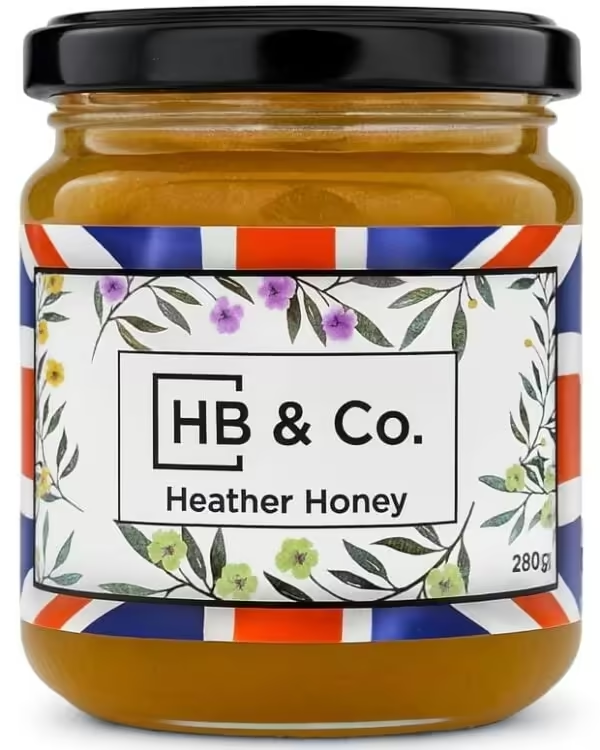
But autumn is also when our Heather Honey is harvested. Our bees work the Yorkshire Moors in August, when the heather is at its peak, and the honey is extracted once that single-season harvest is complete. Like the ivy bee, heather honey belongs to a narrow window: it is available only in the quantities that one summer on the moor can produce. Both the bee and the honey are a reminder that the best things in nature have a season, and that season is worth paying attention to.
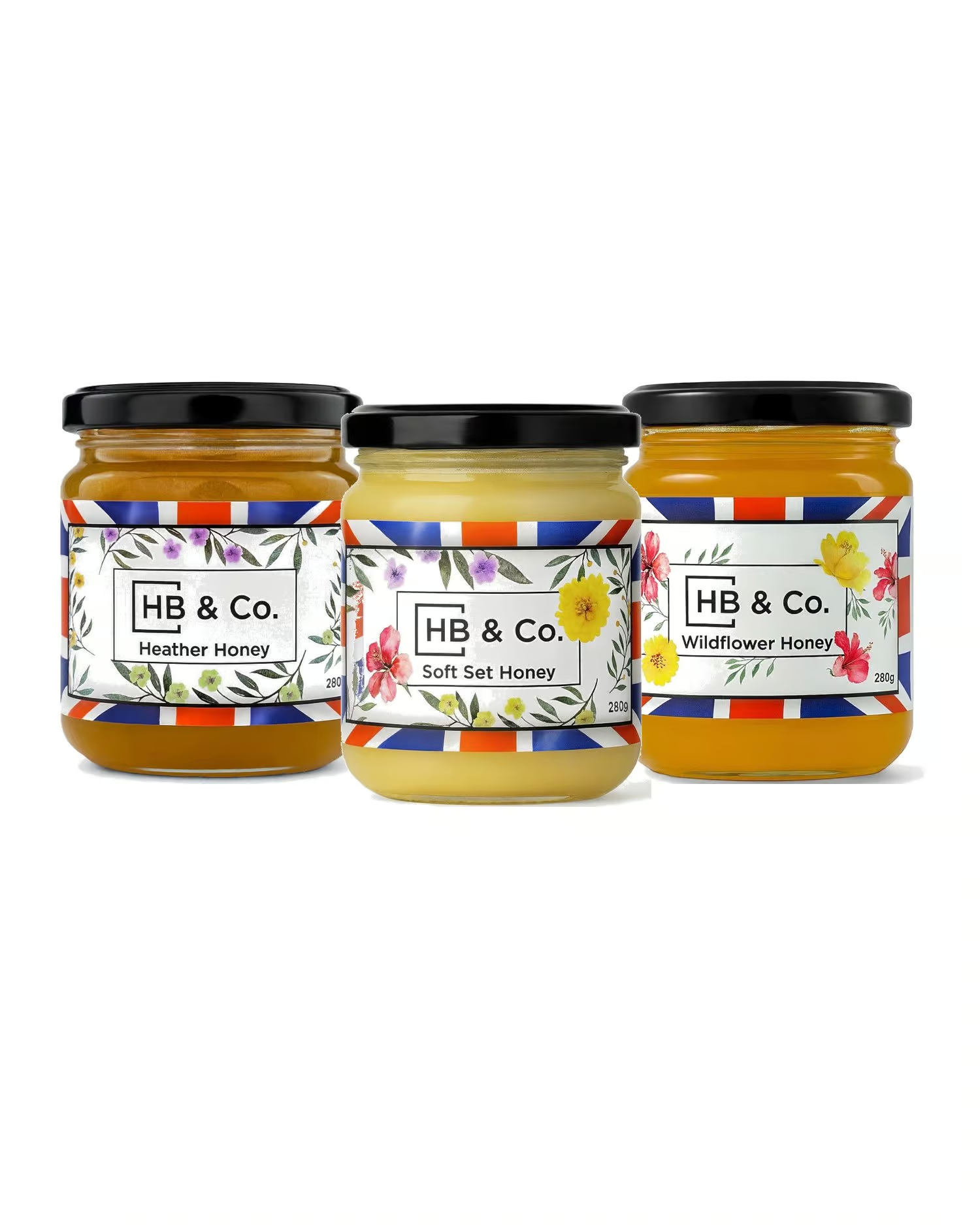
If you want to explore the range of what Britain's bees produce across the whole year, our British Honey Bundle brings together Wildflower, Soft Set and Heather honey from our SALSA-certified British supplier, three harvests from three landscapes in one gift.
Source Conflicts and Open Questions
Is the ivy bee oligolectic or polylectic?
The ivy bee is widely described as strictly oligolectic on ivy. The Sussex study found 98.5% ivy pollen in collected loads, strongly supporting this.[5] However, Müller and Kuhlmann (2008) showed that when ivy is unavailable or flowering is delayed, females will collect pollen from Asteraceae (daisies, ragwort), and on the continent the species can be considerably less reliant on ivy than in Britain.[6] The honest answer is that C. hederae is strongly but not absolutely tied to ivy, and the degree of specialisation varies by location and season.
Does it compete with native autumn pollinators?
As the ivy bee has spread, concern has grown about whether its dominance on autumn ivy flowers reduces pollen and nectar for late-flying bumblebees, hoverflies and other native insects that depend on ivy as a crucial late-season resource. The Sussex study noted the ivy bee was more abundant than the honeybee on ivy, but the evidence for competitive exclusion of native species remains limited.[5] The question is unresolved and an active area of monitoring.
Frequently Asked Questions
How do I identify an ivy bee?
Look for a honeybee-sized bee with a gingery-orange thorax and broad, clearly defined buff or orange bands across each abdominal segment. Both males and females are strongly banded, unlike most other bees. The key context clue is timing and plant: if you see this pattern in September or October on ivy flowers, it is almost certainly an ivy bee. Fresh specimens have a warm orange tinge to the banding; older individuals fade to buff or white.
When do ivy bees appear in the UK?
Males emerge from late August and females a little later, from early September. Both sexes are active through October and into early November, matching the flowering period of ivy. It is the last solitary bee of the British season and one of the few bees still foraging when most others have finished.
Are ivy bees dangerous? Do they sting?
Ivy bees are gentle and pose no meaningful risk. Females have a sting but will only use it under severe provocation; males cannot sting at all. Even large nesting aggregations of thousands of bees are safe to watch at close range. BWARS advises that if ivy bees are nesting in your lawn, the best approach is simply to enjoy them: they will be active for only around six weeks and will do no lasting harm to the lawn or surrounding garden.
Where do ivy bees nest?
In the ground, typically in sandy or loamy south-facing banks, soft cliffs and sparsely vegetated slopes in full sun. They often nest in large aggregations, with many females choosing the same favourable patch, producing a cluster of small round entrance holes with circles of freshly dug soil. They sometimes nest in lawns with bare or thin patches of grass.[7]
Why does the ivy bee only visit ivy flowers?
The ivy bee is an oligolect, a specialist that collects pollen from a single plant source. Its flight season evolved to match the late-autumn flowering period of common ivy (Hedera helix), which provides a reliable and abundant pollen source when virtually every other flower has closed for the year. A 2021 Sussex study found that 98.5% of pollen collected by females was ivy pollen. This tight dependency also means ivy is essential for the bee's survival: where ivy is absent or in poor condition, ivy bees cannot successfully nest nearby.
Is the ivy bee native to Britain?
It is a natural colonist rather than a native species. It arrived by its own means, most likely crossing the Channel from northern France, and was first recorded in Dorset in 2001. It was not deliberately introduced. BWARS and most scientific literature treat it as a natural range expansion comparable to that of the tree bumblebee, which also reached Britain in 2001. Some conservation bodies still list it as non-native, which is technically accurate, but the ecological context is very different from an introduction.
How far has the ivy bee spread in the UK?
Rapidly and continuously. From a single Dorset site in 2001 it reached Sussex by 2004, covered most of southern England by 2009, expanded through Wales and the Midlands through the 2010s, and by 2021 had been recorded in Scotland and Ireland. It is now considered well established across much of England and Wales. See the UK Native Bee Species Map for current distribution information.
Does the ivy bee make honey?
No. Ivy bees are solitary: each female provisions only her own nest cells with pollen and nectar for her offspring. There is no colony, no surplus, and nothing to harvest. All harvestable honey comes from managed honeybee (Apis mellifera) colonies.
Sources and References
- Bees, Wasps and Ants Recording Society (BWARS). Colletes hederae species account: identification, distribution and nesting biology. bwars.com
- Schmidt, K. & Westrich, P. (1993). Colletes hederae n. sp., eine bisher unerkannte auf Efeu (Hedera) spezialisierte Bienenart. Entomologische Zeitschrift 103(6):89–112. Original species description.
- NatureSpot. Ivy Bee (Colletes hederae): size, forewing measurements and nesting notes. naturespot.org
- Carreck, N. L. et al. (2023). Distribution and abundance of the ivy bee Colletes hederae in Britain. Biological Invasions Records. reabic.net
- Hennessy, G. et al. (2021). Foraging ecology of Colletes hederae on ivy in Sussex: pollen analysis and abundance relative to Apis mellifera. Arthropod-Plant Interactions. link.springer.com
- Müller, A. & Kuhlmann, M. (2008). Pollen hosts of western palaearctic bees of the genus Colletes: the Asteraceae paradox. Biological Journal of the Linnean Society 95(4):719–733. doi.org
- BWARS. Colletes hederae FAQs: nesting in lawns, conservation status, identification guidance. bwars.com