

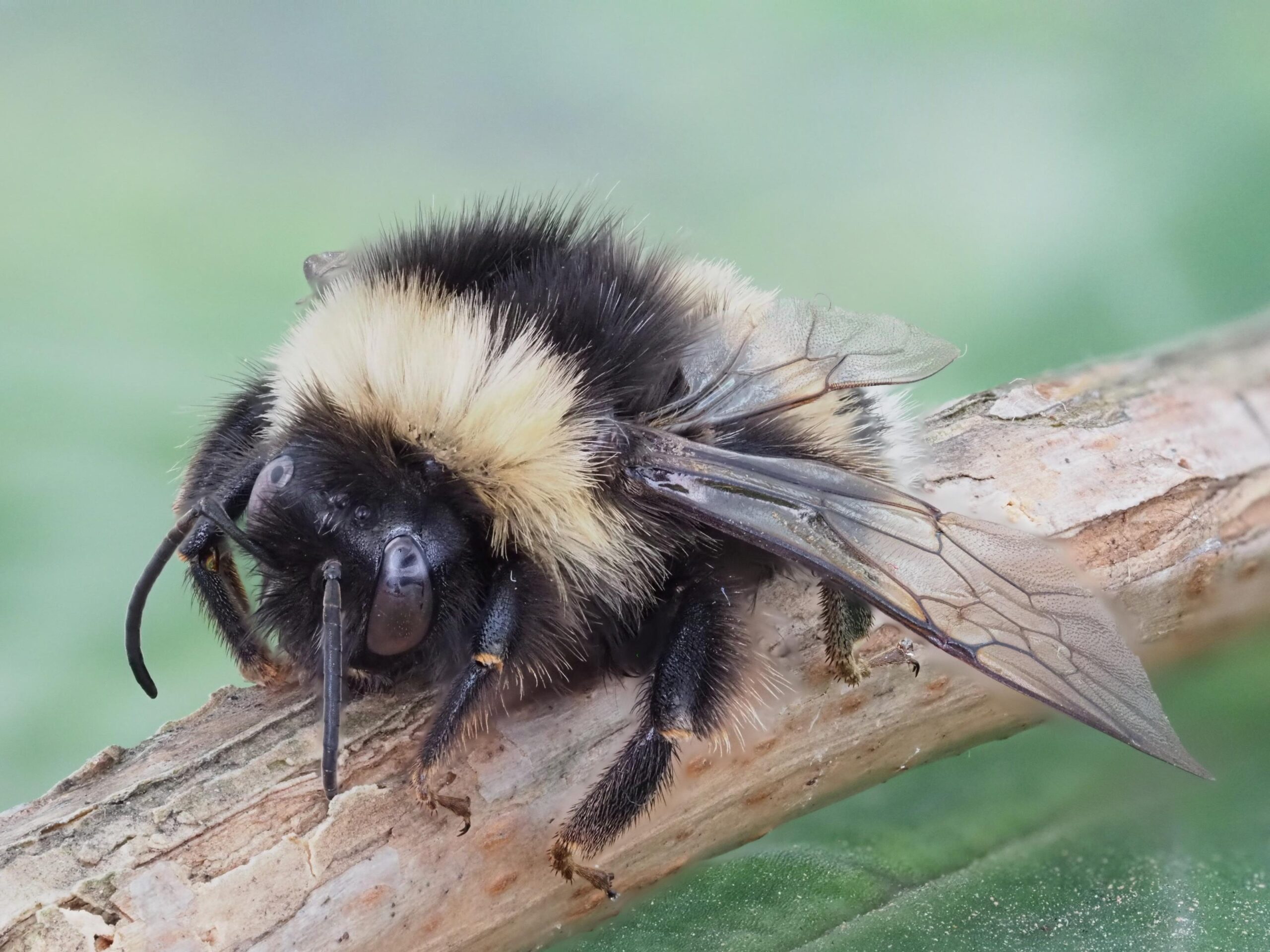
Esin Üstün from Istanbul, Turkey, CC BY 2.0, via Wikimedia Commons
White-tailed Bumblebee
Bombus lucorum
Linnaeus, 1761 • Apidae • Bombus sensu stricto
The white-tailed bumblebee is one of the most familiar bees in Britain, yet it conceals a remarkable identity problem. What most people call Bombus lucorum is actually three separate species: the white-tailed bumblebee proper, the cryptic bumblebee (B. cryptarum), and the northern white-tailed bumblebee (B. magnus). All three look almost identical in the field, and even experts with a specimen in hand frequently cannot tell them apart. DNA analysis or chemical identification of male pheromones is needed for certainty. Widespread across the whole of Britain from Cornwall to Shetland, the lucorum complex is one of the most abundant groups of bumblebees in the country, and one of the first to emerge each spring. Explore its range on the UK Native Bee Species Map, or read about bumblebees worldwide in the World Bee Atlas.
Quick Facts
Taxonomy: One Name, Three Species
The white-tailed bumblebee was described by Carl Linnaeus in 1761 and placed in the subgenus Bombus sensu stricto, the "true bumblebees," alongside its closest relative Bombus terrestris.[1] For most of the twentieth century it was treated as a single highly variable species. In 1983, Scholl and Obrecht coined the term Bombus lucorum complex to formally recognise that three distinct but near-identical taxa were being grouped under one name.[7] Since then, molecular work using mitochondrial DNA and the chemical analysis of male labial gland secretions has confirmed all three as separate species.
The three members of the complex are: Bombus lucorum (white-tailed bumblebee), the most widespread; Bombus cryptarum (cryptic bumblebee), common in upland, northern and western Britain; and Bombus magnus (northern white-tailed bumblebee), largely confined to northern Britain, Ireland, and coastal heathland. In practice, all three are frequently recorded simply as Bombus lucorum agg. (aggregate), particularly for workers, which cannot be separated at all by morphology alone.[3]
| Kingdom | Animalia |
| Phylum | Arthropoda |
| Class | Insecta |
| Order | Hymenoptera |
| Family | Apidae |
| Tribe | Bombini |
| Genus | Bombus Latreille, 1802 |
| Subgenus | Bombus sensu stricto |
| Species | Bombus lucorum Linnaeus, 1761 |
| Complex | B. lucorum, B. cryptarum, B. magnus |
Identification: Lemon Yellow and Clean White
The lucorum complex shares a diagnostic banding pattern: a pale yellow collar at the front of the thorax, a yellow band across the second abdominal tergite, and a clean white tail. The yellow is distinctively lemon or straw-coloured, noticeably paler and colder in tone than the warmer mustard-yellow of the buff-tailed bumblebee (Bombus terrestris). The tail in queens and workers is pure white, never the buff or orange of B. terrestris queens.[3]
Separating the three complex members
Queens offer the best chance of field separation, though even this is not always definitive. Bombus lucorum queens average slightly smaller (18–20 mm) with a narrower, often pinched yellow collar that ends bluntly near the wing bases and a narrower yellow band on tergite 2. B. magnus queens are larger with a broader collar that extends well down the sides of the thorax. B. cryptarum queens tend to have a pronounced inward curve of black hairs at the front of each wing base, giving the collar a distinctive concave outer edge.[2] Workers of all three are essentially inseparable in the field. Males can be distinguished by pheromone chemistry but not by sight.
Separating from Bombus terrestris
The most important separation in everyday identification is from the buff-tailed bumblebee. The differences are subtle in workers but clear in queens: B. lucorum queens have a bright white tail and lemon-yellow bands; B. terrestris queens have a dull buff-orange or brownish-orange tail and warmer, more mustard-coloured yellow. When both species forage together, the colour difference is apparent. Workers of both species can be virtually identical, and BWARS recommends recording ambiguous workers as "Bombus lucorum/terrestris" unless a definitive feature is visible.[3]
Colony Life Cycle
Queens of the lucorum complex are among the first bumblebees to emerge each spring, typically from mid-March in lowland Britain, sometimes earlier in mild years.[4] After emerging from hibernation, queens feed intensively on spring flowers, particularly sallows, blackthorn, ground ivy, gorse, dead-nettles and early bulb flowers, to restore fat reserves and develop their ovaries before founding a nest.
Nests are almost always underground, typically in the abandoned nest of a small rodent such as a field vole or wood mouse. The queen constructs wax cells, lays an initial batch of worker eggs, and tends them alone until the first workers emerge, usually by mid-April. The colony builds through spring and summer, reaching peak worker numbers of 100 to 400 in July.[4] New queens and males are produced from late June or July, and by late August most colonies have concluded. New queens mate and seek hibernation sites, often burrowing into loose soil or leaf litter on south-facing slopes.
Bombus lucorum, B. cryptarum and B. magnus are three separate species routinely recorded as one. Their workers cannot be separated by morphology; queens require careful examination; only DNA or male pheromone chemistry gives certainty. Most distribution records treat them as an aggregate.
Foraging: A Short Tongue and a Useful Workaround
The lucorum complex has a shorter tongue than many British bumblebees, which means it cannot easily access the nectar of deeply tubular flowers through the legitimate floral entrance. It compensates in two ways: it concentrates foraging effort on open-structured flowers where nectar is accessible, and it nectar robs deeper flowers by biting a hole at the base of the corolla to reach the nectar without entering the flower, delivering no pollination benefit in the process.[5]
Foraging plants span an enormous range. Spring queens favour sallows, blackthorn, cherry, gorse, ground ivy and dead-nettles. Workers forage across the entire season on white and red clover, bramble, raspberry, knapweed, thistles, scabious, viper's bugloss, teasel, buddleia, lavender, cotoneaster, heathers and many garden flowers. Males are particularly associated with thistles, ragworts, knapweeds and scabiouses in late summer. The broad foraging range makes the complex one of the most ecologically important pollinators in the British landscape.[1]
Nectar robbing: pollination without payment
When a lucorum worker bites through the base of a comfrey or clover tube to reach nectar, it collects the reward without contacting the stamens or stigma. The flower receives no pollination service. Nectar robbing is a short-tongue adaptation, common in B. lucorum and B. terrestris but rare in long-tongued species like the garden bumblebee, which simply reaches the nectar legitimately.[5]
Distribution and Habitat
The lucorum complex is one of the most widely distributed bumblebee groups in Britain, recorded from Cornwall to Shetland and from sea level to over 900 metres on Scottish mountains.[1] It occupies virtually every habitat where flowers are present: gardens, farmland, hedgerows, woodland edges, heathland, moorland, coastal grassland, and urban parks. In northern and upland Britain, B. cryptarum and B. magnus become more frequent relative to B. lucorum itself, and in some highland sites they are the dominant members of the complex.
The three species have subtly different habitat preferences. B. lucorum sensu stricto is most frequent in lowland, less exposed landscapes including gardens and farmland. B. cryptarum is most common in upland heather moorland, western woodland edges and humid grassland. B. magnus is particularly associated with coastal and upland heathland in northern England, Scotland and Ireland, where its larger queens have a foraging advantage in wind-exposed conditions.[2] Because most recording treats them as an aggregate, the true distributions of all three remain imperfectly understood.
Cuckoo Bees and Natural Parasites
Two cuckoo bumblebees target the lucorum complex: the gypsy cuckoo bumblebee (Bombus bohemicus) and the southern cuckoo bumblebee (Bombus vestalis). Both are obligate social parasites: the female cuckoo invades an established host colony, kills or subdues the resident queen, and uses the existing workers to raise her own offspring, which consist entirely of new queens and males with no worker caste of their own.[1]
B. vestalis primarily targets B. terrestris but also uses B. lucorum colonies; B. bohemicus specialises on the lucorum complex. Both cuckoos superficially resemble their hosts and are frequently misidentified in the field, but both have yellow patches on the sides of the abdomen near the tail base that the host workers lack. A female cuckoo bumblebee flying low over a garden lawn in May is almost certainly searching for a lucorum or terrestris nest entrance.[1]
Is the white-tailed bumblebee declining in Britain?
Some sources, including the charity Bee Life and some local recording data, report declines in B. lucorum populations in parts of Britain. However, the Bumblebee Conservation Trust and BWARS do not list it as a species of conservation concern, and the Powney et al. 2019 analysis found it to be among the more stable common bumblebee species rather than significantly declining. Part of the confusion arises from the aggregate recording problem: a perceived decline in "B. lucorum" records could partly reflect better recording practice (recording ambiguous workers correctly as lucorum/terrestris) rather than a real change in numbers. The current evidence does not support classifying it as threatened.[6]
How are the three complex members distributed across Britain?
Because most historical recording treats them as B. lucorum agg., the true distributions of all three species in Britain are still being mapped. The BWARS lucorum complex mapping project, combined with increasing use of DNA barcoding in citizen science surveys, is gradually resolving the picture, but confident range maps for all three individually do not yet exist. The NBN Atlas distribution for B. lucorum should be understood as representing the aggregate rather than the species alone.[3]
Britain's White-tailed Bumblebee and Our British Honeys
The lucorum complex is active from the first warm days of March through to September, visiting the same blossom that honeybee colonies exploit across the whole season. It makes no honey: bumblebee colonies store only a few days' worth of nectar at any one time, with nothing to harvest. What it produces is pollination, reliably and at scale, from early spring blackthorn to late-summer knapweed.
Our British honeys come from that same landscape. The Yorkshire Heather Honey is gathered from the same late-summer moorland that B. cryptarum and B. magnus, the northern members of the complex, patrol all summer. Our British Honey Bundle brings together Wildflower, Soft Set and Heather from our SALSA-certified British supplier, three distinct harvests from three British landscapes in one box.

One harvest, one moor, one season. Raw Yorkshire heather honey gathered from the same upland landscape that the northern members of the lucorum complex call home. Cold-extracted, raw. 280g.

Wildflower, Soft Set and Heather from our SALSA-certified British supplier. Three landscapes, one gift.
Shop British Bundle
Raw single-origin honey every month. Heather, Wildflower, Acacia and more. From £8.79/month.
Start SubscriptionFrequently Asked Questions
How do I identify a white-tailed bumblebee?
Look for a bumblebee with a pale lemon-yellow collar, a yellow band on the second abdominal segment, and a clean white tail. The key distinction from the similar buff-tailed bumblebee (B. terrestris) is the tail colour: white in the lucorum complex, buff-orange in B. terrestris queens. The yellow is also noticeably cooler and paler (lemon) rather than warmer (mustard). Workers of both species are extremely difficult to tell apart and should be recorded as lucorum/terrestris unless a clear diagnostic feature is visible.
What is the Bombus lucorum complex?
The lucorum complex is the collective term for three nearly identical bumblebee species: Bombus lucorum (white-tailed bumblebee), Bombus cryptarum (cryptic bumblebee) and Bombus magnus (northern white-tailed bumblebee). The three were long treated as one species and are still frequently recorded together as "B. lucorum agg." because workers cannot be separated in the field. The complex was formally recognised by Scholl and Obrecht in 1983 and the three species are now accepted as distinct on the basis of DNA and male pheromone chemistry.
When does the white-tailed bumblebee fly?
Queens emerge from mid-March in lowland Britain, sometimes earlier in mild years. They are among the first bumblebees of spring. Workers appear from mid-April, and colonies produce new queens and males from late June or July. Most colonies finish by late August or September, though workers can be seen foraging into October in warm autumns.
Where does the white-tailed bumblebee nest?
Almost always underground, in the abandoned burrow of a small rodent such as a field vole or wood mouse. The queen takes over the existing nest structure and builds wax cells within it. Nests can be in lawns, meadow edges, hedgerow bases, or open ground, wherever suitable rodent burrows are available. The colony reaches 100 to 400 workers at peak.
How is the white-tailed bumblebee different from the buff-tailed bumblebee?
Both have yellow bands and a pale tail, but in queens the tail colour is the key: white in B. lucorum, buff-orange in B. terrestris. The yellow banding in lucorum is also lemon-yellow rather than warm mustard. B. terrestris is slightly larger and tends to have a brighter, warmer yellow. Workers of both species can be virtually inseparable, and BWARS recommends recording ambiguous workers as lucorum/terrestris. See the Buff-tailed Bumblebee profile for a full comparison.
Does the white-tailed bumblebee nectar rob?
Yes, regularly. Because it has a relatively short tongue, it cannot reach the nectar of deep-tubed flowers through the legitimate floral entrance. Instead, workers bite a hole through the base of the corolla to access the nectar directly, bypassing the flower's reproductive structures and delivering no pollination. This behaviour is commonly seen on comfrey, red clover, and other tubular flowers, and is also practised by the buff-tailed bumblebee.
Is the white-tailed bumblebee found across the whole UK?
Yes. The lucorum complex is one of the most widespread bumblebee groups in Britain, recorded from sea level to high mountain ground across the whole country including Shetland. In northern and upland Britain the cryptic bumblebee (B. cryptarum) and northern white-tailed bumblebee (B. magnus) become more common relative to B. lucorum itself. Use the UK Native Bee Species Map to explore regional distribution.
Does the white-tailed bumblebee make honey?
No. Like all bumblebees, colonies store only a few days' supply of nectar at any time. There is no surplus and nothing to harvest. All commercial honey comes from managed honeybee (Apis mellifera) colonies, which uniquely store large reserves to carry the colony through winter.
Sources and References
- Bees, Wasps and Ants Recording Society (BWARS). Bombus lucorum species account: identification, nesting, foraging, cuckoo parasites, distribution. bwars.com
- Bertsch, A., Schweer, H. & Titze, A. (2004). Discrimination of the bumblebee species Bombus lucorum, B. cryptarum and B. magnus by morphological characters and male labial gland secretions. Beiträge zur Entomologie 54(2):365–386. doi.org
- Bumblebee Conservation Trust. White-tailed bumblebee: species guide, identification notes, separation from buff-tailed and from B. cryptarum and B. magnus. bumblebeeconservation.org
- Bumblebee.org. Bombus lucorum sensu stricto: colony cycle, queen emergence, worker sizes. bumblebee.org
- Buzzaboutbees.net. Bombus lucorum: foraging range, short tongue adaptation, nectar robbing. buzzaboutbees.net
- Powney, G. D. et al. (2019). Widespread losses of pollinating insects in Britain. Nature Communications 10:1018. doi.org
- Scholl, A. & Obrecht, E. (1983). New enzyme markers for the species identification in the Bombus lucorum complex. Apidologie 14(4):233–242. Original complex description. doi.org