
 English (UK)
  Italiano
  Français
  简体中文
简体中文 
Honey vs Sugar:
What You Are Really Choosing
A clear-eyed look at two of the world's most used sweeteners: where they come from, how each is made, how they behave in the kitchen, and what they cost the planet. Written by a family with six generations of beekeeping heritage, with no health claims and no hype.
In This Guide
- Nutrition and Composition: The Numbers
- What the Evidence Actually Says
- Glycaemic Index: What the Data Shows
- What Researchers Are Studying
- Honey and the Gut
- How Each Sweetener Is Made
- A Brief History of Honey and Sugar
- The Scale of Global Sugar
- Honey Varieties and Their Differences
- Using Honey Instead of Sugar: A Practical Guide
- Environmental Impact
- The Verdict
- Frequently Asked Questions
Honey and sugar. Two sweeteners that have shaped human civilisation, fuelled wars, driven trade routes, and sat at the centre of almost every culture's relationship with food. Today they sit side by side in most kitchens, often treated as interchangeable. But they are fundamentally different substances: different in origin, different in chemistry, different in how they behave in the kitchen, and different in their cost to the planet.
This guide covers all of it: from the molecular make-up of each sweetener to the legacy of the trans-atlantic sugar trade, from a beekeeper's hive in Transylvania to the vast sugarcane plantations of Brazil. We have drawn on published nutritional data, official guidance from bodies like the NHS, and over six generations of beekeeping experience. One thing we will not do is dress honey up with health claims it cannot legally carry. Honey is a natural sugar. The honest case for it is provenance, craft and flavour, not wellness promises.
If you want the practical comparison, jump to the nutrition table. If you would rather start tasting, our raw Acacia honey is the gentlest place to begin, or browse the full single-origin range. To understand what "raw" really means, see raw honey vs regular honey.
Key Takeaways
- Raw honey and white sugar are not interchangeable: honey is minimally processed and naturally carries water, enzymes and trace plant compounds, while white sugar is fully refined sucrose.
- Honey is roughly 1.25 times sweeter than sugar, so you can usually use less for the same sweetness, and it brings real flavour rather than sweetness alone.
- The NHS counts the sugars in honey as free sugars and advises adults stay under 30g a day. Swapping sugar for honey does not change that, so enjoy it in moderation.
- For baking, honey's moisture keeps bakes softer for longer. See our best honey for baking guide and the Bakers' Kitchen Selection.
- Honey costs more because you are paying for provenance and craft. Our 280g jars start at £10.99, or from £8.79 a jar on a honey subscription (subscribe and save 20%, free UK delivery on every order).
Nutrition and Composition: The Numbers
Raw honey and white sugar, side by side, per 100g
| Metric | Raw Honey | White Sugar | What it means in practice |
|---|---|---|---|
| Calories (per 100g) | 304 kcal | 387 kcal | Honey is less calorie-dense by weight |
| Calories (per tbsp) | 64 kcal | 49 kcal | A tablespoon of honey weighs more, so it is higher per spoon |
| Carbohydrates (per 100g) | 82g | ~100g | Honey carries water and other compounds; sugar is near-pure sucrose |
| Water content | ~17% | 0% | Honey's moisture keeps baked goods softer for longer |
| Sweetness vs sugar | About 1.25× sweeter | Baseline | You can use less honey for the same sweetness |
| Natural composition | Trace minerals, natural enzymes, pollen, plant compounds | None (refined out) | A raw, whole product vs a single refined molecule |
| Flavour | Distinct, varies by floral source | Neutral sweetness only | Honey adds character; sugar adds only sweetness |
| Processing level | Raw or minimally filtered | Heavily refined | Single-origin and traceable vs an industrial commodity |
| Shelf life | Keeps very well when sealed and stored cool | Keeps very well | Both store well; raw honey may crystallise naturally over time |
| Cost (per 100g) | Higher | Lower | You are paying for provenance, rawness and craft |
Calorie, carbohydrate and water figures: USDA FoodData Central. The "natural composition" row describes what each product naturally contains and is not a health claim; honey is a sugar and is best enjoyed in moderation. Raw honey crystallises naturally over time, as our guide to crystallised honey explains, and you can read more everyday uses in our Acacia honey benefits and uses guide.
Honey is roughly 1.25 times sweeter than table sugar, which means you can usually use a little less to reach the same level of sweetness.
On sweetness and substitutionIf you are swapping sugar for honey, start here
Raw, single-origin honey in 280g jars. The gentle one first.
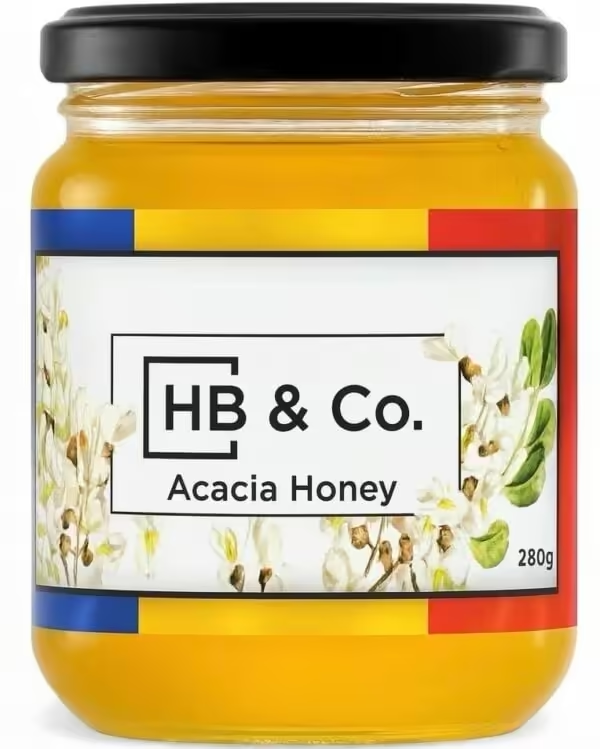
Raw Acacia Honey
Delicate, light and gently floral, with a clean finish that is slow to crystallise. Acacia is the easiest honey to reach for when you are used to sugar: mild enough for tea, coffee, yoghurt and baking, from our family apiaries in Transylvania.
What the Evidence Actually Says
We sell honey, so do not take our word for it. Here is what independent bodies say.
Honey is a sugar. Treat it like one.
The NHS counts the sugars naturally found in honey as free sugars, the same category as table sugar, and recommends adults have no more than 30g of free sugars a day, about seven sugar cubes. A tablespoon of honey is roughly 17 to 21g, so it makes up a meaningful share of that. Swapping sugar for honey does not exempt it.
Source: NHS, Sugar: the facts.
What raw honey contains
Raw, unheated honey naturally retains pollen, trace minerals and the enzymes bees add inside the hive. Full refining strips white sugar down to pure sucrose, with the colour, flavour compounds and trace nutrients removed. That is a difference in what the two products are, not a claim about what either does for your health. For what heating and filtering change, see raw honey vs regular honey.
Composition described factually; not a health or nutrition claim.
One firm safety rule: not for babies under one
The NHS advises that honey should never be given to infants under 12 months, because of the small risk of infant botulism. After the first birthday it is considered fine for healthy children. This is the one piece of honey guidance that is not about taste.
Source: NHS, foods to avoid giving babies.
We do not make health claims
You will notice we do not tell you honey cures, treats or prevents anything. UK rules do not permit unauthorised health claims for honey, and we would rather earn your custom on flavour and provenance. You may have read that honey has a lower glycaemic index than sugar; because honey is still a free sugar that raises blood glucose, we do not present that as a benefit. If you are managing a condition such as diabetes, speak to your GP or a registered dietitian.
UK Nutrition and Health Claims rules; general dietary guidance from the NHS.
This section is general information, not medical or dietary advice. If you have a health condition, consult a healthcare professional before changing your diet.
Glycaemic Index: What the Data Shows
Independent laboratory data, presented plainly, with no health claim attached
The glycaemic index (GI) is a laboratory measure of how quickly a carbohydrate raises blood glucose compared with pure glucose, which scores 100. It is third-party data, not a verdict on whether a food is good or bad for you. We are including the figures because people search for them, but we want to be clear up front: a GI number is not a health claim, and we do not present honey's GI as a benefit of buying our honey.
Honey
35–58
Varies by floral source. Lighter honeys such as Acacia tend to sit lower in the range; darker, higher-glucose honeys sit higher.
White sugar
~65
Sucrose is consistent across brands, so its GI does not vary in the way honey's does.
White bread (reference)
~75
Included only as a familiar reference point on the same scale.
Here is the honest part. A lower GI figure does not make honey a health food, and it is not a free pass. The NHS classes the sugars in honey as free sugars, and honey still raises blood glucose. If you are managing your blood sugar or living with diabetes, the right approach is a conversation with your GP or a registered dietitian, not a number on a honey label. We will not tell you honey is "better for your blood sugar," because that is a claim we are not permitted to make and would not stand behind.
GI figures: University of Sydney Glycaemic Index Database. Presented as third-party data for general information; not medical advice and not a health claim.
What Researchers Are Studying
A neutral summary of independent research, for general interest only
Honey has been the subject of a lot of research, and people reasonably want to know what it says. So here is a plain summary of what independent researchers and bodies have reported. Read it as background, not as advice. We are not permitted to claim that our honey treats, prevents or improves any condition, and we are not doing so here. Honey is a sweetener, it should be enjoyed in moderation, and if a health question matters to you, a healthcare professional is the right source.
Plant compounds
Researchers have reported that raw honey contains flavonoids and phenolic acids, plant compounds whose concentration varies a great deal by floral source, with darker honeys such as Heather tending to contain more than lighter ones. This describes what is in the honey; it is not a statement that eating it produces a health effect.
Alvarez-Suarez et al. (2017), PMC5549483.
Medical-grade honey is a different product
You may have seen research on honey in wound care. That work concerns sterilised, medical-grade honey used clinically, which is a different product from culinary honey. It is not something to attempt at home, and it is not what we sell. We mention it only so the distinction is clear.
Tashkandi (2021), PMC8496555.
Coughs and sore throats
For an ordinary cough, the NHS lists a warm drink with honey and lemon among the things you can try at home (not for under-1s). That is general self-care guidance from the NHS, not a medicinal claim from us. If you are after a comforting honey for this, people often reach for our milder varieties.
NHS self-care guidance for coughs.
Local honey and hay fever
There is a popular belief that local honey, which carries local pollen, might help with seasonal allergies. The scientific evidence for this is mixed and far from settled. We are not making the claim; if hay fever affects you, it is worth a word with your GP. Local, unfiltered honey such as our Wildflower does retain more pollen than heavily processed honey, which is a composition fact.
Popular belief; evidence inconclusive.
Honey versus sugar studies
Some studies have compared honey with table sugar in the diet. In reporting their results, the researchers themselves consistently stress the same caveat we would: honey is still a sugar and should not be eaten in excess. We point to the research rather than summarising any single finding as a benefit.
Bogdanov et al. (2008), PMC3005390.
The one firm safety rule
Honey must never be given to infants under 12 months, because of the small risk of infant botulism. After the first birthday it is considered fine for healthy children. This is firm NHS and WHO guidance, and the one piece of honey advice that is not about taste.
General information drawn from independent sources, not medical or dietary advice, and not a claim about HoneyBee & Co. honey. If you have a health condition, particularly diabetes, speak to a healthcare professional before changing your diet.
Honey and the Gut
An active area of research, described honestly
One difference people ask about is what honey and sugar do once they reach the gut. Here is what the research describes, with the same honesty as the rest of this page: it is interesting, it is unfinished, and it is not a benefit we claim for our honey.
Raw honey naturally contains small amounts of oligosaccharides, complex sugars that are not fully broken down in the small intestine. Some researchers have described these as having "prebiotic" properties, meaning they reach the large intestine where they may interact with gut bacteria. Researchers themselves are clear that this is an active and developing area rather than settled science, and individual responses vary. Refined white sugar, by contrast, is rapidly absorbed and contributes none of these compounds.
We are flagging this as something scientists are studying, not as a reason to eat more honey. Honey remains a free sugar, the daily limits still apply, and if gut health is a focus for you, a registered dietitian is the right person to ask.
Oligosaccharides in honey: Schell et al. and related reviews, PMC5583132. Described as an emerging research area; not a health claim.
How Each Sweetener Is Made
Two very different journeys from source to jar
Raw Honey
Foraging: worker bees collect nectar using their straw-like tongues, storing it in a specialised honey stomach called a crop.
Enzymatic conversion: enzymes from the bee's glands begin breaking sucrose down into glucose and fructose on the journey back to the hive.
Evaporation: bees fan the nectar in the comb to reduce its water content from around 70% to roughly 17 to 20%, creating a stable product.
Capping: when ready, bees seal each cell with a thin layer of beeswax, signalling that the honey is ready to harvest.
Harvesting: frames are extracted and the honey is strained to remove wax and debris. Raw honey is bottled without heat treatment.
No additives: nothing added, nothing removed. The product is complete as it leaves the hive.
White Sugar
Harvesting: sugarcane or sugar beet is harvested, typically by machine, after a full growing season.
Extraction: the plant is crushed or sliced and soaked to draw out the raw, sugar-rich juice.
Treatment: the juice is treated with lime and sulphur dioxide to remove impurities, then filtered and heated into a thick syrup.
Crystallisation: the syrup is concentrated in vacuum pans until crystals form, producing a mix of crystals and molasses.
Centrifuging: the mixture is spun to separate crystals from molasses, then washed and dried into raw sugar.
Refining: raw sugar is redissolved, decolourised and recrystallised into pure sucrose, stripped of all colour, flavour and trace nutrients.
What is sometimes sold as honey is not always what it appears. Honey adulteration, the bulking of genuine honey with corn or rice syrup, has been found at scale in UK and European markets. Always choose traceable, single-origin honey from a supplier who can tell you exactly where it comes from. Read our story.
A Brief History of Both Sweeteners
Thousands of years of the human relationship with sweetness
The earliest known honey harvest
Cave paintings in Spain's Cueva de la Arana depict humans harvesting honey from wild colonies, the earliest recorded evidence of human honey use. Honey predates agriculture itself.
Beekeeping in ancient Egypt
Egyptian records show organised beekeeping along the Nile. Honey was used as food, in medicine and in religious ceremonies, and was placed in tombs.
Sugarcane cultivation begins
Sugarcane cultivation begins in what is now New Guinea and spreads slowly to India. At this stage, sugar is consumed by chewing the raw cane.
Sugar refining spreads west
Refining techniques travel from India through Persia to the Mediterranean, and sugar begins its slow journey to becoming a European commodity.
Sugarcane reaches the Americas
Columbus introduces sugarcane to the Caribbean. The crop thrives, and within decades the sugar industry's demand for labour drives one of history's most devastating humanitarian catastrophes.
Sugar becomes a staple
Sugar shifts from a luxury reserved for the wealthy to a dietary staple across Europe. Honey, previously the primary sweetener, begins its long displacement.
High fructose corn syrup invented
Marshall and Kooi develop HFCS. By the 1980s, major soft-drink makers switch to it, driving mass adoption across processed food.
The great honey fraud
Investigations find much of the honey on UK supermarket shelves had been bulked with cheap rice and corn syrups, underlining the value of buying from transparent, traceable independent producers.
The return to raw
Demand for raw, traceable honey grows year on year as people move away from refined sugar and supermarket blends. Single-origin raw honey is at the forefront of that shift.
The Scale of Global Sugar
Numbers that put the sugar industry in perspective
The global sugar industry is one of the most water-intensive agricultural operations on earth. The World Wildlife Fund identifies sugarcane farming as a major driver of biodiversity loss. Brazil's Atlantic Forest has been significantly diminished by sugarcane expansion, water sources are routinely diverted, and processing wastewater has been documented polluting river systems across Latin America. Beekeeping, even at commercial scale, requires no deforestation and minimal water, and supports the biodiversity around it through pollination.
Not All Honey Is the Same
Colour, flavour and texture vary with the flowers the bees visited
One of the most important things to understand about honey is that it is not a single, uniform substance. Its colour, flavour, aroma and texture all depend on the floral source. That is why choosing the right variety matters, both for taste and for how it performs in a recipe.
Acacia Honey
Very light and gently floral with a clean, mild finish. Slow to crystallise, which makes it the easy everyday choice for tea, coffee and delicate bakes.
Explore Acacia Honey ›Wildflower Honey
A complex honey drawn from many floral sources, so the flavour shifts with the season. Carries local pollen and a classic, rounded honey taste.
Explore Wildflower Honey ›Heather Honey
Dark, robust and aromatic with a naturally thick, jelly-like texture. A bold honey that stands up to strong flavours and spiced bakes.
Explore Heather Honey ›Linden Honey
Also known as lime blossom. Light golden with a fresh, slightly minty aftertaste, popular across Central and Eastern Europe.
Explore Linden Honey ›Sunflower Honey
Bright golden with a warm, clean sweetness. Naturally crystallises quickly, a sign of purity, and one of the most versatile honeys for cooking.
Explore Sunflower Honey ›Soft Set Honey
Not a variety but a texture: gently seeded to a smooth, spreadable set that stays stable at room temperature. Ideal if you prefer honey that is not runny.
Explore Soft Set Honey ›Using Honey Instead of Sugar: A Practical Guide
Everything you need to make the switch in the kitchen
Because honey is sweeter than sugar and is about 17% water, swapping it into recipes takes a few small adjustments. Get them right and the results are excellent: honey adds moisture, a subtle floral depth and a golden crust that sugar cannot match. Our full baking guide goes deeper, variety by variety.
Reduce the liquid
For every cup of honey, cut other liquids by 3 to 4 tablespoons to balance honey's natural water content and keep the bake from turning dense.
Lower the temperature
Honey browns faster than sugar. Drop the oven by about 15C (one gas mark) and start checking early, especially for cakes and breads.
Add a pinch of bicarbonate of soda
Honey is mildly acidic. A pinch (about a quarter teaspoon per cup of honey) helps the bake rise, if the recipe does not already include it.
Best for, and less suited to
Honey shines in breads, cakes, muffins, marinades and dressings, and stirred into tea or porridge. It is harder to use in hard-crack confectionery and crystallised frostings that rely on sugar's behaviour.
Head to Head: Honey vs Sugar
A direct comparison across the things that genuinely differ
Raw Honey
- Made by bees from flower nectar; a natural product with no industrial refining
- Naturally contains enzymes, pollen, trace minerals and plant compounds
- About 1.25 times sweeter than sugar, so you typically use less
- Distinct flavour and aroma that change with the floral source
- Keeps very well when stored sealed and cool; may crystallise naturally
- Low environmental footprint; beekeeping supports pollination
- Single-origin and traceable when bought from an honest producer
- Should not be given to infants under 12 months
White Sugar
- Refined from cane or beet through heavy industrial processing
- Pure sucrose, with colour, flavour and trace nutrients removed
- Less sweet per gram, so you typically use more
- Neutral; adds sweetness but no flavour of its own
- Keeps very well, with consistent texture and behaviour in recipes
- Significant environmental cost: deforestation, water use, runoff
- Highly consistent commodity, with little variation between brands
- Lower cost per gram in the UK
Environmental Impact
Two industries with very different relationships with the planet
Honey Production
Beekeeping needs no land clearing, no irrigation and no chemical processing. A single hive can pollinate vast numbers of flowers each day, supporting the surrounding ecosystem. The main concerns are commercial beekeeping's pressure on wild bees and the long-distance transport of hives. Our ethical partnerships.
Sugar Production
The global sugar industry is a leading driver of deforestation and biodiversity loss. Sugarcane is one of the world's most water-intensive crops, and processing wastewater has been documented polluting river systems. The WWF names it a major threat to biodiversity.
The Bee Population Question
Over recent decades, wild and managed bee populations have declined across Europe and North America, driven by pesticide use, habitat loss, monoculture, disease and climate change. Supporting beekeepers who keep healthy hives is one direct way to help. Read about the threats bees face.
of the UK's wildflowers depend on bee pollination. Every jar of ethically produced honey supports a hive that is actively pollinating its surroundings. Learn which flowers bees love most.
Ready to Make the Switch?
Explore our range of single-origin raw honeys, from family apiaries in Transylvania and SALSA-certified British suppliers, backed by six generations of beekeeping heritage.
The Verdict
An honest conclusion
Honey is not a health food. It is a sweetener, one that happens to come with real flavour, a more interesting make-up, and a far lighter environmental footprint than refined white sugar. It is also about 25% sweeter, so you genuinely use less. But moderation applies equally to both: the NHS counts honey as a free sugar, and neither honey nor sugar should be eaten without thought.
The real question is not "honey or sugar?" in isolation. It is what kind of product you want in your kitchen and what you support with your money. Refined white sugar is an industrially processed commodity with a troubling historical and environmental legacy. Raw honey from an ethical, traceable producer is a natural product that has sustained people since before agriculture, and it tastes of where it came from.
If you are going to use a sweetener, and most of us will, the considered choice is raw honey from a producer you trust. Choose it for what it is: its flavour, its provenance and its craft.
Composition
Honey carries trace minerals, enzymes and plant compounds absent from refined sugar. Advantage: Honey.
Flavour
Honey adds character and aroma that vary by variety; sugar adds sweetness alone. Advantage: Honey.
Environmental cost
Sugar drives deforestation and water use at scale; ethical beekeeping supports ecosystems. Advantage: Honey, by a margin.
Kitchen versatility
Sugar is more predictable and cheaper; honey adds depth but needs small adjustments. Advantage: depends on the recipe.
Cost
Sugar is cheaper per gram; honey costs more but you use less. Advantage: sugar on price, honey on value.
Quality and traceability
Supermarket honey carries real adulteration risk; single-origin raw honey is where true quality lies. Advantage: raw honey from a trusted source.
Frequently Asked Questions
The questions we hear most about honey and sugar
Is honey healthier than sugar?
I have diabetes. Can I just use honey instead of sugar?
How much honey is sensible per day?
Can I substitute honey for sugar in any recipe?
Why has my honey crystallised? Is it still good?
What makes raw honey different from supermarket honey?
Can I give honey to my baby?
Is honey vegan?
What is high fructose corn syrup, and why does it matter here?
Sources and Further Reading
- NHS. Sugar: the facts. nhs.uk
- NHS. Foods to avoid giving babies and young children. nhs.uk
- NHS. Cough: self-care guidance. nhs.uk
- World Health Organization. Guideline: sugars intake for adults and children (2015). who.int
- USDA FoodData Central. Honey and granulated sugar nutrient profiles. fdc.nal.usda.gov
- University of Sydney Glycaemic Index Database. glycemicindex.com
- Alvarez-Suarez JM, et al. (2017). Honey as a source of dietary antioxidants. PMC5549483
- Tashkandi H. (2021). Honey in wound healing: an updated review. PMC8496555
- Bogdanov S, et al. (2008). Honey for nutrition and health: a review. PMC3005390
- Honey, oligosaccharides and the gut microbiota (review). PMC5583132
- World Wildlife Fund. Sugarcane and the environment. worldwildlife.org
- The Honey (England) Regulations 2015. legislation.gov.uk