
 English (UK)
  Italiano
  Français
  简体中文
简体中文  한국어
한국어 
How to Spot Fake Honey
The honest answer is that you probably cannot, not from your kitchen. Here is what the evidence actually shows, why the popular home tests detect nothing, and what genuinely protects you instead.
Of 320 honey consignments sampled at European Union borders, 147 were suspected of not complying with the Honey Directive.
European Commission, "From the Hives" coordinated action, samples taken November 2021 to February 2022, results published March 2023
That figure has been quoted almost everywhere, usually with an alarming headline attached and a list of tests you can do at home to protect yourself. The tests do not work. Not some of them. None of them.
This is an article written by people who sell honey, which is a reason to read it sceptically. So it is worth saying at the outset what we are not going to do. We are not going to name a brand, a retailer or a supermarket, because accusing a named company of selling adulterated honey without evidence in our hands would be defamatory and we have no such evidence. We are not going to tell you that imported honey is suspect, because our own Acacia comes from our family's hives outside Britain and we would be arguing against ourselves.
What we are going to do is set out what the Commission actually found, what laboratory testing can and cannot detect, the parts of the story that the scare pieces leave out, and the handful of things that genuinely reduce your risk as a buyer.
The tests you have been told to do
Search this topic and the same four experiments come back, repeated across hundreds of pages with total confidence and no sourcing. Each one has a tidy explanation and none of them survives contact with how adulteration actually works.
The water test
The claim: drop a spoonful into a glass of cold water. Real honey sinks and holds together, fake honey dissolves.
Why it failsWhat settles or disperses is governed by viscosity and moisture content, both of which vary enormously between genuine honeys. A high moisture wildflower honey and a thick soft set behave completely differently, and both are real. Sugar syrup blended into honey is fully dissolved in it, so there is nothing to separate out.
The thumb test
The claim: put a drop on your thumb. If it stays put it is pure, if it spreads or runs it is adulterated.
Why it failsAgain this is moisture and viscosity, and it changes with temperature, with floral source, and with whether the honey has begun to crystallise. Our Acacia is slow to crystallise and stays runny for a long time. That is a botanical characteristic, not a purity signal.
The flame test
The claim: dip a match in honey and strike it. Pure honey lights, adulterated honey will not because of its water content.
Why it failsWhether it ignites depends on moisture, which varies naturally across honeys. Glucose syrups burn perfectly well too. Laboratories measure moisture with a refractometer or Karl Fischer titration, which gives a number rather than a guess, and moisture alone tells you nothing about added sugar anyway.
Judging by crystallisation
The claim: real honey crystallises, so anything that stays liquid on the shelf has been tampered with.
Why it failsCrystallisation is driven by the ratio of glucose to fructose. High fructose honeys such as Acacia stay liquid far longer than high glucose ones such as rapeseed, and both are entirely genuine. We have written about what crystallisation actually indicates in our guide to crystallised honey.
There is a deeper problem with all of them. Adulteration in the cases the Commission investigated was not crude. Investigators found operators using accredited laboratories to adjust their honey and syrup blends specifically so the mixture would pass testing before it was shipped. If a blend has been tuned to defeat isotope ratio mass spectrometry, a match and a glass of water are not going to catch it.
What each test can actually see
Here is the part that almost nobody publishes, because it is unflattering to the entire genre. Laboratory testing is genuinely difficult, and different methods have different blind spots. This is the map.
Detection thresholds as reported in the analytical literature. Methods and thresholds continue to develop.
What laboratories actually do
Stable carbon isotope ratio analysis, usually shortened to SCIRA, is the long established method. It works because most flowering plants that bees forage use one photosynthetic pathway, known as C3, while maize and sugar cane use another, known as C4. Add cane or corn syrup to honey and the carbon isotope ratio shifts detectably, from roughly seven per cent adulteration upwards.
The difficulty is that beet, rice and wheat are also C3 plants. Syrups made from them share the isotope signature of the honey itself, so SCIRA does not see them. And that is precisely where the industry went. The Commission's own summary notes that maize syrups are now rarely used to extend honey, having been replaced by syrups made mostly from rice, wheat or sugar beet.
The consequence is stark. Work published alongside a commercial NMR database suggested EA-IRMS detected adulteration in only 23.9% of adulterated samples, meaning a clean isotope result cannot by itself be treated as proof that a honey is genuine. Newer approaches combining liquid chromatography with isotope ratio mass spectrometry can reliably pick up around one per cent of C4 sugars and ten per cent of C3 sugars, which closes much of the gap. Nuclear magnetic resonance builds a broader molecular fingerprint and compares it against reference databases.
Why this matters for anyone reading a "lab tested" claim
A honey described as laboratory tested has not necessarily been tested for the thing you are worried about. If the test was SCIRA alone and the adulterant was rice syrup, a clean certificate proves very little. The method matters more than the certificate.
The part nobody quotes
If we stopped here, this would be another scare piece. It would also be incomplete, because the 46% figure carries qualifications that almost every article omits.
The first is the comparison itself. An earlier EU coordinated plan in 2015 to 2017 found 14% non-compliance, and the jump to 46% is routinely presented as evidence that fraud tripled. The Commission's own announcement says something more careful: that the JRC applied a different set of methods, with improved detection capability, throughout the later exercise, which may explain the contrast. Better detection finding more is not the same as more fraud existing.
The second is that the findings are contested. The Global Honey Organization has publicly criticised the report on methodological grounds and called for its retraction, arguing it functions as economic protectionism. We are not in a position to adjudicate that, and we are not going to pretend we are. But a reader deserves to know the argument exists.
The third is that "suspected of non-compliance" is not the same as proven adulteration. Of the operators pursued, 44 EU operators were investigated and seven were sanctioned. That is a meaningful enforcement outcome, and it is a much smaller number than 46% of a market.
Peer-reviewed work in npj Science of Food has made a related point about the field as a whole: that authenticity reports typically require multiple analytical techniques and are consequently complex documents from which it is difficult to draw an unequivocal conclusion. Honey authenticity is genuinely hard. Anyone offering you certainty, in either direction, is overselling.
So can you spot fake honey at home?
No. If sophisticated blends are engineered in accredited laboratories to pass isotope ratio testing, and if the leading isotope method missed roughly three quarters of adulterated samples in one dataset, then nothing you can do at a kitchen table is going to identify them.
That is an uncomfortable thing for a honey company to publish, because the alternative is a listicle of tests that would keep you on this page longer. The tests do not work. We would rather tell you what does.
The real problem is blending, not borders
Around 90% of the honey eaten in the United Kingdom is imported, and it is tempting to read the Commission's country breakdown as a league table of trustworthiness. It is not, and the detail shows why.
Honey entering the EU from China accounted for the highest absolute number of suspicious consignments at 74%, while honey from Turkey had the highest relative proportion at 93%. Honey imported into the EU from the United Kingdom had a suspicion rate of 100%. The Commission's explanation for that last figure is the important part: it was likely the result of honey produced in other countries and further blended in the UK before its re-export.
Read that carefully, because it is the opposite of a patriotic argument. British-produced honey was not what failed. Honey that had passed through a blending operation was. Investigators also described operators masking the true geographical origin of honey by forging traceability information and removing pollens, which is exactly what blending makes possible.
Blending is not illegal and it is not inherently dishonest. Most of the honey on a supermarket shelf is blended, and the labelling law permits it, which we have covered in detail in our guide to local honey in the UK. But every blend step adds distance between the jar and the hive, and it is that distance, rather than any particular country, that the fraud lives in.
Raw Acacia Honey, 280g
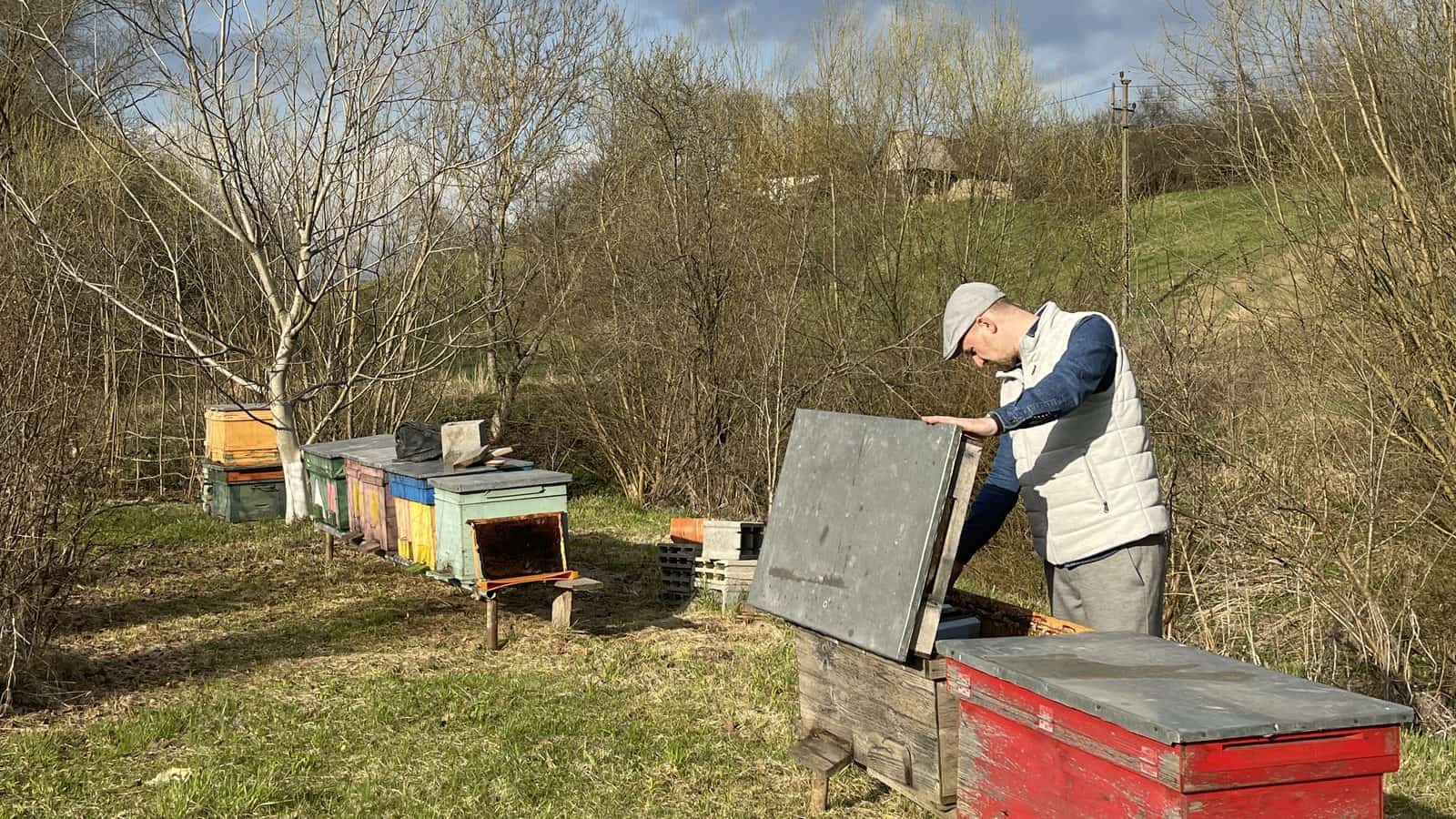
Not blended, not bulked, and not passed through an intermediary. One floral source, one harvest, from hives our family has kept for six generations. We can tell you who took the frames off, because he is Dragos's father.
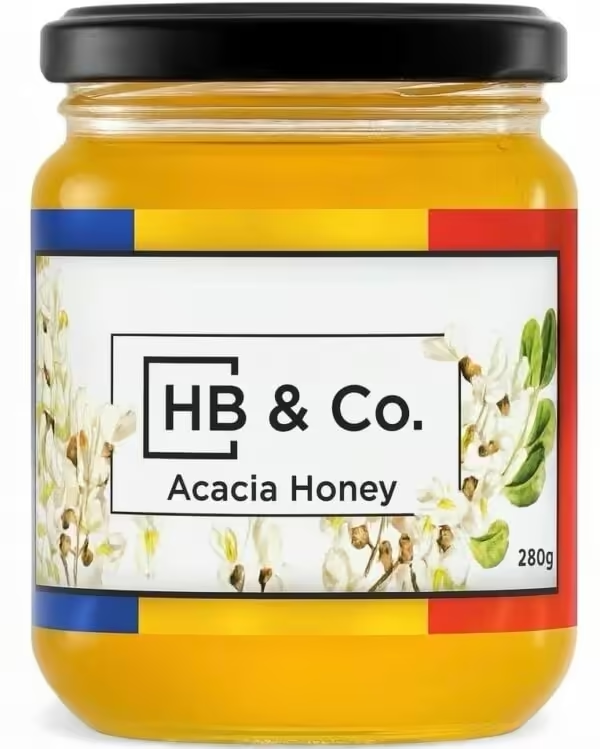
£10.99 for 280g, or £8.79 a month on subscription. 4.9 from 55 Google reviews. Free UK delivery on orders of three jars or more. Our British honey supplier holds SALSA Certification.
What actually reduces your risk
None of these is a test. They are all ways of shortening the distance between you and the hive, which is the only defence available to a person standing in a shop.
| Signal | What it tells you |
|---|---|
| A named producer or apiary | Someone has attached their name to it. Anonymous packing is not evidence of fraud, but it removes accountability. |
| A single stated country, not a blend description | Fewer supply chain steps, fewer opportunities for origin to be obscured. |
| A stated floral source that matches the honey | Single floral honeys are harder to fake convincingly and are usually sold by people who care which flowers the bees were on. |
| Buying direct, or from a small seller | Shorter chain. You can ask questions and get an answer from someone who knows. |
| A price that makes sense | Honey is expensive to produce. A jar priced far below everything around it is worth a second thought, though a high price guarantees nothing. |
There is one honey that is close to unfakeable, and it is worth knowing about for that reason alone. Honey still sealed in its own wax comb cannot be blended, extended or reconstituted without destroying the comb, so the structure itself is the evidence. We have written about it in our guide to comb honey. It is not something we sell, and it is not practical for everyday use, but as a demonstration of what traceability looks like in physical form it has no equal.
If you want to go further into what separates raw honey from the heat treated supermarket kind, that is set out in raw honey versus regular honey, and the differences between floral varieties are covered in our guide to types of raw honey.
Questions people actually ask
How can I test honey for purity at home?
You cannot, and we would rather say so plainly. The water test, thumb test and flame test all measure viscosity and moisture, which vary naturally between genuine honeys and tell you nothing about added sugar syrup. Adulterated blends in the cases European investigators pursued had been engineered in laboratories to pass professional isotope testing, so a kitchen experiment stands no chance.
Is 46% of honey really fake?
The figure comes from the European Commission's "From the Hives" action, in which 147 of 320 consignments sampled at EU borders were suspected of non-compliance with the Honey Directive. Two qualifications matter. Suspected non-compliance is not proven adulteration, and of the operators pursued, 44 were investigated and seven sanctioned. The Commission also notes that improved detection methods were used compared with the earlier exercise that found 14%, which may account for part of the difference.
Does crystallised honey mean it is real?
No, and neither does runny honey mean it is fake. Crystallisation depends on the ratio of glucose to fructose in that particular floral source. Acacia is high in fructose and slow to crystallise. Rapeseed is high in glucose and sets quickly. Both are genuine honeys behaving normally.
What sugar syrups are used to adulterate honey?
According to the European Commission, syrups made from rice, wheat and sugar beet. Maize syrups, once common, are now rarely used. The reason is technical rather than commercial: maize and cane are C4 plants and show up in carbon isotope testing, whereas rice, wheat and beet are C3 plants, like most of the flowers bees forage, and share the honey's own isotope signature.
Does a "lab tested" label mean honey is authentic?
It depends entirely on which test. Carbon isotope analysis alone will not detect rice, wheat or beet syrup. A certificate showing a clean isotope result therefore proves less than it appears to. If authenticity matters to you, the useful question is which method was used, not whether testing happened.
Is imported honey more likely to be adulterated than British honey?
That is not what the evidence shows, and we sell an imported honey ourselves, so we have no interest in pretending otherwise. Honey imported into the EU from the UK carried a 100% suspicion rate in the Commission's sampling, which it attributes to honey produced elsewhere being blended in the UK before re-export. The risk factor identified was blending and lost traceability, not country of origin.
Sources
- European Commission, DG SANTE, EU coordinated action "From the Hives", samples November 2021 to February 2022, results published March 2023.
- European Commission Joint Research Centre, food fraud analysis of honey consignments, Geel.
- Council Directive 2001/110/EC relating to honey. In Great Britain, the Honey (England) Regulations 2015 and equivalent legislation in Scotland, Wales and Northern Ireland.
- Interlaboratory comparison of LC-IRMS for determination of carbon isotope ratios of saccharides in honey, detection thresholds for C3 and C4 sugars.
- npj Science of Food, honey authenticity and the opacity of analytical reports, 2022.
- Global Honey Organization, published criticism of the "From the Hives" methodology.