

 English (UK)
  Italiano
  Français
  简体中文
简体中文  한국어
한국어 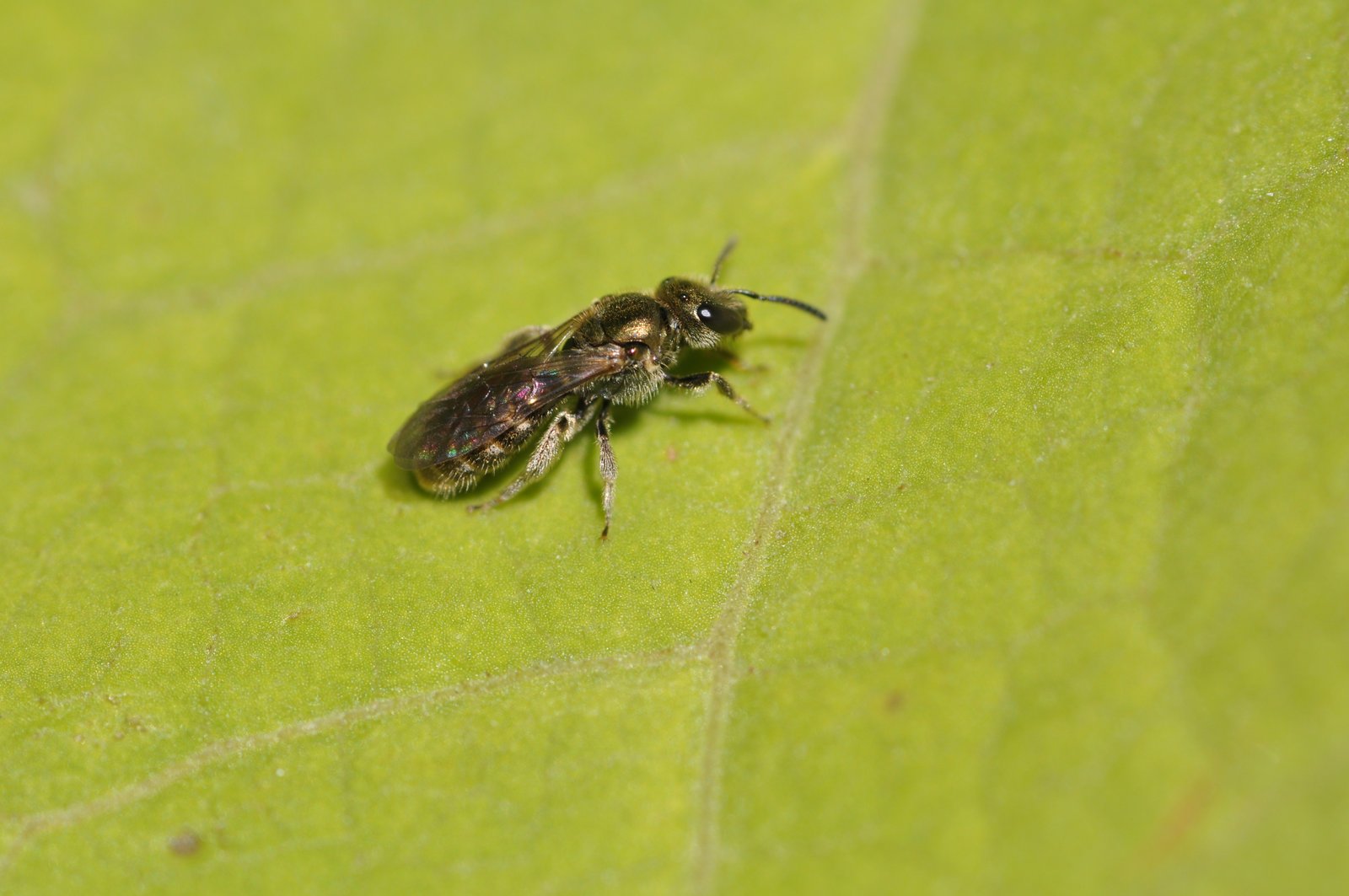
Smeathman's furrow bee, Lasioglossum smeathmanellum, showing the metallic blue-green sheen that gives it the name shiny-faced furrow bee. Photograph by Aiwok, CC BY-SA 3.0, via Wikimedia Commons.
UK Bee Species
Smeathman's Furrow Bee Lasioglossum smeathmanellum
Kirby, 1802 · subgenus Dialictus · subfamily Halictinae · family Halictidae
Also known as the shiny-faced furrow bee, for the bright metallic sheen on its head and body.
A glint of blue-green on an old wall, no bigger than a housefly. One of Britain's tiniest bees, and one of its quiet success stories.
The metallic sheen that earns the shiny-faced furrow bee its name belongs to Smeathman's furrow bee. While many bees are in retreat, this one is thriving, colonising the mortar of old walls, soft-rock cliffs and brownfield across southern Britain.[4]
Four metallic furrow bees, one hand lens
Britain has four small furrow bees with a metallic green sheen, and they are notoriously hard to separate in the field.[2] A tiny bright-green bee on a garden flower could be any of them, and telling them apart for certain means a lens and a close look at the sculpture of the thorax. Smeathman's is one of the more distinctive: its sheen leans blue-green across both thorax and abdomen, and it carries conspicuous pale felt-like patches on the second and third abdominal segments.[1]
| Small metallic furrow bee | What sets it apart | Where you meet it |
|---|---|---|
| Smeathman's furrow bee L. smeathmanellum | Blue-green sheen over thorax and abdomen; dense, uneven punctures on a shiny thorax; a dull, roughened propodeum throughout; clear pale hair patches on segments 2 and 3. | Old walls, soft-rock coastal cliffs, brownfield. |
| Green furrow bee L. morio | Our commonest metallic furrow bee; upper thorax dull and densely pitted, roughened between the punctures. | Gardens, parks, waste ground, almost everywhere. |
| Turquoise furrow bee L. cupromicans | Smoother, shinier hind margins on the propodeum; a longer face; males have an all-black clypeus. | More local, often on heath and moor edges. |
| White-footed furrow bee L. leucopus | Pale feet as the name suggests; separated on fine thoracic detail under a lens. | Dry, open, sandy and sunny places. |
One extra clue helps with males: in Smeathman's the tip of the face (the clypeus) is yellow at the front, where the very similar turquoise furrow bee has an all-black one.[1]
A jewel that nests in old walls
Most of Britain's small bees dig into bare earth. Smeathman's furrow bee is one of the few that will just as happily move into masonry. Inland it is frequently found nesting in the soft, crumbling mortar of old walls, tunnelling into the lime between the stones; along the coast it is often abundant in soft-rock cliffs, where the same soft, workable substrate suits it perfectly.[1] Add in brownfield and other warm, sparsely vegetated ground and you have a bee that is unusually at home around people, which is a large part of why it is doing so well.[4]
How to help a wall-nesting bee
If you have an old wall with soft lime mortar, leaving it unpointed and unsealed gives Smeathman's furrow bee somewhere to nest. Pair that with a long succession of open, low-growing flowers from spring to autumn and a patch of warm bare ground, and you support not just this bee but the many small solitary species that share the same needs. Modern hard cement mortar, by contrast, gives them nothing.
When to look
Smeathman's furrow bee has a long flight season, which is one reason it is seen so often. Females are on the wing from late March right through to September; males appear later, from about July, and fly alongside the new females into early autumn. Only mated females survive the winter, hibernating to found the next year's nests.[1]
Flight period after BWARS: females late March to September, males July to September.[1]
Communal, but not a colony
It is easy to assume that a bee nesting in dense groups must be social, with a queen and workers. Smeathman's furrow bee shows how misleading that can be. Many females often nest close together in the same stretch of wall or cliff, sharing the neighbourhood but not the labour: each provisions her own cells.[1] Unlike its close cousin the green furrow bee, which runs small annual colonies with a foundress and helper daughters, Smeathman's is not known to be eusocial. It is communal, a looser arrangement where the safety of numbers comes without a caste system.[1]
Like other furrow bees, its nests can attract cuckoos: cleptoparasitic Sphecodes blood bees, small red-and-black bees that slip into a host's burrow and lay their own eggs in the provisioned cells.[3]
Where it lives in Britain
Smeathman's furrow bee may be encountered almost anywhere in southern England and Wales, and it is often abundant on the soft-rock cliffs of the south and west coasts.[1] It thins out northwards, becoming scarcer in northern England and rarer still in Scotland and Ireland. It is a generalist forager, visiting a wide range of low-growing flowers that larger, longer-tongued bees often overlook, and it is not considered scarce or threatened.[1][6] For where it sits among Britain's other bees, see the UK Native Bee Species Map, or place it among the world's bees in the World Bee Atlas.
Quick facts
| Kingdom | Animalia |
|---|---|
| Phylum | Arthropoda |
| Class | Insecta |
| Order | Hymenoptera |
| Family | Halictidae |
| Subfamily | Halictinae |
| Genus | Lasioglossum |
| Subgenus | Dialictus |
| Species | Lasioglossum smeathmanellum |
The name: a hairy tongue and a Georgian naturalist
The genus name Lasioglossum comes from the Greek for "hairy tongue", and "furrow bee" is the British name for the group, after the fine hairless groove, the rima, that runs down the tip of a female's last abdominal segment.[5] The species was described by the Reverend William Kirby in 1802, one of the founders of British entomology, and its name honours Henry Smeathman, an eighteenth-century naturalist. Around the world the family is known instead as the sweat bees, because some of its members are drawn to the salt in perspiration and will land on skin to lap at it, entirely harmlessly.[3]
A garden full of small bees, and a jar of honey
Tiny generalists like Smeathman's furrow bee keep gardens and hedgerows pollinated. Honeybees turn the same wild and garden flowers into raw honey.
Raw British Wildflower Honey
Set by the same meadow and hedgerow flowers a furrow bee works from spring to autumn. Raw, unfiltered and full of character. Our British honey supplier holds SALSA Certification. 280g, £10.99.
Shop Wildflower Honey
Raw Acacia Honey
Our flagship raw Acacia: pale, delicate and slow to crystallise. Drawn from the Nistor family's Transylvanian apiaries. 280g, £10.99.
Shop AcaciaSubscribe and save 20%
Choose any single honey and save 20% on every delivery, with free UK delivery on every subscription order.
Start a SubscriptionFrequently asked questions
Is the shiny-faced furrow bee the same as Smeathman's furrow bee?
Yes. Lasioglossum smeathmanellum is usually called Smeathman's furrow bee in field guides, and shiny-faced furrow bee is an alternative name that refers to the bright metallic sheen on its head and body. Both names mean the same species.
Why is it called a furrow bee and a sweat bee?
Furrow bee is the British name for the family Halictidae, after a fine hairless groove down the centre of the female's last abdominal segment. Sweat bee is the worldwide name, because some members of the family are drawn to the salt in perspiration and will land on skin to taste it, doing no harm.
How do I tell it from other small green bees?
Britain has four small metallic furrow bees and they are hard to separate in the field. Smeathman's tends to show a blue-green sheen over both thorax and abdomen, with clear pale hair patches on the second and third abdominal segments. A certain identification needs a hand lens and a look at the sculpture of the thorax.
Where does Smeathman's furrow bee nest?
Unusually for a small bee, it often nests in masonry: the soft, crumbling mortar of old walls inland, and soft-rock cliffs on the coast. It also uses warm brownfield and other sparsely vegetated ground.
When is it active?
It has a long season. Females fly from late March to September, and males appear from about July and fly into the autumn alongside the new females.
Does it sting?
Barely. It is a tiny bee with a weak sting and no aggression. Even if one lands on your skin to taste sweat it is harmless and far more likely to fly off than to sting.
Is it rare?
No. It is common and often abundant across southern England and Wales, especially on coastal soft-rock cliffs, and it is thriving rather than declining. It becomes scarcer in northern England and rarer in Scotland and Ireland.
Does Smeathman's furrow bee make honey?
No. Its small nests store only enough pollen and nectar for their own larvae, never a surplus. Only the honeybee makes honey in any quantity. You can compare the bee families in the World Bee Atlas.
Related species
Sources and references
- BWARS (Bees, Wasps & Ants Recording Society). Species account: Lasioglossum smeathmanellum (Kirby, 1802): blue-green sheen, thoracic sculpture, nesting in old walls and soft-rock cliffs, communal but not eusocial, flight period, and British distribution. bwars.com.
- Falk, S. Field Guide to the Bees of Great Britain and Ireland, Bloomsbury, and the Steven Falk Flickr collection: the four small metallic Lasioglossum of Britain and their separation.
- Else, G.R. & Edwards, M. (2018). Handbook of the Bees of the British Isles. Ray Society: the Halictidae, the sweat-bee habit, the furrow on the female's last tergite, and Sphecodes cleptoparasites.
- bioGraphic (California Academy of Sciences), "Beauty and the Bee": L. smeathmanellum as a thriving, jewel-like British sweat bee about the size of a small housefly. biographic.com.
- Etymology: Greek Lasioglossum, "hairy tongue"; the British "furrow bee" refers to the rima, a groove on the female's apical tergite (NBN Atlas; BWARS).
- Nieto, A. et al. (2014). European Red List of Bees. IUCN / Publications Office of the European Union: conservation status context for British and European Halictidae.
- Kirby, W. (1802). Monographia Apum Angliae: original description of the species and its placement.

HoneyBee & Co. draws on six generations of family beekeeping heritage, with honey from the Nistor family apiaries and from carefully chosen British producers. Our British honey supplier holds SALSA Certification, and we offer a 15% NHS Discount. Every jar is raw, unfiltered and traceable to the hive.