

 简体中文
 English (UK)
 Italiano
 Français
 한국어

Sweetener comparison
Honey vs Maple Syrup: A Flower, a Tree, and Why They Behave So Differently
Maple syrup is tree sap boiled down by people, roughly 40 litres of sap for every litre of syrup, and it is mostly sucrose. Honey is flower nectar concentrated by bees, and it is mostly fructose and glucose. Those two facts explain why maple syrup must go in the fridge once opened and honey need not, why honey crystallises and maple syrup rarely does, and why they taste so different on the same pancake. Nutritionally, the NHS treats both the same way: as free sugars.
Two seasons, two sources
Maple syrup is a late-winter product. Ohio State University Extension explains that the season begins “when the temperature rises above freezing during the day and drops below freezing at night”, with most production in February and March (Les Ober, OSU Extension). Those freeze and thaw swings push sap up the trunk, producers tap the tree, and the clear, watery sap is collected and boiled.
Honey is a summer product, and in Britain a late-summer one for some honeys. Bees forage nectar from whatever is flowering, bring it home, add enzymes that split its sucrose, and fan it until it is thick enough to keep. Our heather honey, for example, comes from moorland that flowers in August. The flower, not the bee, sets the flavour, which is why our guide to how nectar becomes distinctive honey matters more to taste than any other factor.
That first number comes from a rule maple producers have used since the 1940s. Researchers at the University of Vermont’s Proctor Maple Research Center revisited it in 2013:
“If one divides 86 by the sugar content of sap, you can estimate the amount of sap required to produce a gallon of syrup.” Timothy Perkins and Mark Isselhardt, “The Jones Rule of 86 Revisited”, Maple Syrup Digest, October 2013
At 2 percent sugar, that works out at about 43 parts sap to one part syrup. Sap from a biology department’s sugar bush study typically runs at 2 to 3 percent sucrose (Saupe, College of St Benedict and St John’s University). In other words, most of what goes into a maple syrup pan leaves as steam. Bees do something similar with fans rather than fire.
Grades and colours: maple has a legal scale, honey has a spectrum
Canada, the largest producer, grades retail maple syrup into four colour classes under the Canadian Grade Compendium, Volume 7, by how much light passes through the syrup. Early-season sap tends to give the paler grades, later runs the darker ones. Honey has no equivalent retail scale in the UK; its colour simply follows the flowers.
Maple: Canada Grade A
75% light transmission or more
50 to under 75%
25 to under 50%
under 25%
Honey: by flower
near water-white, delicate
pale gold, fresh and herbal
golden to amber, rounded
dark amber, bold, faintly bitter
Colour chips are illustrative. Maple descriptors are the official Canadian class names.
The useful overlap: if you like Dark, Robust maple, you will probably like a dark, strong honey. If you buy Golden, Delicate maple, try a pale one. Our 金合欢蜂蜜与石南花蜂蜜 comparison shows how far apart two honeys can be.
The sugar inside: sucrose versus fructose and glucose
枫糖浆
Sap sugar is sucrose, the same molecule as table sugar. Boiling concentrates it to 66 to 68.9 percent soluble solids for Canadian grades. Push it past that and sucrose crystals can form in the bottle.
蜂蜜
Bee enzymes convert most of the nectar’s sucrose. The Codex Standard for Honey requires at least 60g of fructose and glucose per 100g and, for most honeys, no more than 5g of sucrose (Codex CXS 12-1981).
That chemistry shows up in the kitchen. Glucose is what makes honey crystallise: the higher a honey’s glucose, the faster it sets. Fructose browns at lower temperatures than sucrose, so honey colours a cake or glaze faster than maple syrup does, which is why bakers lower the oven a little when using honey. Our 最适合烘焙的蜂蜜 guide covers the method.
Fridge or cupboard: the most practical difference
OSU Extension advises following the “Refrigerate after opening” instruction, warning that unrefrigerated syrup can grow mould on the surface. At 66 to 68.9 percent solids, maple syrup is roughly a third water, more than honey, and enough for surface moulds once the bottle is open.
This is the difference we would put first if a friend asked. Maple syrup is a perishable once opened; honey is a store-cupboard staple. If your cupboard holds only one, and you do not want to think about the fridge, that settles it.
At the table: where each one shines
Pancakes and waffles
Maple’s natural home, and fair enough: it is thinner, so it soaks in. Honey sits on top and stays distinct. Warm a spoon of honey slightly for a thinner pour. For babies under one, leave honey off their pancakes altogether.
Porridge, yoghurt and granola
A genuine tie, decided by flavour: honey adds floral or malty notes; maple adds woody caramel. A dark honey in porridge is our everyday habit. More ideas in our smoothies, yoghurt and pancakes guide.
Roast vegetables, salmon, ham
Both glaze well. Honey sets stickier and browns faster; add it in the last 10 minutes.
Tea and dressings
Honey, because it emulsifies and its flavour can be chosen to suit. Maple in tea is an acquired taste.
Buying a good bottle, or a good jar
With maple, the label does most of the work. Look for 100 percent maple syrup and a colour class name. The class tells you the flavour before you open it: Golden for drizzling over fruit, Amber for pancakes, Dark or Very Dark for baking and glazes, where a stronger flavour survives the oven.
With honey, the label tells you less, so the questions are different. Where was it produced, and is it from one region and flower source or a blend of several countries? UK honey labels must state the country or countries of origin under the 《2015年蜂蜜(英格兰)条例》, and a jar that says only “blend of EU and non-EU honeys” is telling you very little. Our guide to spotting fake honey sets out what testing can and cannot catch. Our own view is simple: buy honey the way you would buy maple syrup, by origin and by colour, and you will rarely be disappointed.
Three claims, checked
- “Maple syrup is healthier than honey.”The NHS lists sugars in “honey, syrups (such as maple, agave and golden)” as free sugars, and adults should have no more than 30g a day (NHS). Choose on taste. Our 蜂蜜与糖的对比报告 和 蜂蜜与龙舌兰糖浆 cover the glycemic-index argument, so we will not repeat it here.
- “Honey and maple syrup are interchangeable.”By volume, close: swap 1 to 1 in most recipes. But honey is thicker and sweeter-tasting, and browns faster, so cakes may need slightly less and a lower oven.
- “Pancake syrup is maple syrup.”Not necessarily. The Canadian grades describe syrup made from maple sap. Flavoured table syrups are a different product: read the ingredients. The same goes for honey blends; the wider picture is in our syrups and sweeteners guide.
If you like Dark, Robust maple, try heather honey
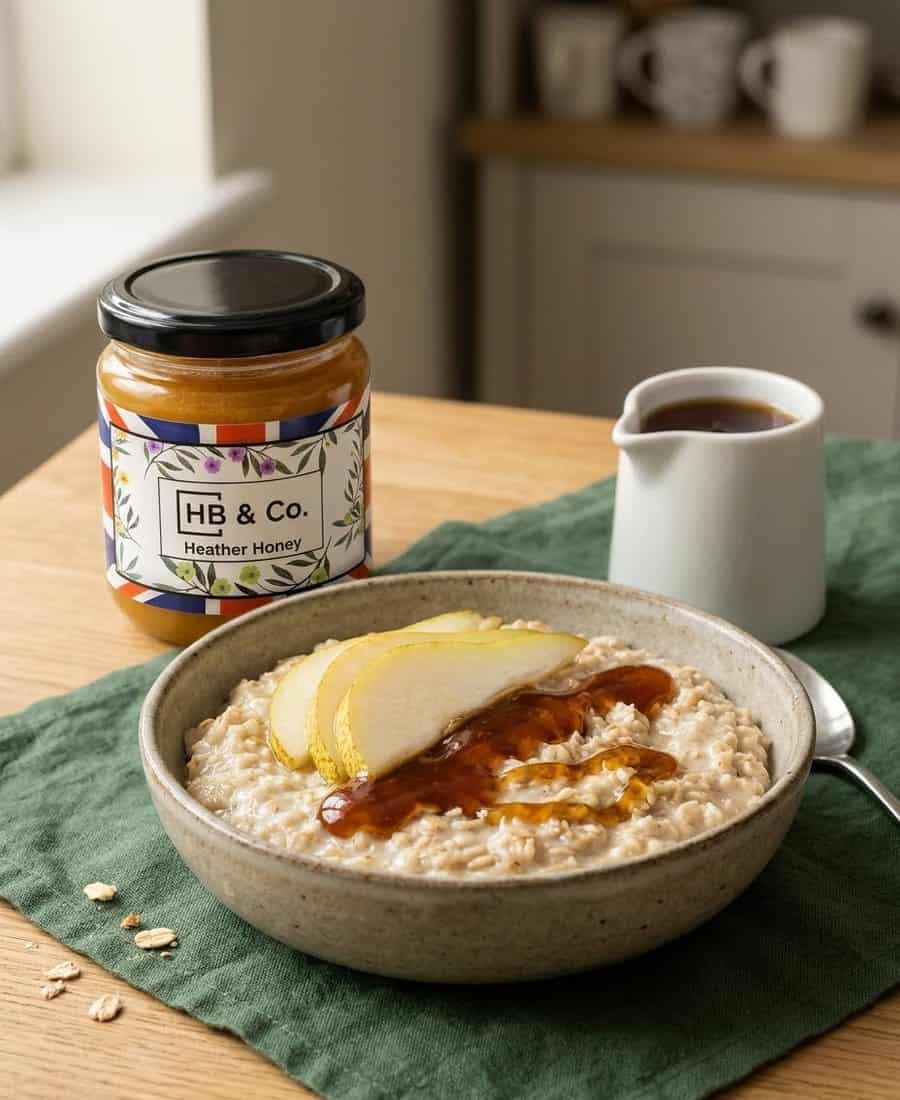
英国石楠蜂蜜 is the closest thing in our range to a dark maple: deep amber, bold, faintly bitter, with a long finish. Ling heather honey has an unusual jelly-like texture that loosens when stirred, so it sits on porridge or pancakes rather than running off. It is a British moorland honey from a single late-summer bloom, and our British honey supplier holds SALSA Certification.
Every jar is 280g, with free UK delivery on 3 or more jars on any order type. To compare it with our other British honey, read wildflower vs heather.
Honey vs maple syrup: questions
Can I substitute honey for maple syrup?
Yes, 1 to 1 by volume in most recipes. Expect a sweeter taste, a thicker texture and faster browning; lower the oven by about 15°C for cakes.
Is maple syrup vegan and honey not?
Pure maple syrup is a plant product and is generally considered vegan. Honey is made by bees, so most vegans avoid it.
Why did my maple syrup grow mould and my honey did not?
Opened maple syrup needs the fridge. Honey’s lower water content means sealed honey does not support mould in the cupboard.
Why does honey go solid but maple syrup does not?
Honey is rich in glucose, which crystallises naturally. Maple syrup is mostly sucrose held below its crystallising point; over-concentrated syrup can form sucrose crystals.
Which tastes more like maple: a light or a dark honey?
A dark honey. Heather and other dark honeys share maple’s depth, though not its woody flavour.