

 简体中文
简体中文  English (UK)
  Italiano
  Français
  한국어
한국어 
Honey is often described as the only food that never expires. That claim is not quite true, but the reality is more interesting than the myth. Under the right conditions, honey can remain safe to eat for decades, possibly centuries, because its chemical composition actively prevents the microbial activity that spoils most foods. What can happen to honey over time is not spoilage in the way that milk or bread goes bad: it is a slow set of chemical changes, principally fermentation if moisture levels rise, and thermal degradation if storage temperatures are too high. Understanding the difference between "gone bad" and "changed naturally" is essential for anyone who keeps honey at home, and it starts with a single measurement: water activity. This article explains what determines honey's shelf life, what the warning signs of genuine deterioration look like, and how to store your honey so it lasts as long as the chemistry allows. For a broader overview of honey's properties, see our complete guide to honey.
Key Takeaways
- Properly stored honey does not expire in any meaningful sense. Its low water activity prevents the microbial growth that causes food spoilage.
- Honey can ferment, but only if its moisture content rises above approximately 20 percent, typically through improper harvesting or poor storage.
- Crystallisation is not spoilage. It is glucose separating from solution and is a sign of natural, unprocessed honey.
- Heat and time cause chemical changes, measured by HMF (hydroxymethylfurfural) levels, that reduce quality without making honey unsafe.
- The best storage conditions are simple: sealed, room temperature, away from sunlight.
Water Activity: The Reason Honey Does Not Spoil
The shelf stability of honey comes down to one property: water activity. Water activity is a measure of how much of the water in a food is available for chemical reactions and microbial growth. Pure water has a water activity of 1.0. Honey typically has a water activity between 0.50 and 0.65, depending on its moisture content and sugar concentration.[1] This is well below the threshold required for virtually all bacteria and most moulds to grow. Even osmophilic yeasts, the specialised organisms capable of surviving in high-sugar environments, cannot reproduce below a water activity of approximately 0.60 to 0.62.[2]
The reason is straightforward: the sugar molecules in honey bind the available water so tightly that microorganisms cannot access enough free water to sustain metabolism. It is the same principle that allows jam and dried fruit to resist spoilage, but honey takes it further because its sugar concentration is higher than almost any other natural food. This property is intrinsic to honey as it comes from the beehive to the jar and does not require refrigeration, preservatives or any processing to maintain.
Honey's water activity typically sits between 0.50 and 0.65. Below 0.60, even osmophilic yeasts cannot grow. This single property explains why properly stored honey does not spoil under normal conditions, without refrigeration, preservatives or special packaging.
When Honey Does Go Wrong: Fermentation
Honey can ferment. It is the one genuine form of spoilage that affects honey, and it happens when the balance between sugar concentration and moisture content tips in the wrong direction. Fermentation is caused by osmotolerant yeasts, primarily Saccharomyces species, that occur naturally in all honey. Under normal conditions these yeasts are dormant because the water activity is too low for them to metabolise. But if the moisture content of honey rises above approximately 20 percent, the water activity increases enough for the yeasts to activate, converting sugars into ethanol and carbon dioxide.[3]
What causes moisture to rise
The most common cause is premature harvesting: extracting honey from frames before the bees have fully capped them. Bees cap honeycomb cells when they have reduced the moisture content to below approximately 18 percent, which they achieve by fanning the cells with their wings. Uncapped honey may contain 20 percent moisture or more, enough to support fermentation. Other causes include storing honey in unsealed containers in humid environments, introducing moisture with wet spoons or utensils, and condensation forming on the surface of honey stored in fluctuating temperatures.
How to recognise fermented honey
Fermented honey shows three clear signs: foaming or bubbling on the surface, a sour or alcoholic smell quite different from honey's normal aroma, and visible gas formation in the jar. If your honey shows any of these, it has fermented and the quality has been compromised. Mildly fermented honey is not dangerous to eat but will taste sour and yeasty. Heavily fermented honey should be discarded.
Crystallisation is not fermentation
Crystallised honey looks cloudy, grainy or solid, but it does not foam, does not smell sour and does not produce gas. Crystallisation is glucose forming natural crystals, a completely different process from fermentation. It is a sign of natural, unprocessed honey and does not indicate spoilage or quality loss. For a full explanation, read The Science Behind the Solid State of Raw Honey.
Chemical Degradation: HMF and Enzyme Loss
Even when honey does not ferment, it changes over time. The principal marker of this change is hydroxymethylfurfural, commonly abbreviated to HMF. HMF forms when fructose degrades under the influence of heat and acidity, a reaction that occurs slowly at room temperature and rapidly at higher temperatures. Fresh honey contains very little HMF, typically below 15 mg per kilogram. The Codex Alimentarius Commission sets a maximum of 40 mg per kilogram for honey from temperate regions, and 80 mg per kilogram for honey from tropical regions, above which the honey is considered to have been overheated or stored for too long under poor conditions.[4]
A 2018 review published in Chemistry Central Journal documented HMF levels across honey samples from dozens of countries, finding that honey stored at room temperature for under a year typically remained well within the 40 mg/kg limit, while honey stored at elevated temperatures or for several years at ambient conditions showed significant HMF increases.[5] A 2024 study in ACS Omega confirmed that heating honey above 75 degrees Celsius dramatically accelerated both HMF formation and the breakdown of fructose and glucose.[6]
Enzyme decline
Honey contains several heat-sensitive enzymes, most notably diastase (amylase), which breaks down starch, and glucose oxidase, which produces hydrogen peroxide and contributes to honey's antimicrobial properties. Diastase activity declines naturally over time, especially at temperatures above 35 degrees Celsius. The Codex Alimentarius honey standard sets a minimum diastase number of 8 (Schade scale) for authentic honey, below which the honey is considered to have been excessively heated or stored for too long.[4]
None of this makes old honey unsafe. HMF at the levels found in aged honey is not considered harmful to humans. But it does mean that honey slowly loses the enzymatic and compositional qualities that distinguish raw, natural honey from a processed sweetener. Storing honey correctly slows these changes to a pace measured in years rather than months.
40 mg/kg: the international quality line
The Codex Alimentarius Commission and the European Commission Honey Directive 2001/110/EC both set 40 mg/kg as the maximum HMF level for honey from temperate climates.[7] Above this threshold, the honey is presumed to have been overheated during processing or stored for an extended period under poor conditions. Fresh honey typically contains less than 15 mg/kg.
The Egyptian Tomb Honey: What the Evidence Actually Shows
The frequently repeated claim that archaeologists found 3,000-year-old edible honey in Egyptian tombs is based on real findings, but the details are more nuanced than most accounts suggest. Eva Crane, the foremost historian of beekeeping, documented sealed vessels of honey-like substances found in Egyptian tombs that remained chemically recognisable after millennia, retaining their sugar composition and low moisture content.[8] Whether they were "edible" in a meaningful sense is a matter of interpretation: they had not spoiled, the sugars were intact, and no microbial contamination was present, but the enzymatic profile and flavour had long since degraded.
What the Egyptian finds actually demonstrate is the power of sealed, dry, cool, dark storage. The tombs provided exactly the conditions that maximise honey's natural stability: no oxygen exchange, no moisture ingress, no UV exposure and a constant temperature far below the 35 degree threshold at which HMF formation accelerates. Your kitchen cupboard does not need to match a pharaoh's tomb, but the principles are the same.
How to Store Honey for Maximum Shelf Life
The guidance is simple and applies to every variety, from Acacia to Heather to Wildflower:
Keep it sealed
The single most important thing you can do. A sealed jar prevents moisture absorption from the environment, which is the only realistic route to fermentation in properly harvested honey. If you transfer honey to a different container, make sure it is dry and has an airtight lid.
Store at room temperature
Between 20 and 25 degrees Celsius is ideal. Avoid the fridge: refrigeration does not improve shelf life (the water activity is already too low for spoilage) and it accelerates crystallisation by placing honey in the 10 to 15 degree zone where glucose crystals form most rapidly. Avoid the freezer: as we explain in Does Honey Freeze?, freezing is unnecessary and simply makes the honey too thick to use.
Keep away from sunlight and heat
UV light and temperatures above 35 degrees Celsius accelerate HMF formation and enzyme degradation. A kitchen cupboard away from the cooker or oven is the ideal location. Do not store honey on a windowsill, above a radiator or next to a hob.
Use dry utensils
Introducing water into the jar raises the moisture content locally and can create conditions for yeast growth. Always use a dry spoon. If you notice condensation on the inside of the lid, wipe it off before resealing.
How Different Varieties Age
Not all honeys age at the same rate. The fructose-to-glucose ratio, initial moisture content and the presence of naturally occurring acids all influence how a specific variety responds to time and temperature.
Acacia Honey is among the most stable varieties in long-term storage. Its high fructose content resists crystallisation, and its low glucose fraction reduces HMF formation compared with glucose-heavy varieties. It remains pourable and pale for longer than most other honeys. Soft Set Honey is already crystallised under controlled conditions, meaning it has reached a stable physical state and will not change further in texture under normal storage. Heather Honey is thixotropic by nature, meaning its gel-like texture is a permanent physical property rather than a sign of age or deterioration. For a full comparison of how each variety differs, see our guide to types of raw honey.
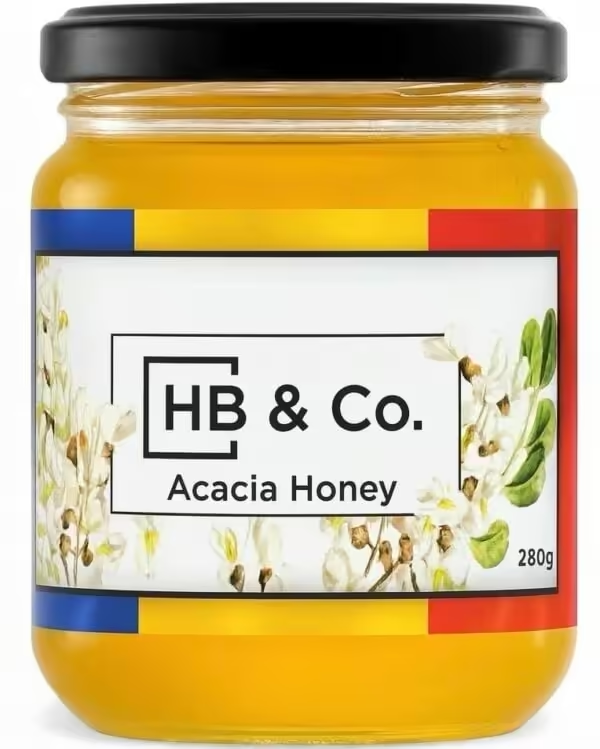
High fructose content means it stays liquid longer, crystallises slowest and maintains its pale colour and mild flavour over extended storage. Raw, cold-extracted from the Nistor family apiaries. 280g.
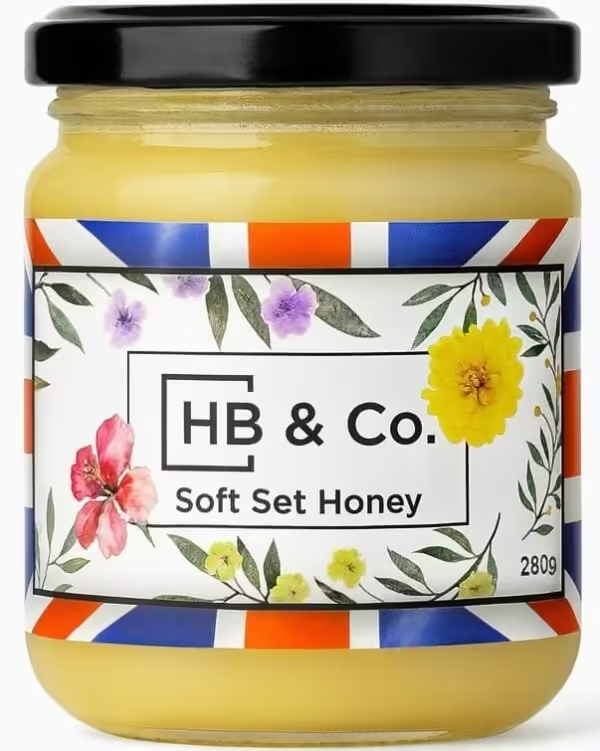
Pre-crystallised under controlled conditions. Smooth, spreadable and texturally stable for months. No further changes to expect. 280g.
Shop Soft Set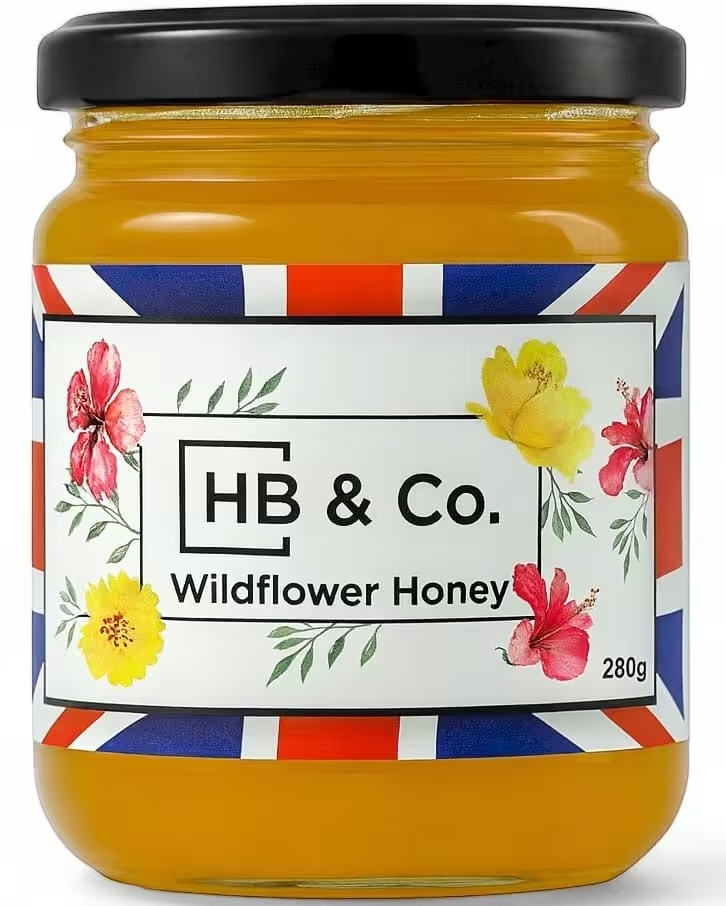
Fresh honey every month. Never a jar sitting in the cupboard too long. From £8.79/month.
Start SubscriptionFrequently Asked Questions
Does honey have an expiry date?
UK food labelling regulations require a "best before" date on honey jars, but this reflects quality rather than safety. Honey does not expire in the way that perishable foods do. Properly stored, sealed honey at room temperature remains safe to eat indefinitely. The "best before" date indicates when the producer expects the flavour, colour and enzymatic profile to be at their peak, typically 2 to 3 years from packing.
Can honey go bad?
Honey can ferment if its moisture content rises above approximately 20 percent, through premature harvesting, poor storage or contamination with water. Signs of fermentation are foaming, sour smell and visible gas bubbles. Under proper storage conditions with the jar sealed and at room temperature, honey does not go bad.
How long does honey last once opened?
If you reseal the jar after each use and keep it at room temperature, opened honey lasts as long as unopened honey. The risk increases only if moisture is introduced (wet spoons, steam from cooking) or if the jar is left unsealed in a humid environment. Use a dry spoon and close the lid promptly.
Is crystallised honey still safe to eat?
Yes. Crystallisation is glucose forming natural crystals and is a completely normal process in raw honey. It does not affect safety or nutritional value. To return crystallised honey to a liquid state, place the jar in warm water (below 40 degrees Celsius) and stir gently. Read more in The Science Behind Solid Honey.
What is HMF and why does it matter?
Hydroxymethylfurfural (HMF) is a chemical compound that forms when sugars degrade under heat and acidity. Fresh honey contains very little. International standards set a maximum of 40 mg/kg for temperate-climate honey. Higher levels indicate the honey has been overheated during processing or stored at elevated temperatures for too long. HMF does not make honey unsafe, but it signals quality reduction.
Should I refrigerate honey?
No. Refrigeration places honey in the 10 to 15 degree Celsius zone where crystallisation is fastest, and provides no preservation benefit because honey's water activity is already too low for microbial growth. Room temperature (20 to 25 degrees Celsius), sealed and away from sunlight is ideal. See also: Does Honey Freeze?
Is the honey found in Egyptian tombs really edible?
Sealed vessels of honey found in Egyptian tombs remained chemically stable after millennia: the sugars were intact, the moisture was low, and no microbial activity had occurred. Whether they tasted good is another question, as the enzymes and flavour compounds would have degraded over that timescale. The finding demonstrates honey's exceptional stability under sealed, cool, dry conditions, not that honey is immune to all change.
Which honey variety lasts the longest?
All varieties last indefinitely under proper storage. In terms of maintaining original appearance and texture, Acacia Honey is the most stable because its high fructose-to-glucose ratio resists crystallisation and its low acid content slows HMF formation. Soft Set Honey is also very stable because it has already reached its crystallised state and will not change further.
Sources and References
- Sogin, J. H. & Worobo, R. W. (2022). Microbiome analysis of raw honey reveals important factors influencing the bacterial and fungal communities. Frontiers in Microbiology 13:1099522. Water activity 0.50-0.65. doi.org
- Chirife, J. et al. (2006). The correlation between water activity and percentage moisture in honey. Journal of Food Engineering 72(3):287-292. Osmophilic yeast threshold 0.60-0.62. doi.org
- Snowdon, J. A. & Cliver, D. O. (1996). Microorganisms in honey. International Journal of Food Microbiology 31(1-3):1-26. Osmotolerant yeasts, fermentation conditions, Saccharomyces dominance. doi.org
- Codex Alimentarius Commission. Revised Codex Standard for Honey (CXS 12-1981, revised 2019). HMF maximum 40 mg/kg, diastase minimum 8 Schade. fao.org
- Shapla, U. M. et al. (2018). 5-Hydroxymethylfurfural (HMF) levels in honey and other food products: effects on bees and human health. Chemistry Central Journal 12:35. Global HMF data. pmc.ncbi.nlm.nih.gov
- ACS Omega (2024). Effect of Temperature and Time on the Physicochemical and Sensory Properties of Crystallized Honey. HMF acceleration above 75 degrees Celsius. pubs.acs.org
- European Commission. Council Directive 2001/110/EC relating to honey. HMF limits, crystallisation recognised as natural. eur-lex.europa.eu
- Crane, E. (1999). The World History of Beekeeping and Honey Hunting. Routledge. Egyptian tomb honey, archaeological stability evidence.