

 简体中文
简体中文  English (UK)
  Italiano
  Français
  한국어
한국어 Honey can freeze. But not in your kitchen freezer, not in the coldest winter in Britain, and not under any conditions you are likely to encounter at home. The freezing point of honey sits somewhere around minus 40 degrees Celsius, a temperature so far below what domestic freezers reach that the question itself reveals something important about how poorly understood honey's physical chemistry is. What most people observe when they put honey in the freezer or leave it in a cold garage is not freezing at all: it is thickening, and sometimes crystallisation, two completely different processes with completely different causes. Understanding the distinction matters if you want to store honey properly, and it begins with understanding what honey actually is: a supersaturated sugar solution with a water content so low that ice crystals cannot form under normal cold conditions.
Key Takeaways
- Honey does not freeze at 0 degrees Celsius. Its freezing point is approximately minus 40 degrees Celsius, far below any domestic freezer.
- What happens in a freezer at minus 18 degrees Celsius is thickening, not freezing. The honey becomes extremely viscous but does not form ice crystals.
- Crystallisation is not freezing. It is glucose separating from solution, and it happens most rapidly between 10 and 15 degrees Celsius.
- Freezing honey is unnecessary for preservation. Honey's low water activity already prevents microbial spoilage at room temperature.
- Acacia honey is particularly resistant to both crystallisation and cold-thickening due to its high fructose-to-glucose ratio.
What Honey Is Made Of: The Chemistry That Prevents Freezing
Honey is not a simple liquid. It is a supersaturated solution of sugars dissolved in a small amount of water. The Food and Agriculture Organization of the United Nations defines natural honey as containing approximately 38 percent fructose, 31 percent glucose, and 17 to 20 percent water, with the remainder composed of trace enzymes, amino acids, minerals and organic acids.[1] That means roughly 80 percent of honey by weight is dissolved sugar. For comparison, seawater contains about 3.5 percent dissolved salt, and even that modest concentration is enough to lower its freezing point to minus 1.8 degrees Celsius.
The principle at work is called freezing point depression: when a solute dissolves in a solvent, it disrupts the formation of the crystalline structure needed for the solvent to freeze, lowering the temperature at which freezing occurs. This is one of the four colligative properties described in physical chemistry and is the same reason road salt prevents ice from forming on winter roads.[2] In honey, the concentration of dissolved sugars is so extreme that the freezing point drops to approximately minus 40 degrees Celsius, with some variation depending on the specific honey's moisture content and floral source.
To learn more about how composition varies between honey types, see our guide to types of raw honey and the detailed breakdown in our complete guide to honey.
Thermal studies examining honey viscosity and phase behaviour confirm that honey's freezing point typically ranges between approximately minus 40 and minus 51 degrees Celsius depending on moisture content and floral source. A domestic freezer at minus 18 degrees Celsius is nowhere close to reaching this threshold.
What Actually Happens When You Put Honey in the Freezer
At minus 18 degrees Celsius, the temperature of a standard domestic freezer, honey does not freeze. What it does is become dramatically more viscous. Molecular mobility slows, the honey stiffens and resists pouring, and it may become difficult to extract from the jar with a spoon. But it remains amorphous: there are no ice crystals, no solid phase transition, and no structural change equivalent to water turning to ice.[3]
This behaviour is consistent with what food scientists call a glass transition rather than a freezing transition. As temperature drops, the honey approaches a glassy state, an amorphous solid with no crystalline structure, rather than forming the ordered ice lattice that water produces when it freezes. The result is a jar of honey that looks and feels harder but has not undergone any chemical change.
| Temperature | What happens to honey |
|---|---|
| 20 to 25 degrees Celsius | Optimal storage. Honey remains liquid and pourable. Minimal crystallisation risk. |
| 10 to 15 degrees Celsius | Crystallisation zone. Glucose begins separating from solution. Honey may turn cloudy or grainy. |
| 0 degrees Celsius | Honey thickens noticeably. No freezing occurs. Crystallisation slows compared with 10 to 15 degrees Celsius. |
| Minus 18 degrees Celsius (freezer) | Very thick and stiff. Difficult to scoop. No ice crystals form. Remains amorphous. |
| Minus 40 degrees Celsius and below | True freezing may begin. Only achievable in industrial or laboratory equipment. |
Crystallisation Is Not Freezing
The most common misunderstanding about honey and cold temperatures is the confusion between crystallisation and freezing. They are completely different processes with different causes, different temperature ranges and different outcomes.
How crystallisation works
Crystallisation occurs when glucose, the less soluble of the two main sugars in honey, separates from the liquid solution and forms solid crystals. This happens most rapidly between 10 and 15 degrees Celsius, which is why honey stored in a cool pantry or an unheated garage in autumn and winter is most likely to crystallise. Factors that accelerate crystallisation include a high glucose-to-fructose ratio, the presence of pollen particles or air bubbles that act as nucleation sites, and lower moisture content.[4] The European Commission Honey Directive 2001/110/EC recognises crystallisation as a natural characteristic of authentic honey.[5]
For a full explanation of why honey solidifies and what it means for quality, read The Science Behind the Solid State of Raw Honey and our guide to crystallised honey.
Why acacia honey resists crystallisation
Different honeys crystallise at different rates depending on their sugar composition. Acacia honey has one of the highest fructose-to-glucose ratios of any common honey variety, which is why it remains liquid and pourable for months after extraction. Because fructose is more soluble than glucose, high-fructose honeys are slower to reach the supersaturation threshold that triggers crystal formation. This is not a processing trick: it is a direct consequence of the nectar chemistry of the black locust tree (Robinia pseudoacacia). Our Acacia Honey is slow to crystallise for the same reason it is pale and mild: the floral source determines the character.[6]
By contrast, Soft Set honey is deliberately crystallised under controlled conditions to produce a smooth, spreadable texture. Crystallisation in this case is not a defect but a desired outcome, producing a honey that holds its shape on toast. Understanding the difference between unwanted granulation and intentional set is part of understanding what raw, natural honey actually is.
Water activity: why honey does not spoil
Honey typically has a water activity between 0.50 and 0.65, well below the 0.60 to 0.62 threshold required for osmophilic yeasts to grow.[7] This is the same property that makes freezing unnecessary for preservation: the water in honey is chemically bound to sugar and unavailable for microbial use or ice crystal formation.
Should You Store Honey in the Freezer?
No. There is no practical reason to freeze honey at home. Honey's low water activity already prevents microbial spoilage under normal storage conditions, and freezing adds nothing to its preservation while making it difficult to use. The best storage practice is simple: keep the jar sealed, store it at room temperature around 20 to 25 degrees Celsius, and keep it away from direct sunlight.[1]
Refrigeration is actively counterproductive because it places honey squarely in the 10 to 15 degree crystallisation zone, accelerating glucose crystal formation without offering any preservation benefit. If you have ever put a jar in the fridge and found it grainy a few weeks later, this is why.
If your honey has thickened or crystallised
Place the jar in a bowl of warm water, no hotter than 40 degrees Celsius. Stir gently. The crystals will dissolve back into solution within 15 to 30 minutes. Do not microwave honey: the uneven heating can create hot spots that exceed 40 degrees Celsius and begin degrading the enzymes and volatile compounds that distinguish raw honey from processed alternatives. Excessive heat also accelerates the formation of hydroxymethylfurfural (HMF), a chemical marker used by the Codex Alimentarius Commission to assess whether honey has been overheated during processing.[8]
For more on what happens to honey over time, including the role of HMF and enzyme degradation, read our articles on myths and misconceptions about raw honey and potential honey side effects.
How Different Honey Varieties Respond to Cold
Not all honeys behave identically in cold conditions. The fructose-to-glucose ratio, moisture content and the presence of natural nucleation particles (including pollen grains) all influence how a specific honey responds to low temperatures.
Acacia Honey is the most cold-resistant variety in our range. Its high fructose content means it remains pourable at lower temperatures than most other honeys and is the slowest to crystallise. Linden Honey and Wildflower Honey have a more balanced sugar ratio and will crystallise more readily in cool conditions, though this is entirely natural and does not affect quality. Heather Honey is thixotropic by nature: it is naturally thick and gel-like and responds to cold by becoming stiffer, but it does not crystallise in the same way as other varieties because its physical structure is different.
To explore the full range and find the variety that suits your storage conditions and taste, visit our complete health benefits guide or browse the honey subscription for monthly deliveries.
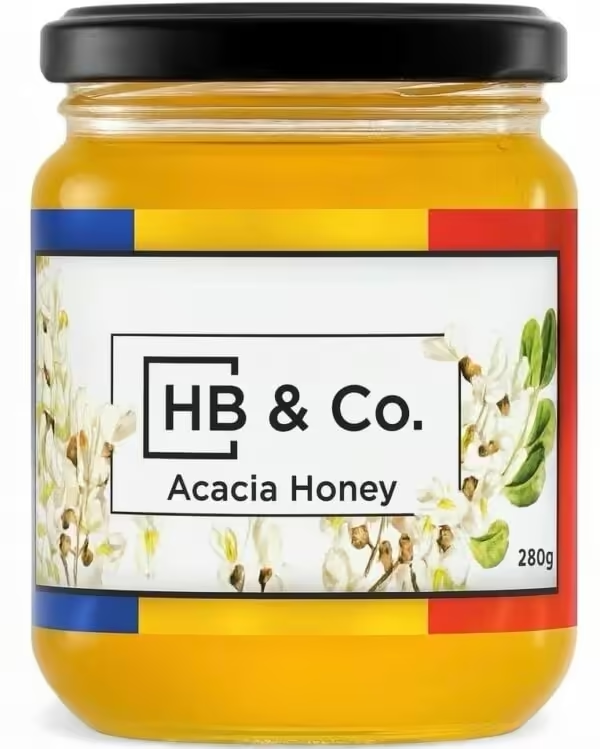
The honey least affected by cold temperatures. High fructose content means it stays pourable longer than any other variety. Pale, mild, raw and cold-extracted from the Nistor family apiaries. 280g.
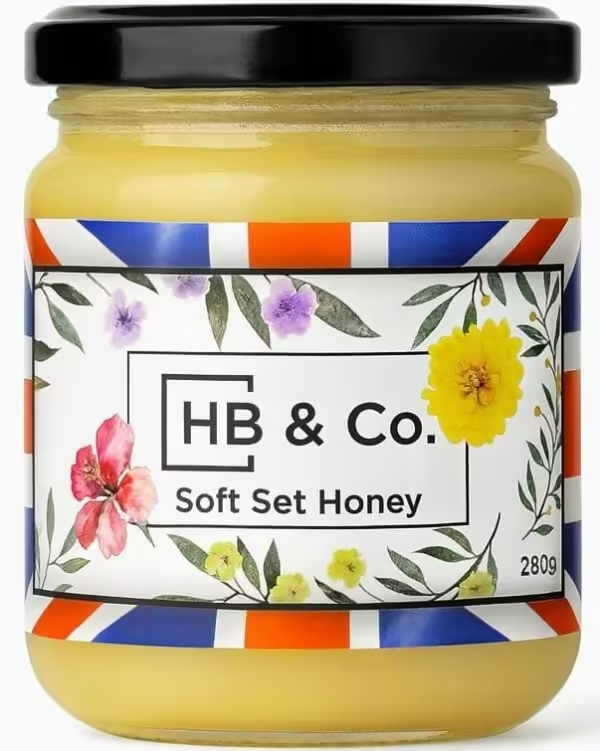
Crystallisation as a feature, not a flaw. Smooth, spreadable, holds its shape. The opposite of what you get from an accidental fridge. 280g.
Shop Soft Set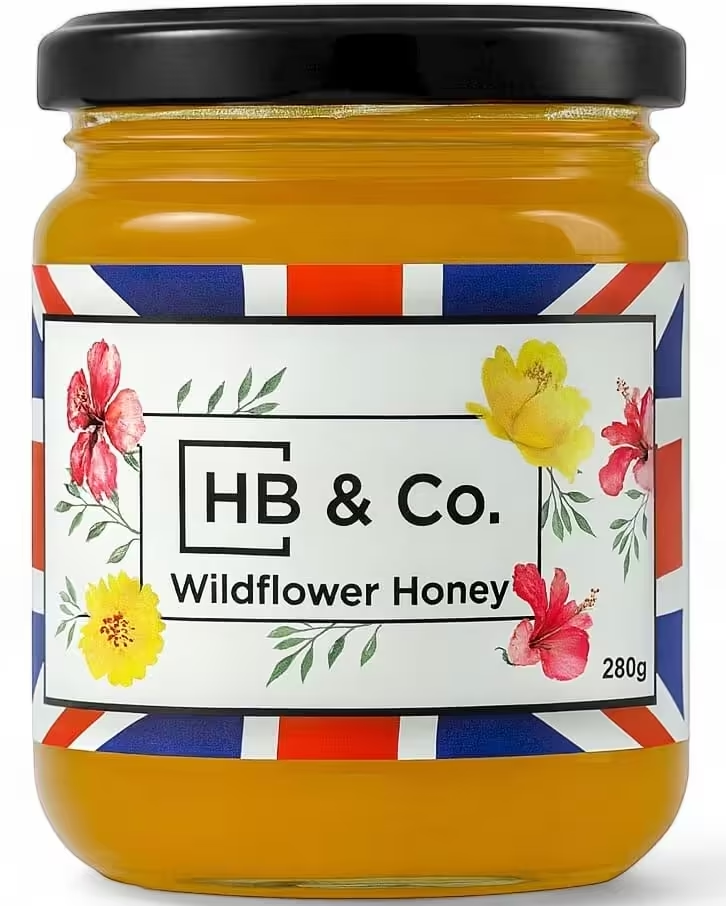
Raw single-origin honey every month. Acacia, Wildflower, Heather and more. From £8.79/month.
Start SubscriptionFrequently Asked Questions
Does honey freeze in a normal freezer?
No. A domestic freezer operates at approximately minus 18 degrees Celsius. Honey's freezing point is around minus 40 degrees Celsius. In a freezer, honey becomes very thick and stiff but does not form ice crystals or undergo a true phase transition to solid. It remains an amorphous, scoopable mass.
Why does honey not freeze like water?
Because honey is approximately 80 percent dissolved sugar by weight. The high concentration of fructose and glucose molecules disrupts ice crystal formation through a process called freezing point depression, lowering the temperature required for freezing far below what domestic equipment can achieve. Water freezes at 0 degrees Celsius; honey requires roughly minus 40 degrees Celsius.
Is crystallised honey the same as frozen honey?
No. They are completely different processes. Crystallisation is glucose separating from solution and forming solid sugar crystals, most rapidly between 10 and 15 degrees Celsius. Freezing is water forming ice crystals at much lower temperatures. Crystallised honey has changed texture; frozen honey (if you could achieve it) would have changed state. Read more about why honey crystallises.
Does freezing damage honey?
Cold temperatures at domestic freezer levels do not destroy honey's sugars, enzymes or nutritional properties. However, repeated warming and cooling cycles can encourage crystallisation and may introduce condensation moisture, which could increase fermentation risk if the jar seal is not airtight. There is no benefit to freezing honey that justifies the inconvenience.
What is the best way to store honey?
Sealed, at room temperature (20 to 25 degrees Celsius), away from direct sunlight. Do not refrigerate. Honey's low water activity prevents microbial spoilage without cold storage. This applies to all varieties including Acacia, Heather, Wildflower and Soft Set.
Which honey variety is most resistant to cold thickening?
Acacia honey, because of its high fructose-to-glucose ratio. Fructose is more soluble than glucose and resists both crystallisation and viscosity increase at lower temperatures. This is a natural property of acacia nectar chemistry, not a result of processing.
Can I microwave honey that has gone hard?
It is better not to. Microwaves heat unevenly and can create hot spots above 40 degrees Celsius, which degrades enzymes and increases hydroxymethylfurfural (HMF), a marker of heat damage. Instead, place the jar in a bowl of warm water (below 40 degrees Celsius) and stir gently. The honey will return to a pourable state within 15 to 30 minutes without losing quality.
Is the honey TikTok frozen honey trend safe?
The "frozen honey" trend involves putting honey in a freezer and eating it in its thickened state. Since the honey does not actually freeze, it is safe to eat in the same way any honey is safe to eat, though consuming large quantities in one sitting is not advisable due to the sugar content and potential laxative effect. The trend is not harmful, but it reflects a misunderstanding of what is physically happening: the honey is cold and thick, not frozen.
Sources and References
- Food and Agriculture Organization of the United Nations. Honey and Beeswax. FAO Agricultural Services Bulletin No. 124. Composition, water content, storage guidance. fao.org
- Atkins, P. & de Paula, J. (2010). Atkins' Physical Chemistry. 9th Edition, Oxford University Press. Colligative properties, freezing point depression.
- Yanniotis, S., Skaltsi, S. & Karaburnioti, S. (2006). Effect of moisture content on the viscosity of honey at different temperatures. Journal of Food Engineering 72(4):372-377. doi.org
- Bogdanov, S. et al. (2008). Honey composition and properties. Bee Product Science. Crystallisation factors, glucose-fructose ratio. bee-hexagon.net
- European Commission. Council Directive 2001/110/EC relating to honey. Crystallisation recognised as natural characteristic. eur-lex.europa.eu
- Springer Nature. Investigation of hydroxymethylfurfural levels in commercial acacia honey: fructose-glucose ratio, reducing sugar content, crystallisation resistance. Discover Applied Sciences (2024). springer.com
- Sogin, J. H. & Worobo, R. W. (2022). Microbiome analysis of raw honey reveals important factors influencing the bacterial and fungal communities. Frontiers in Microbiology 13:1099522. Water activity 0.50-0.65 range, antimicrobial properties. doi.org
- Shapla, U. M. et al. (2018). 5-Hydroxymethylfurfural (HMF) levels in honey and other food products: effects on bees and human health. Chemistry Central Journal 12:35. Codex Alimentarius HMF limits. pmc.ncbi.nlm.nih.gov