
 Français
  English (UK)
  Italiano
  简体中文
简体中文  한국어
한국어 
The difference between raw honey and regular honey is not a matter of opinion, branding or marketing. It is a measurable difference in processing temperature, filtration method, enzyme content and pollen presence, all of which can be tested in a laboratory. Raw honey is extracted from the comb and strained at hive temperature, typically below 40 degrees Celsius, preserving the enzymes, pollen and volatile compounds that bees put into it. Regular honey, the kind that dominates supermarket shelves, is heated to between 60 and 78 degrees Celsius and pressure-filtered to remove pollen, delay crystallisation and produce a uniform, clear product with a longer shelf life. Both are honey. But only one retains the full biochemical profile that makes honey something more than flavoured sugar. This article explains what happens during processing, what is lost, and how to tell the difference. For a broader overview of what honey is and how it works, see our complete guide to honey.
Key Takeaways
- Raw honey is not heated above 40 degrees Celsius and retains its natural enzymes, pollen and antioxidants.
- Regular honey is typically heated to 60 to 78 degrees Celsius, which degrades enzymes, increases HMF and removes pollen through pressure filtration.
- Pollen removal makes it impossible to verify the floral or geographic origin of processed honey.
- Crystallisation is faster in raw honey because pollen grains act as nucleation sites. This is a sign of quality, not a defect.
- Every HoneyBee and Co. honey is raw and cold-extracted, never heated above hive temperature.
What "Raw" Actually Means
There is no legal definition of "raw honey" in UK or EU food law. The European Commission Honey Directive 2001/110/EC defines honey and sets quality standards but does not distinguish between raw and processed honey as a labelling category.[1] In practice, the industry consensus is that raw honey has not been heated above the natural temperature of the beehive, approximately 35 to 40 degrees Celsius, and has been strained rather than pressure-filtered.
This means raw honey retains the pollen grains that bees collect, the enzymes they add during the ripening process, and the volatile aromatic compounds that give each honey its distinctive flavour profile. For a deeper look at what distinguishes raw from organic, pure and natural honey, see our guide to raw, organic, pure or natural honey.
What Happens During Commercial Processing
Commercial honey processing typically involves two steps: heating and filtration. The heating step, often called pasteurisation, raises the honey's temperature to between 60 and 78 degrees Celsius for several minutes. This serves three commercial purposes: it kills osmotolerant yeast cells that could cause fermentation, it delays crystallisation so the product stays liquid and clear on the shelf, and it makes the honey flow more easily through bottling equipment.[2]
The filtration step goes beyond simple straining. Standard straining removes visible debris, wax fragments and bee parts while leaving pollen intact. Commercial pressure filtration or ultrafiltration removes the pollen grains entirely, producing a perfectly clear honey with no particulates. This makes the honey look uniform and appealing on a shelf but also makes it impossible to verify the honey's floral or geographic origin through melissopalynology, the science of pollen analysis.[3]
Below 40 degrees Celsius, honey's enzymes, pollen and volatile compounds remain intact. Above 49 degrees Celsius, diastase activity begins to decline. At 78 degrees Celsius, the temperature used in full commercial pasteurisation, most enzyme activity is destroyed and HMF formation accelerates significantly.
What Processing Destroys
Enzymes
Bees add several enzymes to nectar as they process it into honey. The most important are diastase, which breaks down starch; invertase, which splits complex sugars; and glucose oxidase, which produces hydrogen peroxide and gluconic acid when the honey is diluted, giving honey antimicrobial activity documented in laboratory studies. Research on honey quality consistently shows that diastase activity drops as temperature rises above 49 degrees Celsius, and the Codex Alimentarius honey standard sets a minimum diastase number of 8 (Schade scale) as a quality marker.[4] Fully pasteurised honey routinely falls below this threshold.
Pollen
Pollen grains in honey are not a contaminant. They are a natural component of the product and the primary means by which a honey's botanical and geographic origin can be verified. When commercial filtration removes pollen, the honey can no longer be traced to a floral source or country of origin. A 2021 study comparing raw local Polish honeys with imported blends found that imported honeys had significantly higher HMF, lower diastase numbers and reduced antioxidant content, consistent with heavy processing and extended storage.[5]
Antioxidants and phenolic compounds
Raw honey contains a range of polyphenols and flavonoids, plant-derived compounds with antioxidant activity measured in laboratory assays, whose concentration varies with floral source. Heat degrades some of these compounds, and pressure filtration removes others that are bound to pollen or wax particles. The net effect is that processed honey retains the sugar content of raw honey but loses a measurable portion of its non-sugar bioactive compounds.[6]
Side-by-Side Comparison
| Property | Raw honey | Regular (processed) honey |
|---|---|---|
| Processing temperature | Below 40 degrees Celsius (hive temperature) | 60 to 78 degrees Celsius |
| Filtration | Strained (pollen retained) | Pressure or ultrafiltration (pollen removed) |
| Diastase activity | Preserved | Reduced or destroyed |
| Glucose oxidase | Active (laboratory antimicrobial activity when diluted) | Diminished |
| Pollen present | Yes (origin verifiable) | No (origin unverifiable) |
| HMF level | Low (typically below 15 mg/kg) | Higher (rises with heat and time) |
| Crystallisation | Faster (pollen = nucleation sites) | Slower (nucleation sites removed) |
| Appearance | May be cloudy or opaque | Clear, uniform, liquid |
| Shelf appearance | May crystallise in weeks to months | Stays liquid for months to years |
| Flavour complexity | Full floral character retained | Reduced; more uniform |
HMF: the processing fingerprint
Hydroxymethylfurfural (HMF) forms when sugars degrade under heat. Fresh raw honey contains less than 15 mg/kg. The Codex Alimentarius sets 40 mg/kg as the maximum for temperate-climate honey. Research has found that supermarket honeys can contain five times more HMF than honey obtained directly from beekeepers, consistent with heavy processing or prolonged storage.[5]
How to Tell the Difference When Buying
Read the label
Look for the words "raw," "cold-extracted" or "unpasteurised." If the label says "pure honey" but does not mention processing temperature, it may have been pasteurised. "Blend of EU and non-EU honeys" on a label means the product contains honey from multiple unspecified countries, often a sign of heavy processing and price-driven sourcing. For more on what label terms actually mean, read myths and misconceptions about raw honey.
Look at the texture
If a honey has been on a shelf for months and is still perfectly liquid and clear, it has almost certainly been heated and filtered. Raw honey from most floral sources will show some cloudiness or begin to crystallise within weeks to months. The exception is acacia honey, which remains naturally liquid for longer due to its high fructose-to-glucose ratio, but even raw acacia will eventually develop some cloudiness over extended periods.
Know the source
Single-origin honey from a named beekeeper, region or floral source is far more likely to be raw than a blended supermarket product. At HoneyBee and Co., every jar is traceable to a specific origin: our Transylvanian honeys come from the Nistor family apiaries, where Fanel and Grigore Nistor manage the bees; our British honeys come from a SALSA-certified supplier in the Midlands and Yorkshire. To understand how our honey travels from the beehive to the jar, see our process guide. For a full breakdown of what each variety tastes like and where it comes from, explore our guide to types of raw honey.
Every HoneyBee and Co. Honey Is Raw
Every one of our six single-origin honeys is raw and cold-extracted, never heated above hive temperature. Acacia, Linden and Sunflower from Transylvania; Wildflower, Soft Set and Heather from Britain. The pollen is intact, the enzymes are active, the flavour is the full expression of the landscape and season. To learn more about our health credentials, read Is Honey Good for You?
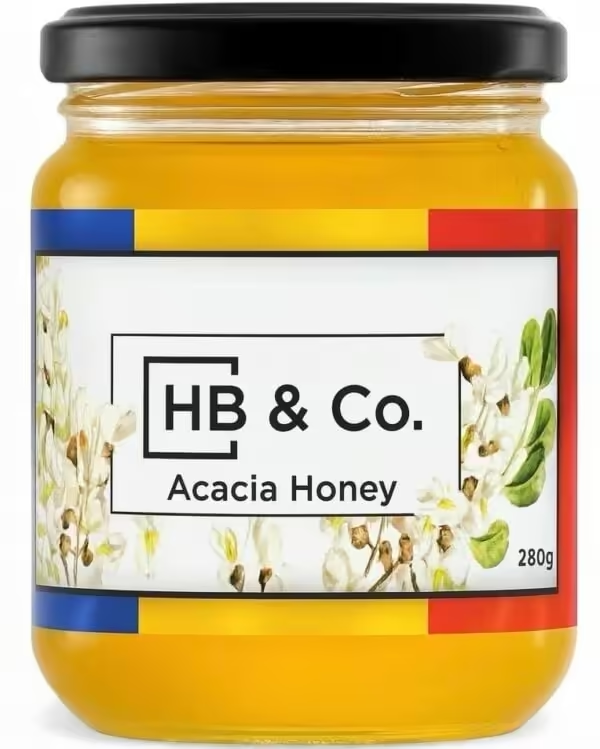
Pale, mild and slow to crystallise. High fructose content means it stays pourable naturally, without any processing. The clearest example of what raw honey should look and taste like. 280g.
Acacia, Wildflower and Heather. Three raw honeys from three landscapes, all cold-extracted. 280g each.
Shop Discovery Trio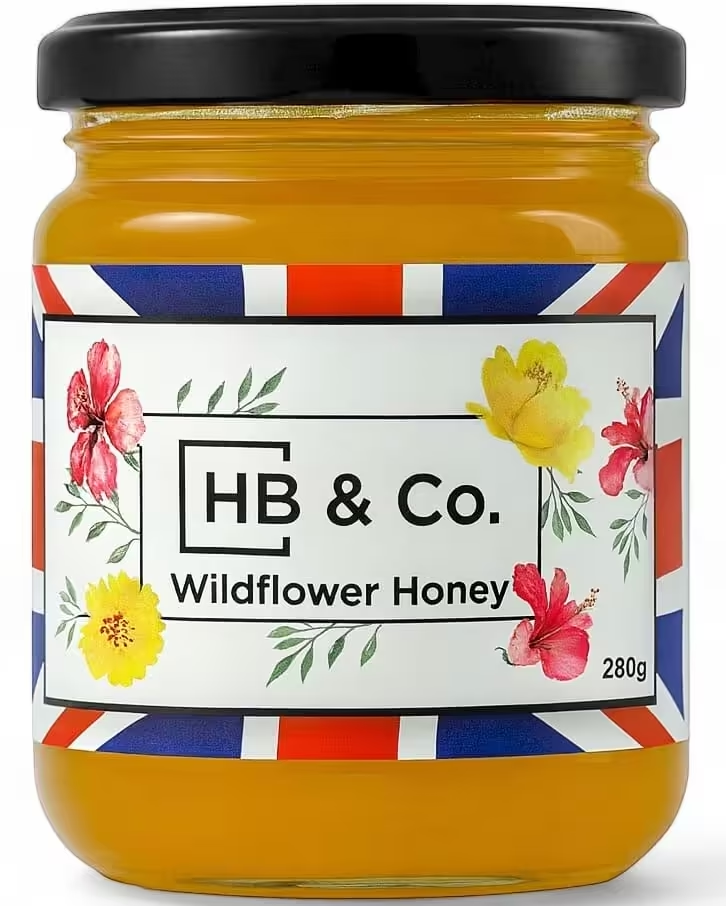
Raw single-origin honey every month. Acacia, Wildflower, Heather and more. From £8.79/month.
Start SubscriptionFrequently Asked Questions
What is the difference between raw honey and regular honey?
Raw honey has not been heated above approximately 40 degrees Celsius and is strained rather than pressure-filtered, preserving its natural enzymes, pollen and antioxidants. Regular honey is heated to 60 to 78 degrees Celsius and pressure-filtered, which removes pollen, degrades enzymes and increases HMF levels. Both are honey, but raw honey retains its full biochemical profile.
Is raw honey healthier than processed honey?
Raw honey retains active enzymes (diastase, glucose oxidase, invertase), pollen, and a fuller profile of phenolic compounds than processed honey. Whether this translates to measurable health benefits depends on the quantity consumed and the individual. The difference is real and measurable in a laboratory; the health impact is less straightforward to quantify. See Is Honey Good for You? for sourced detail.
Why does raw honey crystallise faster?
Because it contains pollen grains and microscopic wax particles that act as nucleation sites around which glucose crystals form. Processed honey has had these particles removed through filtration, so crystallisation is delayed. Crystallisation is a natural process and a sign of unprocessed honey, not a defect.
How can I tell if honey is truly raw?
Look for the word "raw" or "cold-extracted" on the label. Check for cloudiness or slight opacity, which indicates pollen and natural particles are present. Ask about the source: single-origin honey from a named producer is more likely raw than a blended product. Avoid labels that say "blend of EU and non-EU honeys" if raw is what you want.
Does raw honey taste different from processed honey?
Yes. Raw honey retains the full flavour profile of its floral source, including volatile aromatic compounds that are degraded by heat. Processed honey tends to taste more uniform and generic. The difference is most obvious when comparing raw Heather Honey (bold, thixotropic, complex) with a blended supermarket honey (mild, liquid, one-dimensional).
Is all supermarket honey processed?
Most is. The majority of supermarket honey in the UK is a blend of EU and non-EU honeys that has been pasteurised and pressure-filtered. Some premium supermarket ranges stock raw or cold-extracted honeys, but you need to read the label carefully. The safest route to guaranteed raw honey is buying from a named producer.
Can you cook with raw honey?
Yes, but heating raw honey above 40 degrees Celsius during cooking will degrade its enzymes in the same way commercial pasteurisation does. If you want to preserve the raw properties, add honey after cooking: drizzle it over finished dishes, stir it into warm (not boiling) drinks, or use it in dressings and cold sauces. For baking, the sugar and flavour survive; the enzymes do not.
Is HoneyBee and Co. honey raw?
Every jar. All six of our single-origin honeys are raw and cold-extracted, never heated above hive temperature (approximately 35 to 40 degrees Celsius). Our Transylvanian honeys come from the Nistor family apiaries; our British honeys from a SALSA-certified supplier. The pollen is intact, the enzymes are active, the honey is exactly as the bees made it.
Sources and References
- European Commission. Council Directive 2001/110/EC relating to honey. Definition, quality standards, labelling requirements. eur-lex.europa.eu
- Subramanian, R. et al. (2007). Processing of honey: A review. Journal of Food Engineering 79(1):1-12. Pasteurisation temperatures 60-78 degrees Celsius, enzyme degradation, HMF formation. doi.org
- Laos, K. et al. (2024). Impact of processing steps (filtration, creaming and pasteurization) on the botanical classification of honey using LC-QTOF-MS. Food Research International. Pollen removal and origin verification. sciencedirect.com
- Codex Alimentarius Commission. Revised Codex Standard for Honey (CXS 12-1981, revised 2019). Diastase minimum 8 Schade, HMF maximum 40 mg/kg. fao.org
- Kaczmarska, K. et al. (2021). The Comparison of Physicochemical Parameters, Antioxidant Activity and Proteins for the Raw Local Polish Honeys and Imported Honey Blends. Molecules 26(9):2423. HMF five times higher in supermarket vs beekeeper honey. pmc.ncbi.nlm.nih.gov
- Shapla, U. M. et al. (2018). 5-Hydroxymethylfurfural (HMF) levels in honey and other food products: effects on bees and human health. Chemistry Central Journal 12:35. pmc.ncbi.nlm.nih.gov