
 Français
  English (UK)
  Italiano
  简体中文
简体中文  한국어
한국어 
Most honey on British supermarket shelves is a blend of honeys from multiple unspecified countries, heated to delay crystallisation and pressure-filtered to remove pollen. It is legal, it is sweet, and it is not what honey can be. If you want honey that retains its natural enzymes, pollen and the full flavour of a specific landscape and season, you need to know what to look for on the label, what questions to ask, and what the price should tell you. This guide covers everything you need to buy honey with confidence: what "raw" and "cold-extracted" mean in practice, why single-origin matters, how to read the back of a jar, and what the six main honey varieties taste like and do differently. Whether you are buying your first jar of premium honey or looking for a gift, this is a comprehensive guide to buying with confidence. For the science behind honey's composition and health properties, see our complete guide to honey.
What to Look For
- Look for the words "raw" and "cold-extracted" on the label. If neither appears, assume the honey has been pasteurised.
- Avoid "blend of EU and non-EU honeys." This means multiple unspecified origins, often heavily processed.
- Choose single-origin honey from a named producer, region or floral source. Traceability is the strongest quality signal.
- Expect to pay more for genuine raw, single-origin honey. If it costs the same as blended supermarket honey, question why.
- Crystallisation is a sign of quality, not spoilage. If a honey never crystallises after months on the shelf, it has been heavily processed.
Why "Raw" and "Cold-Extracted" Matter
The terms "raw" and "cold-extracted" are not legally defined in UK food law, but in industry practice they mean something specific: the honey has not been heated above the natural temperature of the beehive (approximately 35 to 40 degrees Celsius) and has been strained rather than pressure-filtered. This preserves the enzymes bees add during the ripening process, the pollen grains that identify the honey's botanical origin, and the volatile aromatic compounds that give each honey its distinctive flavour.[1][3] For a detailed breakdown of what processing removes, see our article on raw honey vs regular honey.
When a jar says "pure honey" but does not mention processing temperature, it may still have been pasteurised. "Pure" is a legal term meaning the product contains only honey and no added ingredients according to Food Standards Agency labelling guidance,[5] but it says nothing about how that honey was treated after extraction. The word you want on the label is "raw." For a deeper look at what these terms mean in practice, read raw, organic, pure or natural honey and myths and misconceptions about raw honey.
Single-Origin vs Blended: Why It Matters
Single-origin honey comes from one floral source, one region, or one producer. The flavour, colour, texture and aroma reflect a specific landscape and season. Blended honey combines honeys from multiple sources, sometimes multiple countries, to produce a uniform product year-round. Blending is not inherently bad, but it eliminates the distinctiveness that makes honey interesting and it often accompanies heavy processing to achieve a consistent colour and texture.[4]
The analogy is wine. A single-estate wine from a named vineyard tells you something about the soil, the climate and the winemaker. A blended table wine from unspecified origins tells you nothing except that it is wine. Both are drinkable. But only one has a story, a character and a reason to choose it over the next bottle on the shelf. For a guided look at how floral source shapes honey's character, explore our types of raw honey and see how honey gets from the beehive to the jar.
Every HoneyBee and Co. honey is single-origin and traceable: Acacia, Linden and Sunflower from the Nistor family apiaries in Transylvania; Wildflower, Soft Set and Heather from our SALSA-certified British supplier. Six landscapes, six flavour profiles, one standard: raw, cold-extracted, never blended.
Our Six Honeys: A Quick Guide
| Variety | Origin | Character | Best for | Price |
|---|---|---|---|---|
| Acacia | Transylvania | Pale, mild, slow to crystallise | Tea, drizzling, everyday use | £10.99 |
| Linden | Transylvania | Amber, aromatic, herbal finish | Cheese, baking, warm drinks | £10.99 |
| Sunflower | Transylvania | Golden, mild, crystallises readily | Cooking, spreads, everyday | £10.99 |
| Wildflower | British Midlands | Complex, seasonal, varies year to year | Toast, dressings, flavour exploration | £10.99 |
| Soft Set | British Midlands | Smooth, spreadable, creamy | Toast, porridge, sandwiches | £10.99 |
| Heather | Yorkshire Moors | Bold, thixotropic, gel-like | Bold flavour, cheese, gifting | £12.99 |
Not sure where to start? The Discovery Trio brings Acacia, Wildflower and Heather together in one box, spanning three landscapes and three very different flavour profiles. For cheese pairing, the Cheese Board Honey Selection is built specifically for the purpose. For tea drinkers, the Tea Lovers Honey Selection pairs mild and aromatic honeys with different tea styles.
What Price Tells You
Genuine raw, single-origin honey costs more than blended supermarket honey because it is more expensive to produce, harder to source consistently, and impossible to scale the way industrial blending can. If a jar of "raw" honey costs the same as a blended product, either the margins are unsustainable or the quality claim is unreliable. A good benchmark: expect to pay between 8 and 15 pounds for a 280g jar of genuine raw, single-origin honey in the UK. Below that, ask questions. Above that, you are paying for rarity, terroir or brand.
SALSA Certification: the food safety standard
Our British honey supplier holds SALSA Certification (Safe and Local Supplier Approval), a food safety standard recognised by major UK retailers and food service operators. It confirms that the supplier meets audited standards for hygiene, traceability and food safety. Not all small-scale honey producers hold this certification, and it is a meaningful quality signal when buying honey from a British supplier.[2]
Storage: Keeping Your Honey at Its Best
Once you have bought good honey, storage is simple: sealed, room temperature (20 to 25 degrees Celsius), away from direct sunlight. Do not refrigerate: it accelerates crystallisation without any preservation benefit. Do not freeze: as we explain in Does Honey Freeze?, it is unnecessary and just makes the honey hard to use. Honey does not expire under proper storage, as covered in Does Honey Expire? Use a dry spoon, close the lid, and your honey will last as long as you need it to.
Subscriptions: Never Run Out
If you find a honey you like, a subscription saves 20% on every jar and includes free UK delivery on every order. Choose any of our six varieties and receive a fresh 280g jar every month. Change variety, pause or cancel at any time. Subscriptions start from 8.79 pounds per month.
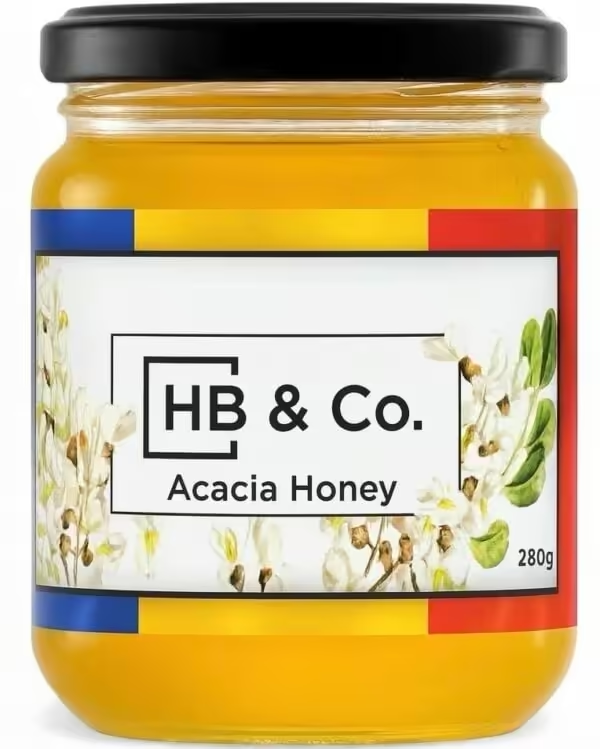
If you are trying raw honey for the first time, start here. Pale, mild, slow to crystallise, and versatile enough for tea, toast, cooking and drizzling. Raw, cold-extracted from the Nistor family apiaries in Transylvania. 280g.
Acacia, Wildflower and Heather. Three raw honeys from three landscapes. The best way to explore our range. 280g each.
Shop Discovery Trio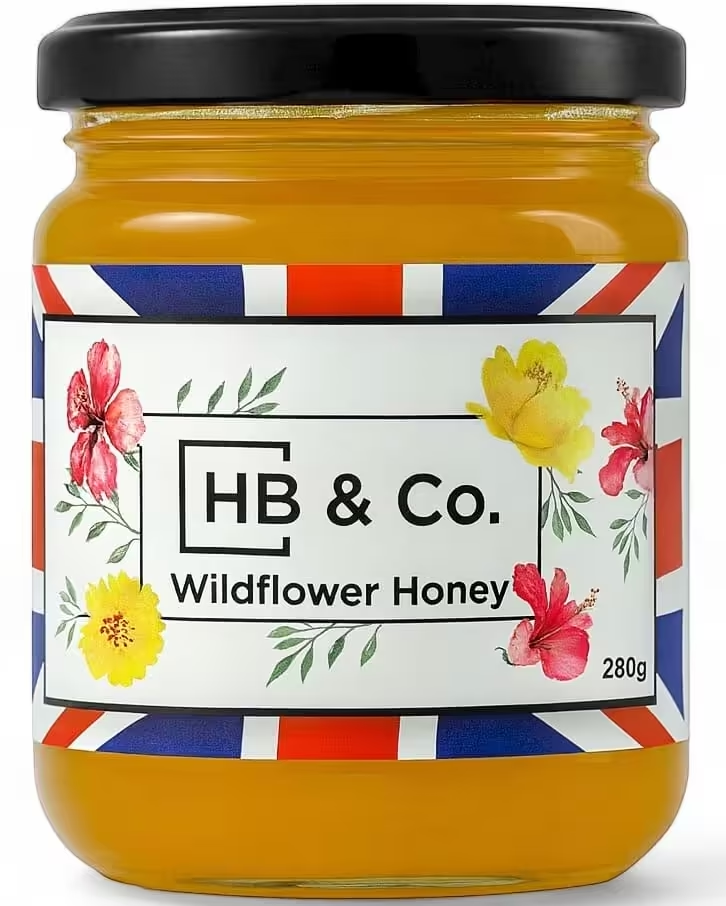
Raw single-origin honey every month. From £8.79/month. Free UK delivery. Change variety any time.
Start SubscriptionFrequently Asked Questions
What should I look for when buying honey?
Three things: the word "raw" or "cold-extracted" on the label; a named floral source, region or producer (not just "honey"); and the absence of "blend of EU and non-EU honeys." These three checks separate premium honey from commodity product. For detail on what processing does, see Raw Honey vs Regular Honey.
Why is raw honey more expensive?
Because it cannot be produced at scale. Raw honey requires careful temperature control, manual handling, and single-origin sourcing, all of which cost more than heating and blending honey from multiple countries. The price reflects the care, traceability and quality that processed honey does not offer.
What does "blend of EU and non-EU honeys" mean?
It means the jar contains honey from multiple unspecified countries, blended together. The producer is not required to name the countries. This labelling is legal under EU Directive 2001/110/EC and is common on supermarket own-brand honeys. It tells you nothing about the origin, processing method or quality of the individual honeys in the blend.
Is crystallised honey bad?
No. Crystallisation is a natural process in which glucose separates from solution. It is a sign of unprocessed honey, not a defect. To return crystallised honey to liquid, place the jar in warm water (below 40 degrees Celsius) and stir gently. Processed honey stays liquid because filtration removes the pollen grains that trigger crystallisation.
Which honey should I buy first?
Acacia is the best starting point for most people. It is mild, versatile, stays liquid naturally, and works in tea, on toast, in dressings and as a general sweetener. If you want something bolder, try Heather. If you want to explore, the Discovery Trio gives you three varieties in one box.
How should I store honey?
Sealed, at room temperature (20 to 25 degrees Celsius), away from sunlight. Do not refrigerate or freeze. Use a dry spoon. For full storage science, see Does Honey Expire? and Does Honey Freeze?
What is SALSA Certification?
SALSA (Safe and Local Supplier Approval) is a UK food safety certification for small and medium-sized producers, audited by independent assessors. Our British honey supplier holds SALSA Certification, confirming they meet standards for hygiene, traceability and food safety. It is a meaningful quality indicator when buying from smaller British producers.
Do you offer free delivery?
Free UK delivery on all orders of 3 or more jars (one-time purchase) and on every subscription order regardless of quantity. Standard delivery is 2 to 5 working days. 15% NHS Discount available.
Sources and References
- European Commission. Council Directive 2001/110/EC relating to honey. Definitions, quality standards, labelling ("blend of EU and non-EU honeys"). eur-lex.europa.eu
- SALSA (Safe and Local Supplier Approval). About SALSA: audit standards, food safety, traceability. salsafood.co.uk
- Codex Alimentarius Commission. Revised Codex Standard for Honey (CXS 12-1981, revised 2019). Quality markers: diastase, HMF, moisture. fao.org
- Kaczmarska, K. et al. (2021). Comparison of raw local honeys and imported blends: HMF, diastase, antioxidant activity. Molecules 26(9):2423. pmc.ncbi.nlm.nih.gov
- Food Standards Agency. Honey labelling guidance: permitted descriptions, origin statements. food.gov.uk