

 English (UK)
 Italiano
 Français
 简体中文
 한국어

A plain honey loaf, three days old and better for it. The crumb darkens and tightens as the honey draws moisture back in.
Baking
Honey Cake Recipe: A Moist British Loaf That Improves for Days
Honey cake is the one cake that argues with the rule about eating things fresh. Honey holds on to water, so the loaf is at its best two or three days after baking, when the crumb has settled and the honey has moved back through it. This is a melted-method loaf: butter, honey and a little brown sugar warmed together, stirred into flour and spice, baked low. One bowl, one tin, an hour in a cool oven, then patience.
Honey loaf cake
Ingredients
- 175 g unsalted butter
- 200 g linden honey, plus 2 tbsp for the glaze
- 75 g light brown soft sugar
- 2 medium eggs, beaten
- 100 ml whole milk
- 225 g plain flour
- 1 tsp baking powder
- Half a tsp bicarbonate of soda
- Half a tsp fine salt
- 1 tsp ground ginger
- Half a tsp ground cinnamon
- Finely grated zest of 1 lemon
Method
- Heat the oven to 160 degrees (140 fan). Butter a 900 g loaf tin and line it with a strip of baking paper that overhangs the long sides.
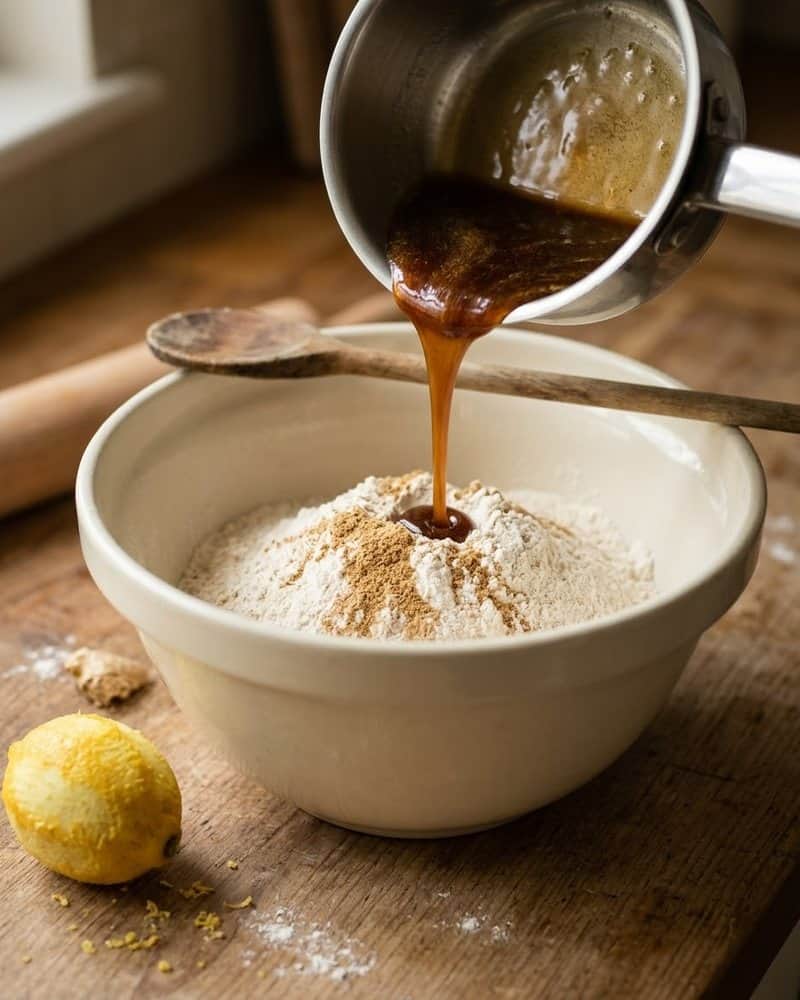
- Melt the butter, honey and sugar in a pan over a low heat, stirring until the sugar has dissolved. Take it off the heat and let it cool for 10 minutes; hot syrup would scramble the eggs.
- Sift the flour, baking powder, bicarbonate, salt and spices into a large bowl. Add the lemon zest.
- Stir the eggs and milk into the cooled honey mixture, then pour it into the flour and mix with a wooden spoon just until no dry flour remains. The batter is loose. Do not beat it.
- Pour into the tin and bake for 55 to 65 minutes. Check at 40 minutes: if the top is already deep brown, lay a sheet of foil loosely over it. It is done when a skewer in the centre comes out with no wet batter, and the top springs back.
- Warm the 2 tablespoons of honey and brush it over the hot cake in the tin. Cool in the tin for 20 minutes, lift out by the paper and cool completely.
- Wrap in baking paper and then foil. Leave for a day before cutting if you can bear it.
Why it is better on day three
Honey is roughly four fifths sugar and one fifth water: UK law caps its moisture at 20 percent (The Honey (England) Regulations 2015, Schedule 1), and most of that sugar is fructose and glucose rather than the sucrose in a bag of caster. Fructose in particular pulls water towards it and holds on. In a cake that means the crumb loses moisture to the air more slowly than a sugar-only sponge and, as the honey redistributes through the loaf overnight, the texture turns from cakey to dense and slightly sticky. A 2024 study that swapped sucrose for honey in bread found the honey loaves held about 38 to 41 percent moisture against 35 percent in the control, with the authors concluding that “honey could be an excellent alternative to sucrose” in that bread (Cannas and colleagues, Foods, 2024). The study was bread rather than cake and the honeys were Sardinian, so treat it as supporting evidence, not proof about your loaf; the fortnight in the Welsh recipe is the older and more convincing data point.
The practical rule: wrap the cooled cake in paper and foil, keep it at room temperature, and cut from day two. It keeps for five days, and the last slice toasted with salted butter is the best one.
Honey browns before sugar: the oven rule
The same sugars that keep the cake moist also brown faster than sucrose, which is why honey cakes have a reputation for a dark, sometimes bitter top over an underbaked middle. The fix is low heat for longer. This loaf bakes at 160 degrees, twenty degrees cooler than a standard sponge, and still needs the foil tent from about 40 minutes. If a recipe you already use calls for 180, drop it to 160 the first time you swap in honey and expect the bake to take ten to fifteen minutes longer. Our guide to the best honey for baking covers the swap in more detail.
Swapping honey into your own cakes
Four adjustments, every time. Use about three quarters of the weight of honey for the sugar removed, because honey is sweeter. Cut the other liquid in the recipe by about 40 ml for every 200 g of honey, to account for the water the honey brings. Add a quarter teaspoon of bicarbonate of soda per 200 g, since honey is mildly acidic (the law allows up to 50 milli-equivalents of acid per kilo) and the bicarbonate both neutralises it and gives lift. And drop the oven by 20 degrees.
In our family the cake was made with whatever the autumn jars held, usually linden or sunflower, and it was the cake that travelled: to church, to the fields at harvest, wrapped in a cloth. It kept, which was the point. The oven rule was learned by burning one.
| To replace | Use | Reduce other liquid by | Add | Oven |
|---|---|---|---|---|
| 100 g sugar | 75 g honey | 20 ml | Pinch of bicarbonate | Minus 20 degrees |
| 200 g sugar | 150 g honey | 40 ml | Quarter tsp bicarbonate | Minus 20 degrees |
| 300 g sugar | 225 g honey | 60 ml | Half tsp bicarbonate | Minus 20 degrees, foil from 35 minutes |
Which honey for a honey cake
At 200 g in a loaf, honey is about a fifth of this cake by weight, so the jar decides the flavour. We bake this one with linden honey: pale, aromatic, with a faint mint and lime-blossom note that survives an hour in the oven when gentler honeys fade to a general sweetness. If you know it as lime honey, it is the same thing; lime honey and linden honey are two names for one tree. For a milder loaf, acacia gives a cleaner, less perfumed cake, and linden versus acacia tastes the two against each other. Heather makes a darker, almost treacly cake that is wonderful but no longer subtle.
A jar that has crystallised is fine for this recipe, since the honey is melted with the butter anyway; softening a set jar takes a few minutes in warm water if you want to measure it more easily. If you are deciding between honey and the syrups sold beside it, honey versus agave is the comparison most bakers ask us about.
Serving, keeping and who it is for
Plain, in thick slices, with tea; the Tea Lover’s selection exists for this pairing. Toasted on day four with salted butter, or warmed with poached pears as a pudding. Wrapped well it keeps five days at room temperature and freezes for three months; glaze after defrosting.
One note for families, because this is a cake children will be given. The NHS says not to give honey to a child until they are over one year old, because it can occasionally contain bacteria that cause infant botulism (NHS, Foods to avoid giving babies and young children). The NHS advice does not make an exception for baked honey, so this cake is for the over-ones.
The honey in the cake
Linden honey from our family’s hives in Transylvania: raw, single-origin, slow to crystallise, and the jar we bake with when the honey has to be tasted in the result. It is in the Romanian Heritage bundle with acacia and sunflower, and three at a time in the linden stock-up pack. Every jar is 280 g. Free UK delivery on 3 or more jars on any order type, standard delivery 2 to 5 working days; 55 Google reviews at 4.9 stars. Browse the shop for the rest.
Linden honey Baker’s Kitchen selectionQuestions
Why did my honey cake sink in the middle?
Usually underbaking hidden by a dark top: the crust looked done before the centre set. Tent with foil from 40 minutes and trust the skewer, not the colour. Opening the oven before 40 minutes and over-mixing the batter are the other two causes.
Can I make it with all honey and no sugar?
Yes. Use 250 g honey and leave out the brown sugar; the cake will be a little denser and will brown faster, so tent it from 30 minutes. The brown sugar in the recipe is there for the crust and a slight toffee note, not for sweetness.
Can I bake it in a round tin?
A 20 cm round tin takes the same batter and bakes in 45 to 50 minutes at the same temperature. Loaf tins suit this cake better because the thick slices keep longer once cut.
Does honey cake freeze?
Well. Wrap the unglazed, fully cooled loaf in paper and foil and freeze for up to three months. Defrost wrapped at room temperature, then brush with warm honey.
Is this the same as medovik or Jewish honey cake?
No. Medovik is a layered cake of thin honey sponges with a sour cream filling; the honey cake baked for Rosh Hashanah is usually a tall, oiled, coffee-and-spice loaf. This is the plainer British loaf tradition recorded in Welsh and English farmhouse recipes, closer to a gingerbread without the treacle.