

 Italiano
 English (UK)
 Français
 简体中文
 한국어

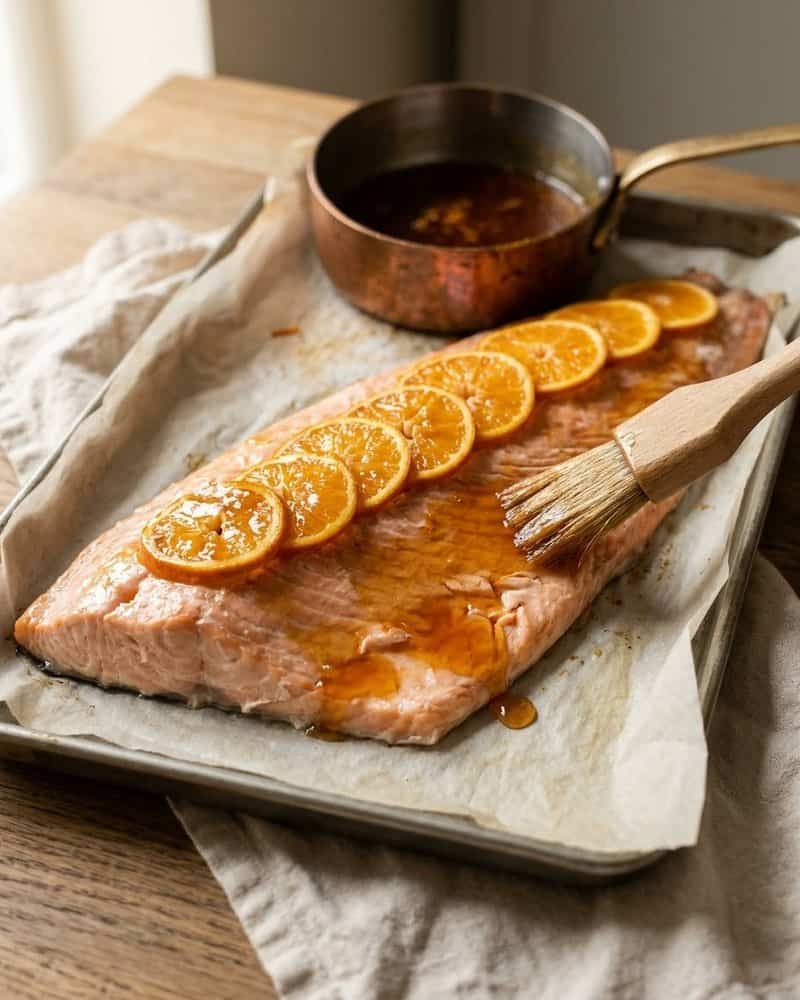
A whole side, glazed twice in the last six minutes so the honey lacquers rather than scorches. Acacia honey keeps the glaze pale enough for the clementine to show.
Christmas Eve
Honey Glazed Salmon for Christmas Eve: A Whole Side in Twenty Minutes
A side of salmon is the easiest centrepiece of the whole holiday and the one most often ruined by its glaze. Honey burns before fish cooks, so the glaze goes on late, in two coats, during the last six minutes in a hot oven. Reduce it first on the hob so it clings. Check the fish by cutting into the thickest part, not by the clock. Acacia honey, clementine, a little soy and ginger: the version below feeds six and takes twenty minutes from tray to table.
RicettaThree glazesWhy the glaze goes on latePlan the eveningChristmas Eve in our houseWhich honeyServing and leftoversDomande
For the salmon
- 1 whole side of salmon, about 1 kg, skin on, pin-boned
- 1 tbsp olive oil
- Half a tsp flaky salt
- 2 clementines, thinly sliced, plus 1 more for juice
Per la glassa
- 4 tbsp acacia honey
- Juice of 1 clementine (about 50 ml)
- 1 cucchiaio di salsa di soia
- 1 cucchiaio di aceto di sidro
- 2 cm fresh ginger, finely grated
- 1 garlic clove, finely grated
- A pinch of chilli flakes (optional)
To finish
- Small handful of dill or flat parsley
- 1 spring onion, finely sliced
Honey and clementine glazed side of salmon
- Take the salmon out of the fridge 20 minutes before cooking. Heat the oven to 200 degrees (180 fan) and line a large tray with baking paper, long enough for the whole side.
- Make the glaze: put the honey, clementine juice, soy, vinegar, ginger, garlic and chilli in a small pan and simmer over a medium heat for 4 to 5 minutes, until it coats the back of a spoon and a line drawn through it holds for a second. It will thicken more as it cools. Set aside.
- Lay the salmon skin down on the paper. Rub with the oil, scatter the salt, and lay the clementine slices along the length. Do not glaze yet.
- Roast for 8 minutes. The surface will have turned from translucent to pale pink at the thin end.
- Brush half the glaze over the fish and the clementine slices. Return to the oven for 3 minutes. Brush on the rest and give it 3 to 6 minutes more, depending on thickness: a 2.5 cm centre takes the full time.
- Check by cutting a small slit into the thickest part. The flesh should have changed from glassy to opaque and should separate along its lines with gentle pressure; a trace of deeper pink at the very centre is right for a side this size, because it keeps cooking as it rests.
- Rest for 3 minutes on the tray. Slide the paper and fish together onto a board or platter, scatter the herbs and spring onion, and spoon over any glaze that has pooled on the paper.
Three glazes from the same four tablespoons of honey
The method does not change: reduce on the hob, brush on twice in the last six minutes. The flavour does. All three start with 4 tablespoons of acacia honey for a 1 kg side.
| Smalto | Add to the honey | Carattere | Serve with |
|---|---|---|---|
| Clementine, soy and ginger (above) | Clementine juice, 1 tbsp soy, 1 tbsp cider vinegar, ginger, garlic | Bright, festive, lightly savoury; the one for the Eve table | Buttered greens, crushed potatoes with dill |
| Mustard and dill | 1 tbsp Dijon, 1 tbsp wholegrain mustard, 1 tbsp lemon juice, chopped dill stirred in after reducing | Sharper, Scandinavian, pale gold | Rye bread, cucumber salad, soured cream |
| Hot honey and lime | Juice of 1 lime, 1 tsp chilli flakes or a sliced red chilli, 1 tbsp fish sauce | Sticky, hot, sour; a Boxing Day crowd-pleaser | Rice, coriander, quick-pickled red onion |
The hot honey version uses the no-cook infusion method from our hot honey guide if you have a jar made already; otherwise the chilli simply goes into the pan. The clementine glaze also works on a joint of ham and on roast carrots, and the soy version is a close cousin of the one on our ali di pollo al miele e soia.
Why the glaze goes on late
Most of the sugar in honey is fructose, and fructose browns faster than table sugar. Eva Crane, who founded the International Bee Research Association, reported that fructose reacts more strongly with amino acids at high temperatures than glucose does, so a fructose bake comes out darker than a sucrose one and has to leave the oven earlier to avoid burning (Crane, “Learning about honey through fructose”, Bee World 63(4), 1982). Salmon flesh supplies the amino acids. Brush a honey glaze on at the start of an 18-minute roast at 200 degrees and the sugars blacken on the ridges of the fish while the centre is still raw. Brush it on for the last six minutes and the same reaction gives you an amber lacquer, which is the whole point.
Reducing the glaze first matters for the same reason. A thin glaze runs off the fish onto the paper and burns there; a glaze simmered until it coats a spoon stays where you brush it and only has to colour, not thicken, in the oven. If your honey has crystallised, the simmer dissolves it; there is no need to soften the jar prima di tutto.
Honey glazes are not just about colour. A 2023 review of marinades concluded that “honey marinade showed better properties compared to other ingredients” in the chemical, physical and sensory measures the included studies used, against sugar, salt and lactic acid marinades (Mat and Sarbon, in Recent Advances in Global Meliponiculture, 2023). The studies it reviewed were mostly on meat rather than fish and the abstract gives no figures, so treat it as a reason to prefer honey over sugar in the pan, not as a claim about this recipe.
Plan the evening backwards
Christmas Eve cooking is a timing problem more than a skill problem. Work back from the moment you want to sit down.
- MorningMake the glaze and keep it covered in the fridge. Slice the clementines. Pin-bone the salmon if the fishmonger has not.
- Minus 60Potatoes on. Salmon out of the fridge and onto its lined tray, oiled and salted, clementines laid on; cover loosely.
- Minus 30Oven on to 200 degrees. Glaze out of the fridge; it will have set, so warm it for a minute until it brushes.
- Minus 22Salmon in. Greens in the steamer at minus 10.
- Minus 14First coat of glaze.
- Minus 11Second coat.
- Minus 5Check with a knife. Out, rest on the tray, herbs on.
- ZeroSlide onto the board. Pour something cold. Sit down.
Christmas Eve in our house
In Romania, where our family’s hives are, Christmas Eve is the last day of the Advent fast, and the fast is taken seriously. The ethnologist Delia Suiogan told Radio Romania International that “it is very important not to eat at all on Christmas Eve, for purification”, while the most important meals of the year are being prepared in the same kitchen (Chiorpec, “Christmas in Romania”, RRI, 2022). Fish was the food that sat on the line between fasting and feasting, and in our family it was the first proper plate after the carol singers had been and gone.
The honey came from the autumn jars, usually acacia because it was the mildest and did not fight the fish. Nobody called it a glaze. It was brushed on at the end because that was when there was a free hand, and it was the right instinct for the wrong reason. Here in the UK, salmon has taken the place of the river fish, and we have kept the late brush.
Which honey for a glaze
Four tablespoons of honey carry this dish, so the jar is tasted. We glaze with miele di acacia for three reasons. It is pale, so the glaze stays amber rather than mahogany and the clementine shows through. It is mild and faintly vanilla-like, so the citrus, soy and ginger lead and the honey rounds them off rather than shouting. And it is slow to crystallise and pours thin, so it measures and brushes easily and reduces evenly in the pan. Linden against acacia is the comparison to read if you want a glaze with a floral edge: linden gives a faintly minty, lime-blossom note that is lovely with the mustard and dill version.
For a bolder, darker glaze, use miele di girasole, which has more body and a buttery depth that suits the hot honey and lime version; it is one of the three jars in the Selezione di prodotti per barbecue e grigliate alongside acacia and wildflower, which was put together for exactly this kind of cooking, and our grilling guide covers the same glaze on a barbecue. Heather is too strong here: magnificent on cheese, overbearing on fish.
The honey in the glaze
Acacia honey from our family’s hives in Transylvania: raw, single-origin, pale and slow to crystallise, the jar we reach for whenever the honey should round off a dish rather than lead it. It comes with linden and sunflower in the Pacchetto “Patrimonio rumeno”, three at a time in the acacia stock-up pack, and in most of our set regalo di miele. Every jar is 280 g. Free UK delivery on 3 or more jars on any order type, standard delivery 2 to 5 working days, returns within 30 days unopened; 55 Google reviews at 4.9 stars. The full range is in il negozio.
Miele di acacia Entertainer’s selectionServing, leftovers and who it is for
A glazed side wants plain company: crushed new potatoes with butter and dill, steamed greens with lemon, a sharp salad. Start with something from miele con vino e formaggio if the evening is long, and finish the board with the acacia and blue cheese pairing, since the jar is already open. If you are buying Scottish salmon for the occasion, the name is a UK protected geographical indication: the register entry changed from Scottish Farmed Salmon PGI to Scottish Salmon PGI in April 2024 (UK protected food and drink names register), so a fish labelled with either name is farmed in Scotland under that specification.
Leftovers: cool the fish within an hour, cover and refrigerate, and eat it cold the next day flaked into a salad or warmed through gently in a covered dish; we do not keep cooked salmon beyond two days. The glaze itself keeps a week in a jar in the fridge and is very good on roast carrots.
Domande
Can I use fillets instead of a whole side?
Yes. Four 150 g fillets take 10 to 12 minutes at the same temperature: roast 5 minutes plain, glaze, 3 minutes, glaze again, 2 to 4 minutes. Everything else is the same.
Why did my honey glaze burn?
It went on too early, or it was too thin and ran onto the tray. Reduce it on the hob until it coats a spoon and brush it on only in the last six minutes.
Can I make it ahead?
The glaze keeps a week in the fridge. The fish is best roasted to order; it needs 20 minutes and the oven is the only thing it asks for. Cooked salmon served cold the next day is good, but it is a different dish.
Can I cook it on the barbecue or under the grill?
Under a hot grill, cook skin-side down on a lined tray for 6 to 8 minutes, then glaze and grill in two 90-second bursts, watching constantly. On a barbecue, use indirect heat and a cedar plank or foil tray; our grilling guide covers the method.
Which honey is best if I only have one jar?
Any pale, mild honey makes a clean glaze; a strong dark honey will dominate the fish. Set honey is fine because the glaze is simmered.