

 简体中文
简体中文  English (UK)
  Italiano
  Français
  한국어
한국어 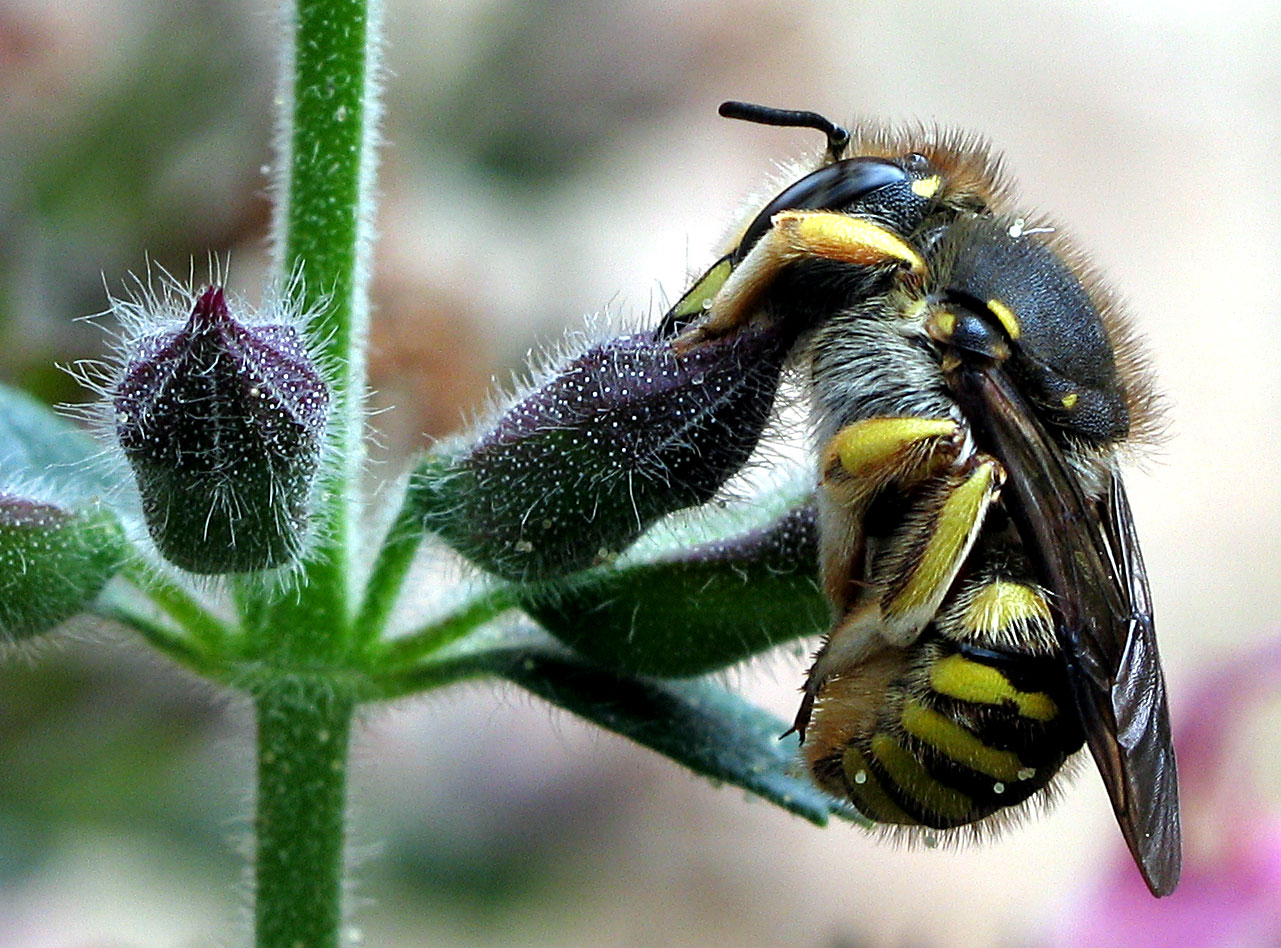
Wool Carder Bee
Anthidium manicatum
Linnaeus, 1758 • Megachilidae • Anthidiini
Quick Facts
Taxonomy and Classification
The wool carder bee was described by Carl Linnaeus in 1758 and belongs to the family Megachilidae, the mason bees and leafcutter bees, in the tribe Anthidiini. The genus Anthidium contains approximately 80 species worldwide, predominantly in the Northern Hemisphere and South America. A. manicatum is the only species of the genus recorded in Britain, although Anthidium florentinum has been found occasionally on the Channel Islands.[1]
Like all Megachilidae, the wool carder bee carries pollen on a ventral abdominal scopa rather than on the hind legs as most other bee families do. This is visible in foraging females as a dense brush of hairs on the underside of the abdomen, typically laden with pollen. Members of tribe Anthidiini differ from the leafcutters and mason bees in that they do not cut leaves or use mud, instead harvesting plant trichomes (surface hairs) or resin as nest-lining material.[2]
| Kingdom | Animalia |
| Phylum | Arthropoda |
| Class | Insecta |
| Order | Hymenoptera |
| Family | Megachilidae |
| Subfamily | Megachilinae |
| Tribe | Anthidiini |
| Genus | Anthidium Fabricius, 1805 |
| Species | Anthidium manicatum Linnaeus, 1758 |
Identification
The wool carder bee is a stocky, fast-moving bee, black with yellow markings on the face, thorax sides and abdomen. The abdominal tergites carry pairs of yellow spots at the sides, giving the abdomen a distinctively spotted rather than banded appearance. The pollen-carrying scopa on the female's underside is visible when she is foraging, giving the impression of a yellow or pale brush on the belly.[1]
Reversed sexual dimorphism
The most unusual feature of the wool carder bee is that the male is substantially larger than the female, at 14 to 17 mm versus 11 to 13 mm for the female. This reversal of the typical pattern, where females are larger in most solitary bees, is extremely rare among bees and is directly connected to the male's territorial mating strategy.[3] Males also carry three to five prominent spines at the tip of the abdomen, used as weapons in territorial combat. In the field, a large, heavily-built, fast-hovering bee patrolling a patch of flowering labiates in summer is almost certainly a male wool carder bee.
The Wool-Carding Behaviour
The female's nest-building behaviour is what gives the species its common name and makes it one of the most distinctive solitary bees to watch. She locates plants with densely hairy or woolly leaves, grips the stem, and uses her multi-toothed mandibles to scrape the surface hairs (trichomes) into a bundle. Working from the top of a stem downward, she strips an entire branch bare in a series of rapid passes, accumulating a ball of plant fibre almost as large as herself, which she holds between her chin and forelegs during flight back to the nest.[1]
Favoured wool sources include lamb's ear (Stachys byzantina), great mullein (Verbascum thapsus), yarrow (Achillea millefolium), house-leek (Sempervivum), cotton thistle (Onopordum acanthium) and various Pelargonium species. At the nest, she teases the fibres out with her mandibles and presses them flat against the cavity wall using her abdomen, building up successive layers of compressed wool that form the cell walls and closing plug.[1]
Nest sites: walls, stems, bee hotels
The wool carder bee nests in pre-existing cavities: beetle exit burrows in dead wood, hollow stems, crevices in mortar joints, abandoned snail shells, and bee hotels with tubes of 7 to 10 mm diameter. Females often prefer elevated nest sites, possibly reducing cleptoparasite detection. A patch of lamb's ear near a south-facing bee hotel with medium-diameter tubes is one of the most reliable ways to attract this species to a garden.[1]
The Territorial Male: Aggression as a Mating Strategy
The male wool carder bee exhibits one of the most intense territorial behaviours of any British solitary bee. He establishes a territory centred on a patch of flowering plants attractive to foraging females, typically woundworts, sages, lavender, lamb's ear, lychnis, bird's-foot trefoil or other Lamiaceae and Fabaceae, and actively defends it against all intruders.[4] Defence is physical: the male charges at other insects, uses his abdomen to batter them, and deploys his abdominal spines to grip and damage them. Bumblebees, honeybees, hoverflies and other solitary bees are all expelled or attacked, not just rival male wool carder bees.
The purpose of territorial defence is not to protect food resources for the male himself but to control the foraging patch of females. Females who forage within his territory are intercepted and mated with. Females exhibit polyandry, mating repeatedly throughout their reproductive lives, and the interval between copulations with different males can be as short as 35 seconds.[5] Males unable to hold a territory use an alternative "sneaking" tactic, approaching females covertly rather than through territory defence.
The male wool carder bee has up to five prominent spines at the tip of the abdomen, used as weapons in territorial combat. He grips rival males and other intruders with these spines during high-speed collisions, sometimes inflicting fatal damage. This weaponry is unique among British solitary bees and is directly linked to the reversed sexual size dimorphism: larger males win more territorial contests and father more offspring.
Foraging
The wool carder bee forages from a wide range of flowers. BWARS records particular associations with the dead-nettle family (Lamiaceae), including woundworts, sages, black woundwort, wild basil and betony, and the legume family (Fabaceae), particularly bird's-foot trefoils and kidney vetch.[1] Other recorded foraging plants include lavender, lamb's ear, thyme, marjoram, catmint, foxgloves, phacelia, borage, knapweeds and various garden flowers. Males additionally patrol and feed from many of the same flowers they defend territorially.
The flight season runs from late May or early June to August, peaking in July. It is a summer bee with no spring activity, and the season coincides with the main flowering period of the Lamiaceae plants it is most strongly associated with. BWARS notes that it is a species commonly found in parks and gardens, and it has benefited from urban planting of Mediterranean herbs and cottage garden perennials that provide both foraging and wool-carding resources.[4]
A Global Bee: Accidental Introduction and Spread
Anthidium manicatum is native to Europe, western Asia and North Africa. It has become one of the most widely distributed unmanaged bee species in the world following a series of accidental introductions. It was first recorded in North America in New York State in 1963, apparently introduced in commercial plant shipments from Europe, and has since spread transcontinentally across the United States and Canada, reaching California by 2007.[6] It is also established in South America (Argentina, Brazil, Uruguay, Paraguay), New Zealand, the Canary Islands and parts of the Mediterranean region outside its native range.
In North America, research has raised concerns about whether the wool carder bee is displacing native cavity-nesting bees from bee hotels and foraging resources, through both direct competition and male territorial aggression that physically excludes smaller native species from flowering plants. The evidence for significant displacement is mixed, with some studies finding local effects and others not, but it is now considered an established invasive species in North America.[6]
Is the wool carder bee expanding northward in Britain?
BWARS notes that the species is "widely distributed throughout much of southern England and Wales, becoming scarcer in the north" and records three Scottish sightings in Dumfries and Galloway, with recent records from Edinburgh also cited in BWARS survey communications.[4] Whether this represents genuine range expansion northward, an increase in recording effort, or normal range variation is not resolved. The species is thought to be increasing in abundance in England, possibly due to the growth of urban gardens with suitable Lamiaceae plantings, but the evidence is observational rather than from systematic monitoring.
A Summer Garden Bee and Summer Honey
The wool carder bee and our British Wildflower Honey share a season and a landscape. This bee peaks in July and August on the same flowers that British honeybee colonies are working at full strength: clovers, vetches, woundworts and the herb-rich margins of unimproved grassland. It makes no honey itself; each female provisions her own wool-lined cells with pollen, nothing more. But it is part of the same pollinator community that makes British wildflower honey possible.
Our Wildflower Honey is raw and cold-extracted, gathered by our SALSA-certified British supplier from the same mixed Midlands blossom landscape that supports the wool carder bee through summer. For a gift that spans the full British season, the British Honey Bundle brings Wildflower, Soft Set and Heather together in one box.
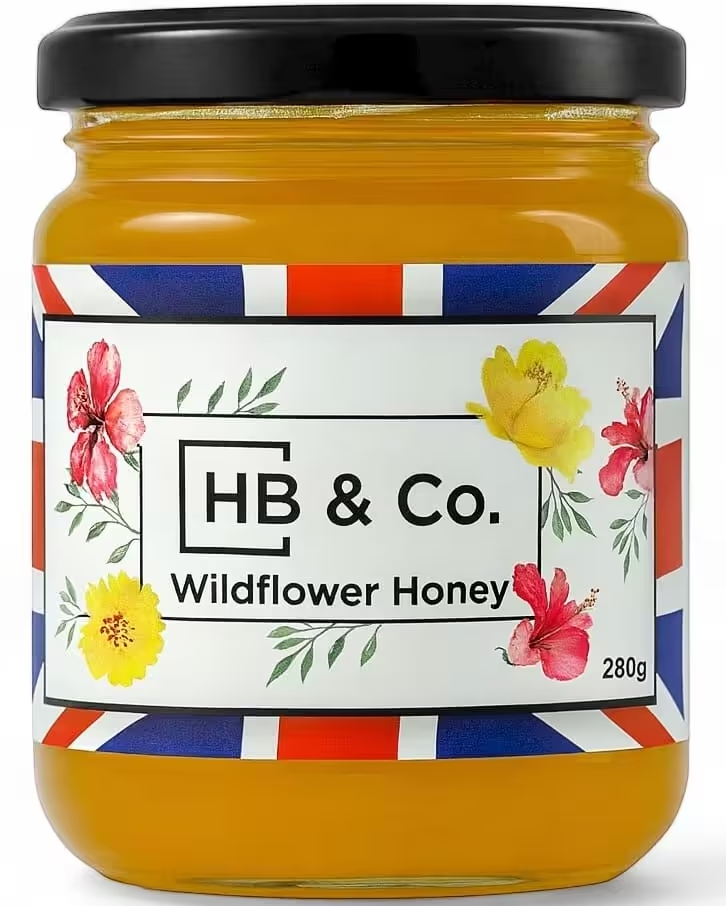
Raw, cold-extracted wildflower honey from the clover, vetch and hedgerow blossom that the wool carder bee also forages through summer. SALSA-certified British supplier. 280g.
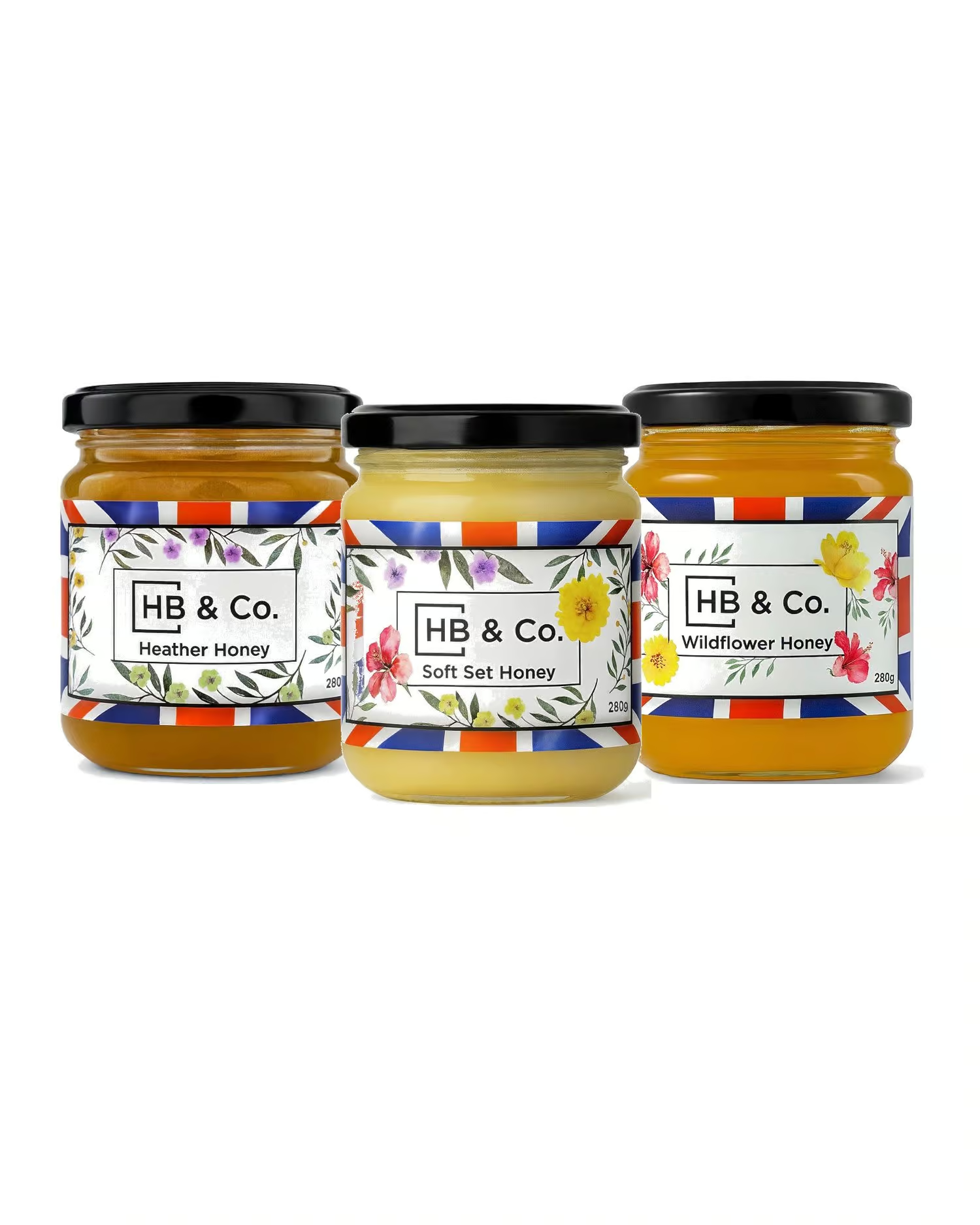
Wildflower, Soft Set and Heather from our SALSA-certified British supplier. Three landscapes, one gift.
Shop British Bundle
Raw single-origin honey every month. Wildflower, Heather, Acacia and more. From £8.79/month.
Start SubscriptionFrequently Asked Questions
How do I identify a wool carder bee?
Look for a stocky, fast-moving bee with a black body and yellow spots at the sides of the abdominal segments. It is one of very few British solitary bees where the male is noticeably larger than the female. Males (14 to 17 mm) patrol flowering plants and hover aggressively, charging at other insects; females (11 to 13 mm) visit woolly-leaved plants and forage on Lamiaceae flowers. The yellow spot pattern rather than yellow bands distinguishes it from most other British bees.
Why is the male wool carder bee larger than the female?
Because the mating system is driven by male territorial defence. Larger males win more territorial contests, control better patches of flowering plants, and therefore mate with more females. Over evolutionary time, selection pressure has favoured larger males to the point where they exceed female size, the reverse of the usual pattern in most solitary bees where the female is larger because she needs more resources for egg production and nest provisioning. The male's abdominal spines and his aggressive patrolling behaviour are all adaptations to the same territorial strategy.
What plants should I grow to attract wool carder bees?
Two types of planting help. For foraging: Lamiaceae herbs and perennials such as woundworts, lamb's ear (Stachys byzantina), lychnis, sage, lavender, catmint, betony, wild basil and marjoram. For wool carding: woolly-leaved plants including lamb's ear, great mullein (Verbascum thapsus) and yarrow. Lamb's ear serves both purposes: the flowers are visited for nectar and pollen, and the leaves are stripped for nest wool. A bee hotel with 7 to 10 mm tubes in a sunny position nearby completes the setup.
When does the wool carder bee fly?
From late May or early June to August, peaking in July. It is entirely a summer bee with no spring activity. The season coincides with the main flowering period of the Lamiaceae plants it favours most. In warm years activity begins in late May; in cooler years early June is more typical for first sightings.
Is the wool carder bee aggressive? Will it sting?
Males are aggressive toward other insects, including bumblebees and other solitary bees that enter their territory, but this aggression is directed at other insects, not at humans. Males cannot sting. Females have a sting but are very unlikely to use it unless directly handled or trapped. Watching a male patrol his territory is entirely safe and one of the best wildlife spectacles a garden can offer in summer.
Where does the wool carder bee nest?
In pre-existing cavities: beetle burrows in dead wood, hollow stems, crevices in mortar, and bee hotel tubes of 7 to 10 mm diameter. The female lines the cavity with compressed layers of plant-hair wool, harvested from woolly-leaved plants with her mandibles. She builds individual wool-lined cells separated by wool plugs, provisioning each with a pollen and nectar loaf before laying a single egg and sealing it.
Does the wool carder bee make honey?
No. It is a solitary bee: each female provisions only her own brood cells with pollen and nectar. There is no colony, no surplus and nothing to harvest. All commercial honey comes from managed honeybee (Apis mellifera) colonies.
Is the wool carder bee found across the whole UK?
It is widespread across England and Wales, common in parks and gardens particularly in southern and central England, and extending into south-west Scotland. It is absent from Ireland. Recent records from Edinburgh suggest ongoing northward expansion. See the UK Native Bee Species Map for its recorded distribution.
Sources and References
- Bees, Wasps and Ants Recording Society (BWARS). Anthidium manicatum Linnaeus, 1758 species account: identification, nest biology, wool sources, distribution, cleptoparasite. bwars.com
- Michener, C. D. (2000). The Bees of the World. Johns Hopkins University Press. Anthidiini tribe, ventral abdominal scopa, trichome harvesting.
- BWARS Beginners Guide. Anthidium manicatum: reversed sexual size dimorphism, territorial behaviour, garden occurrence. bwars.com
- BWARS Wool Carder Bee Survey (2015). Territorial behaviour, northward records, garden associations. bwars.com
- iNaturalist / Alcock, J. (1980). Female mate choice and the mating system of Anthidium manicatum. Polyandry, copulation frequency, male resource-defence polygyny. inaturalist.org
- Gonzalez, V. H., Koch, J. & Griswold, T. (2012). Wool carder bees of the genus Anthidium in the Western Hemisphere. Zoological Journal of the Linnean Society 168(2):221–425. Global introduction history, invasive status in North America. doi.org
- White, G. (1789). The Natural History and Antiquities of Selborne. Letter dated July 11, 1772. First British documentation of Anthidium manicatum carding garden campion at Selborne.