

 English (UK)
 Italiano
 Français
 简体中文
 한국어

A gammon joint simmered gently, then roasted in a heather honey and mustard glaze until the fat turns to amber lacquer.
Christmas recipe
Honey Glazed Ham for Christmas: Oven and Slow Cooker Methods
A Christmas ham is two jobs. First the gammon is cooked through, gently, in liquid: on the hob or in a slow cooker. Then the rind comes off, the fat is scored, and a honey and mustard glaze goes on for a short, hot blast in the oven. Get the first job right and the second takes twenty minutes. Timings per kilogram and the safe core temperature are below.
- Serves8 to 10
- Hands-on25 minutes
- Hob methodAbout 2 hours
- Slow cooker6 to 8 hours low
Gammon, ham and what to buy
Gammon is the cured, raw hind leg of pork; it becomes ham once cooked. You buy a gammon joint and carve a ham. Smoked stands up to a strong honey; unsmoked lets the glaze lead. A 2 kg boneless joint feeds eight to ten with cold cuts for Boxing Day; bone-in weighs about 25 percent more for the same yield. Modern gammon needs no overnight soak unless the label says so.
The glaze, and why honey browns faster than sugar
Honey is mostly two simple sugars: a blossom honey must by law contain at least 60 g of fructose and glucose per 100 g (Honey (England) Regulations 2015), and a Royal Society of Chemistry review puts glucose alone at 25 to 42 g per 100 g (Kolayli and colleagues, Sugars in Honey, RSC 2012). Table sugar is sucrose, which must split before it browns. Fructose and glucose skip that step, caramelising at lower temperatures and reacting directly with the proteins on the meat. The practical result: a honey glaze colours noticeably faster than a sugar-only one, and at 200 degrees it can go from amber to black while you find the oven gloves.
Which honey? We glaze with British heather honey, the one in the range with enough bitterness and smoke to argue with English mustard and cloves; a delicate acacia disappears. Heather is also thixotropic, a gel that runs only when stirred, so it clings to scored fat instead of sliding into the tin. For a rounder, caramel glaze, sunflower honey is second choice. A jar set hard in a cold kitchen is normal: warm it gently.
Honey and English mustard
4 tbsp heather honey, 1 tbsp English mustard, 1 tbsp wholegrain mustard, 1 tbsp dark brown sugar. Sharp, hot, deeply bronzed. The recipe below.
Honey, orange and clove
4 tbsp honey, zest and juice of 1 orange reduced by half, 1 tsp ground cloves. The orange acid cuts the fat; the clove oil scents it as it renders.
Ingredients
For the ham
- 2 kg boneless smoked or unsmoked gammon joint
- 1 onion, halved
- 1 carrot, roughly chopped
- 2 bay leaves
- 1 tsp black peppercorns
- 1 cinnamon stick
- 500 ml dry cider (slow cooker method only)
For the glaze
- 4 tbsp heather honey (about 85 g)
- 1 tbsp English mustard
- 1 tbsp wholegrain mustard
- 1 tbsp dark brown sugar
- About 20 whole cloves, optional
Method 1: hob and oven
- Simmer. Gammon, onion, carrot, bay, peppercorns and cinnamon into your largest pan. Cover with cold water, bring to the boil, skim, then drop to the gentlest simmer: 55 minutes per kg, about 1 hour 50 minutes for 2 kg. A rolling boil makes it tough.
- Check. Done when a probe in the thickest part reads at least 70 degrees. Lift out and stand for 20 minutes. Keep the stock for pea and ham soup.
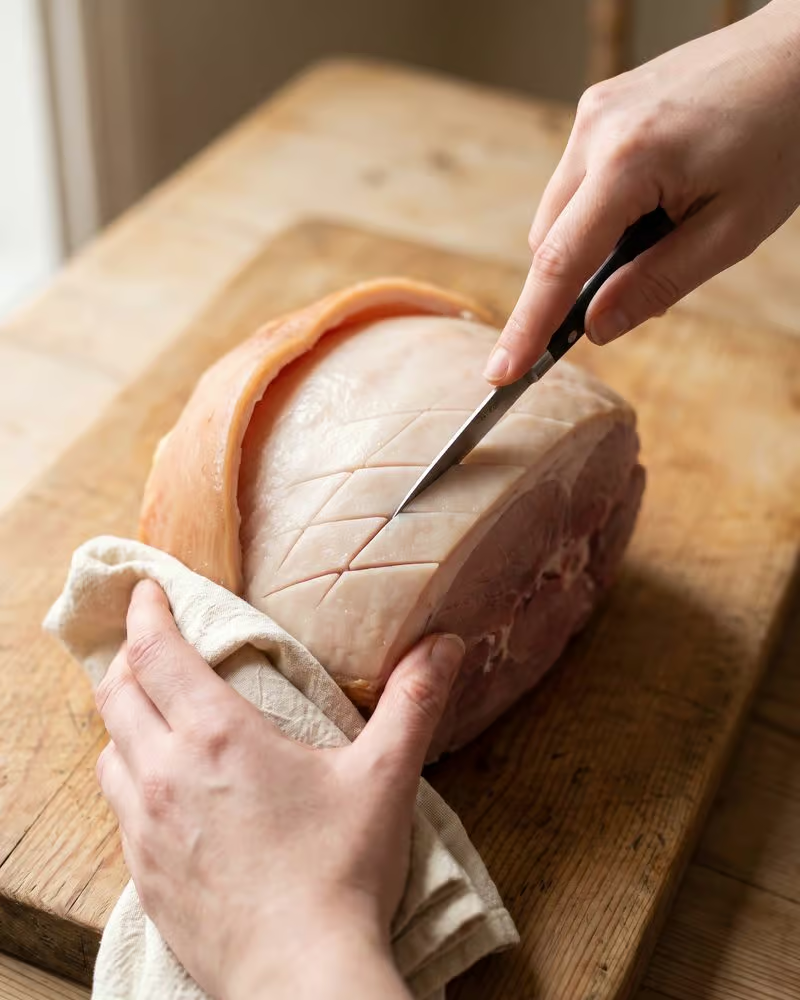
- Strip and score. Snip the string, peel off the rind, leave an even 1 cm layer of fat. Score diamonds about 2 cm apart, through the fat but not the meat. Stud with cloves if using.
- Glaze. Heat the oven to 200 degrees (180 fan). Warm the honey, mustards and sugar in a small pan until the sugar dissolves. Sit the ham in a foil-lined tin and brush on half the glaze.
- Roast. 10 minutes, brush on the rest of the glaze and the tin juices, then 10 to 15 minutes more until dark amber and bubbling. Foil any corner that darkens too fast.
- Rest. At least 15 minutes before carving, or cool fully and serve cold; the glaze firms and the slices hold.
Method 2: slow cooker
The slow cooker replaces the simmer, not the glaze. It frees the hob and nothing boils, but it cannot brown, so the oven blast is not optional.
- Load. Gammon and aromatics into the slow cooker. Pour in the cider and top up with water to about three-quarters cover; the lid traps the steam.
- Cook. Low for 6 to 8 hours or high for 4 to 5 for a 2 kg joint. Slow cookers vary, so probe from 6 hours on low for 70 degrees. Past about 9 hours the joint pulls apart like pulled pork, lovely but not a carving ham.
- Finish. Lift out, stand for 20 minutes, then strip, score, glaze and roast as in steps 3 to 6 above. Pat the fat dry first; a wet joint will not take the glaze.
Two small things that make or break the glaze
The first is the tin. Line it. Honey that drips off the joint hits metal at 200 degrees, sets like toffee and welds on. Foil costs nothing; scrubbing a roasting tin on Christmas Eve costs an hour.
The second: the first brush of glaze is a primer. It soaks into the fat and goes tacky; the second brush builds the lacquer. One thick coat slides off and pools.
Timings by weight
| Joint weight | Hob simmer | Slow cooker, low | Glaze and roast at 200 | Serves |
|---|---|---|---|---|
| 1 kg | 55 to 60 minutes | 4 to 5 hours | 15 to 20 minutes | 4 to 5 |
| 1.5 kg | About 1 hour 25 minutes | 5 to 6 hours | 20 minutes | 6 to 8 |
| 2 kg | About 1 hour 50 minutes | 6 to 8 hours | 20 to 25 minutes | 8 to 10 |
Troubleshooting
The glaze burned. Oven too hot, or the joint went in wet. Pat dry, glaze in two coats, drop to 190. Black clove heads are normal; black fat is not.
The ham is salty. Next time soak it for 12 hours first. This time slice it thinner and add something sweet to the plate, such as hot honey.
The ham is dry. It boiled instead of simmering, or overran in the slow cooker. Slice thinly and warm in its own stock for sandwiches.
Serving, leftovers and safety
Hot, the ham wants something sharp: piccalilli, or a mustard and cider sauce from the stock. Cold, it anchors Boxing Day with a grazing board, and a hot toddy for the cook.
Leftovers follow the turkey rule. The Food Standards Agency says to cool them, cover them and get them into the fridge or freezer within one to two hours, and to eat or freeze them within two days (FSA, Reduce food waste and stay safe this Christmas). Frozen slices keep about two months.
Two notes for families. Gammon is salty, and the NHS lists bacon and similar cured meats among foods to avoid for under-ones (NHS, Foods to avoid giving babies and young children). The same page is clear on honey: do not give it to a child until they are over one year old, because it can occasionally contain bacteria that cause infant botulism. The open jar on the table, not the cooked glaze, is the risk.
The honey we glaze with
Our British heather honey is raw, single-origin and strong enough to argue with mustard. One 280 g jar glazes two hams with some left for the cheese board; the Winter Warmer selection adds wildflower and linden for the season. Our British honey supplier holds SALSA Certification. Free UK delivery on 3 or more jars on any order type, standard delivery 2 to 5 working days, 55 Google reviews at 4.9 stars.
British heather honey Winter Warmer selectionBuying for a ham-maker? The honey gift sets and the Full Collection of all six arrive boxed. Browse the shop, or read our buying guide first.
Questions people ask
Can I cook the gammon the day before and glaze it on Christmas Day?
Yes, and it is the calmest way. Cook, cool, strip and score, then wrap and refrigerate. On the day, let it sit out for an hour, glaze and roast for 25 to 30 minutes at 200 degrees, and probe for 70 degrees again.
Do I have to boil gammon before roasting it?
No. Gammon can be roasted from raw at 180 degrees for about 30 minutes per kg plus 30 minutes, glazed at the end. Cooking it in liquid first gives a juicier, easier-to-score joint.
Which honey is best for a ham glaze?
A strong, dark one. Heather for bitterness and its gel-like cling; sunflower as a rounder second. A set honey is fine because the glaze is warmed anyway; see runny versus set honey.
How long does honey glazed ham keep?
Two days in the fridge, cooled and covered within one to two hours, or about two months frozen in slices. The honey itself keeps very well and remains safe to eat well beyond its best-before date, as we explain in Does honey expire?