

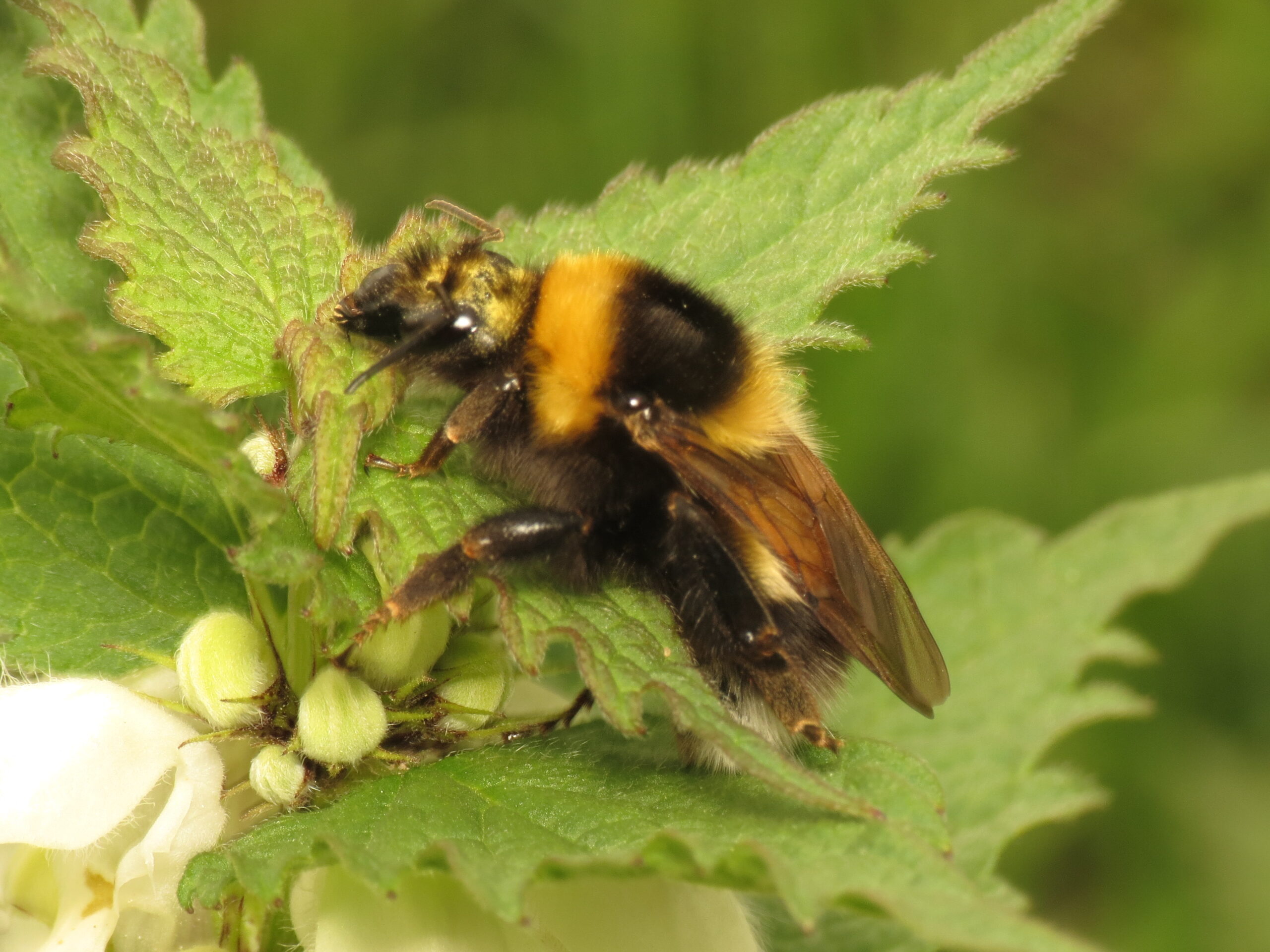
Donald Hobern from Copenhagen, Denmark, CC BY 2.0, via Wikimedia Commons
Garden Bumblebee
Bombus hortorum
Linnaeus, 1761 • Apidae • Megabombus
The garden bumblebee has the longest tongue of any British bumblebee, and it uses it. Where shorter-tongued species give up on deep-tubed flowers or resort to nectar robbing, Bombus hortorum Linnaeus, 1761 extends its tongue into foxgloves, honeysuckle, vetches, red clover and comfrey with ease, reaching nectar that is inaccessible to most other bees. It is a large, shaggy, slightly scruffy-looking species with three yellow bands and a white tail, common in gardens, hedgerows and woodland edges across Britain, and one of the few bumblebees that benefits reliably from diverse flower gardens. Find it on the UK Native Bee Species Map or explore long-tongued bees worldwide in the World Bee Atlas.
Quick Facts
Taxonomy and Classification
The garden bumblebee was described by Carl Linnaeus in 1761. It belongs to the subgenus Megabombus, a grouping of long-tongued bumblebees distributed across Europe and Asia.[1] In Britain, Megabombus contains two long-tongued species: the garden bumblebee and its rarer close relative, the large garden bumblebee (Bombus ruderatus). Both are sometimes confused in the field, though B. ruderatus is a species of open, flower-rich grassland rather than gardens and is considerably scarcer. The species name hortorum is Latin for "of gardens."
| Kingdom | Animalia |
| Phylum | Arthropoda |
| Class | Insecta |
| Order | Hymenoptera |
| Family | Apidae |
| Tribe | Bombini |
| Genus | Bombus Latreille, 1802 |
| Subgenus | Megabombus Dalla Torre, 1880 |
| Species | Bombus hortorum Linnaeus, 1761 |
Identification: The Long Face and Three Yellow Bands
The garden bumblebee is identified by its distinctive combination of markings and a notably long, narrow face. All castes carry three yellow bands: one across the collar (front of thorax), one across the scutellum (rear of thorax, between the wing bases), and one at the base of the abdomen. The tail is white. The face is visibly longer than in other common British bumblebees, earning it the informal description "horse-faced" among field entomologists, and the tongue, when extended, is obviously longer than in neighbouring species.[2]
Queens are 19 to 22 mm, making this one of Britain's larger bumblebee queens. Workers range from 11 to 16 mm and can be quite small early in the season. The coat is long and rather scruffy-looking compared with neater species such as the buff-tailed bumblebee. The pollen basket on each hind tibia carries black hair. The closest confusion species is Bombus ruderatus (large garden bumblebee), which has a similar pattern but is generally larger, less shaggy, and found in different habitats. Bombus jonellus (heath bumblebee) has similar banding but a much shorter face.[2]
The Longest Tongue in Britain
Of Britain's six most common bumblebee species, only two are long-tongued: the garden bumblebee and the common carder bee (Bombus pascuorum).[3] Among all British bumblebees, the garden bumblebee holds the record for the longest tongue relative to body size. This gives it access to flowers that shorter-tongued species cannot exploit through the legitimate floral entrance, including foxgloves, honeysuckle, red clover, vetches, bird's-foot trefoil, comfrey, lungwort, black horehound, woundworts and bindweeds.
The red clover connection
Red clover requires a long-tongued bee to pollinate effectively. The garden bumblebee, along with the common carder bee, is one of the few British species able to reach the nectar at the base of red clover's deep tube. In agricultural systems, the loss of long-tongued bumblebees from farmland has been linked to reduced red clover seed set, with consequences for fodder crop production and soil fertility.[4]
Nesting and Colony Behaviour
The garden bumblebee nests both underground and above ground. Below-ground nests are built in banks and among tree roots; above-ground nests occur in bird boxes, tussocky grass and dense plant litter, and it shares with the early bumblebee an inclination for unusual man-made sites. Colonies contain between 50 and 120 workers and are active from late April to October.[1]
Queens emerge in late March and April and visit spring flowers before founding a nest. Unlike some bumblebees, the garden bumblebee never nectar robs: it has no need to when its tongue can reach the nectar of almost any flower legitimately. Males patrol a fixed circuit around a metre above the ground, marking objects along the route with pheromone to attract new queens. Females mate only once, storing sperm through the winter to fertilise eggs the following spring.[5]
Separating Bombus hortorum from Bombus ruderatus
The garden bumblebee and the large garden bumblebee (B. ruderatus) can be difficult to separate in the field, particularly from queens and large workers. Both have three yellow bands and a white tail. B. ruderatus queens tend to be larger (up to 24 mm) and less shaggy-looking, with a narrower yellow midriff band and a preference for open, flower-rich farmland rather than gardens. Some workers of semi-melanic B. ruderatus overlap significantly with B. hortorum in appearance. BWARS advises multiple clear photographs from different angles before confirming ruderatus.[2]
Deep Flowers and Our Wildflower Honey
The garden bumblebee forages from the same wildflower landscape that produces our British Wildflower Honey: clover, bramble, woundwort, comfrey and the wild herbs of British hedgerows and meadows. It makes no honey itself. But as a pollinator of the plants that honeybees also visit, the garden bumblebee and the honeybee are working the same fields in the same season.
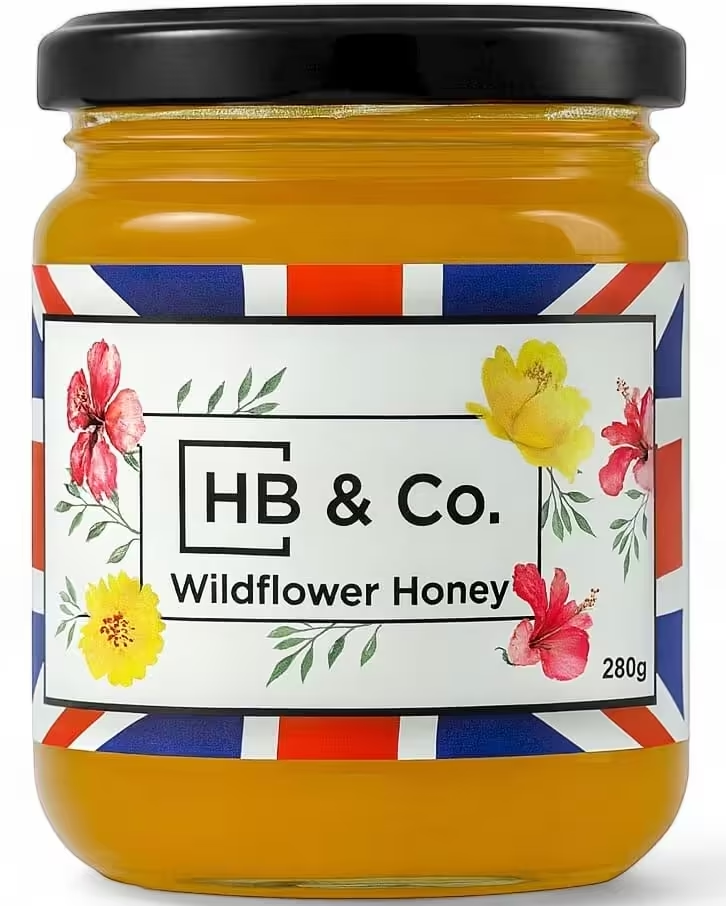
Raw, cold-extracted British wildflower honey from the clover, bramble and hedgerow blossom that garden bumblebees depend on. SALSA-certified British supplier. 280g.
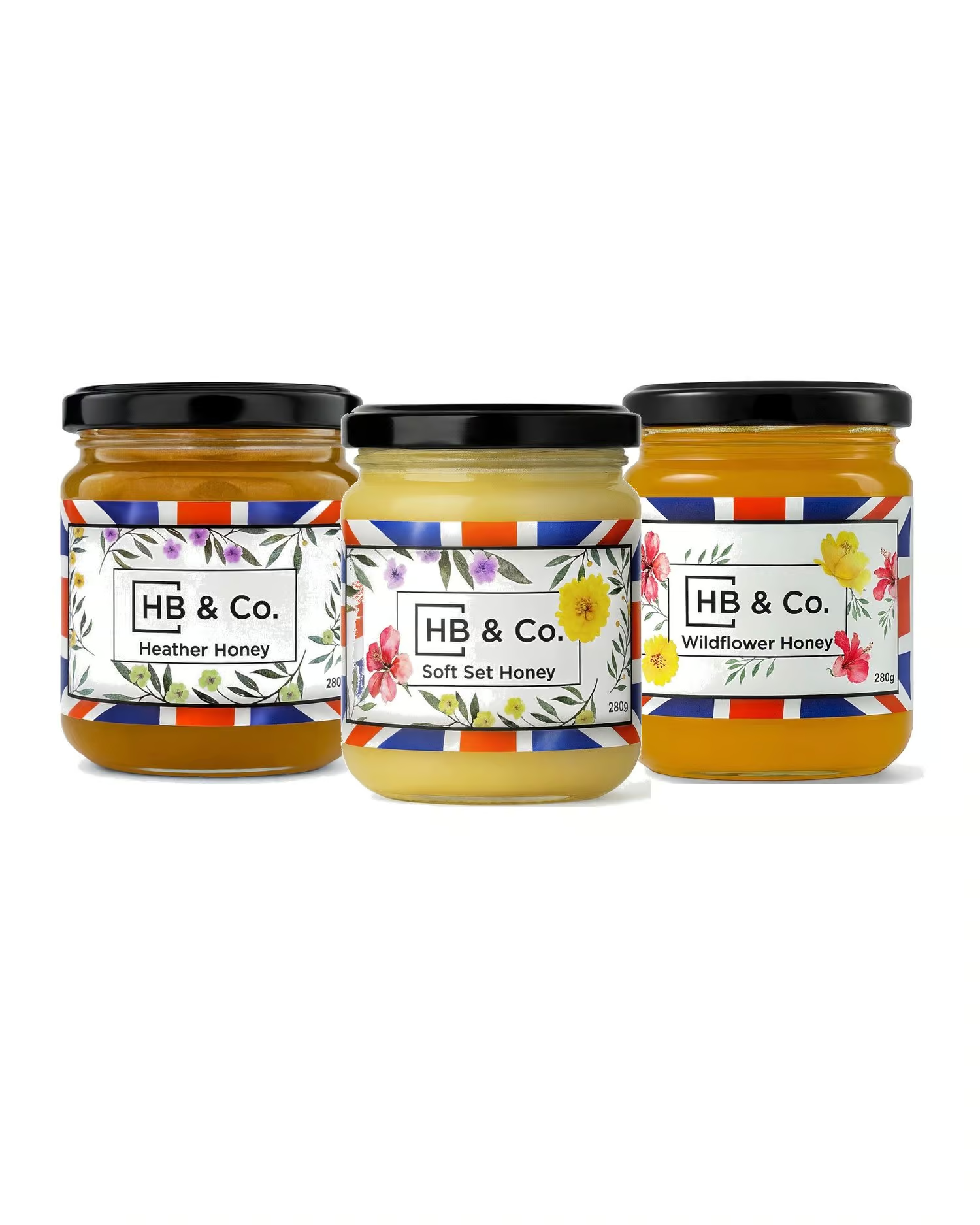
Wildflower, Soft Set and Heather from our SALSA-certified British supplier. Three landscapes, one gift.
Shop British Bundle
Raw single-origin honey every month. Wildflower, Heather, Acacia and more. From £8.79/month.
Start SubscriptionFrequently Asked Questions
How do I identify a garden bumblebee?
Look for a large, shaggy bumblebee with three yellow bands (collar, scutellum, and base of abdomen) and a white tail, and a noticeably long narrow face. The long face is the most reliable field character: it is visibly elongated compared with other common bumblebees. Queens can be very large (up to 22 mm). The coat looks somewhat untidy compared with neater species.
Why does the garden bumblebee have such a long tongue?
The long tongue gives it access to deep-tubed flowers that most other British bumblebees cannot reach through the legitimate floral entrance. Foxgloves, honeysuckle, red clover, vetches, comfrey and woundworts all have corollas that are too deep for short-tongued species. The garden bumblebee can exploit these flowers directly, while shorter-tongued species either ignore them or nectar rob. It is one of only two long-tongued bumblebees among Britain's six commonest species.
Is the garden bumblebee declining?
Long-tongued bumblebees as a group have declined more severely than short-tongued species in Britain, linked to the loss of flower-rich grassland and red clover from farmland since the mid-twentieth century. The garden bumblebee has fared better than its rarer relative Bombus ruderatus, but shows weaker associations with intensively farmed landscapes than short-tongued species.[4] It remains common in gardens, parks and hedgerow-rich landscapes.
What flowers should I plant for garden bumblebees?
Deep-tubed flowers that make use of its long tongue: foxgloves, honeysuckle, red clover, comfrey, lungwort, woundworts, vetches, bird's-foot trefoil, black horehound and teasel. It also visits shallower flowers including bramble, raspberries, thistles and scabious. Having a mix of tube depths benefits all bumblebee species, but the garden bumblebee in particular rewards plantings of tall wildflowers with deep corollas.
How do I tell the garden bumblebee apart from the large garden bumblebee?
Both have three yellow bands and a white tail. The large garden bumblebee (Bombus ruderatus) tends to be slightly larger, less scruffy in appearance, with a narrower yellow midriff band, and is most often found in open flower-rich grassland rather than gardens. Reliable separation requires good photographs from multiple angles. If you are in a garden or urban park, the bee is almost certainly B. hortorum; if on open chalk or clay farmland with abundant red clover, B. ruderatus becomes possible.
When does the garden bumblebee fly?
Queens emerge from late March and April, workers from late April, and new queens and males from July. Colonies are active through to October. The flight season of around six months makes it one of the longer-season British bumblebees. It is present in gardens from the first warm spring days until the last mild days of autumn.
Does the garden bumblebee make honey?
No. Like all bumblebees, it stores only a few days' supply of nectar in the nest. There is no surplus and nothing to harvest. All commercial honey comes from managed honeybee (Apis mellifera) colonies.
Does the garden bumblebee nectar rob?
No. This is one of its notable traits: the garden bumblebee does not nectar rob, even on flowers where nectar robbing by other species is common. Its tongue is long enough to reach the nectar of virtually any British flower through the legitimate entrance, so there is no advantage to biting through the base of the corolla. Short-tongued species like the early bumblebee regularly rob comfrey and other deep flowers.
Sources and References
- Bees, Wasps and Ants Recording Society (BWARS). Bombus hortorum species account: identification, nesting, foraging, cleptoparasites. bwars.com
- Bumblebee Conservation Trust. Bombus hortorum species profile: identification and separation from B. ruderatus. bumblebeeconservation.org
- Thompson, J. N. (2005). Common long-tongued bumblebees in Europe. Summarised in: Goulson, D. (2010). Bumblebees: Behaviour, Ecology and Conservation. Oxford University Press.
- Goulson, D., Lye, G. C. & Darvill, B. (2008). Decline and conservation of bumblebees. Annual Review of Entomology 53:191–208. doi.org
- Animalia.bio. Bombus hortorum: mating, sperm storage and colony cycle. animalia.bio