

 English (UK)
  Italiano
  Français
  简体中文
简体中文  한국어
한국어 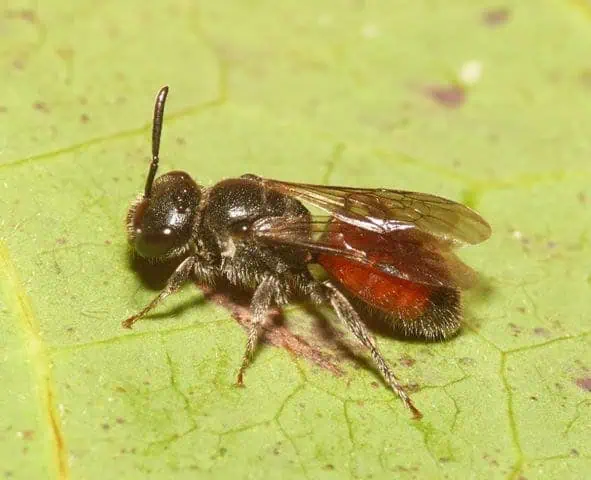
Sphecodes ephippius, the bare-saddled blood bee. Dick Belgers, CC BY 3.0, via Wikimedia Commons.
UK Bee Species
Bare-saddled Blood Bee (Sphecodes ephippius)
Sphecodes ephippius (Linnaeus, 1767) · family Halictidae
The bare-saddled blood bee is a small, almost hairless bee with a black head and thorax and a startling blood-red abdomen. It builds nothing, gathers no pollen and feeds no young of its own. Instead it finds the burrow of a furrow bee and takes it over. It is the commonest and most widespread of Britain's blood bees, and usually the first of them to appear each spring.[2] See where it fits among Britain's bees on the UK Native Bee Species Map, or among the world's bees in the World Bee Atlas.
Quick facts
| Rank | Classification |
|---|---|
| Kingdom | Animalia |
| Phylum | Arthropoda |
| Class | Insecta |
| Order | Hymenoptera |
| Family | Halictidae |
| Genus | Sphecodes |
| Species | Sphecodes ephippius |
The bee that collects no pollen
Nearly every bee a gardener meets is carrying pollen somewhere: on brushes under the abdomen, in baskets on the hind legs, or trapped in dense hair. The blood bees carry none, because they have nowhere to put it. A cleptoparasite has no nest to stock, so the pollen-carrying equipment has simply been lost.
What she needs instead is fuel to fly on. The bare-saddled blood bee takes nectar only, and because her tongue is short she works flowers with shallow open cups: daisies and thistles and their relatives, umbellifers such as hogweed and wild carrot, and members of the pea family.[1] If you find one on a flower it is refuelling, not shopping for her young.
This is the same strategy the nomad bees use on mining bees, and the cuckoo bumblebees use on bumblebees. Britain has a surprising number of these bees, and they are not a marginal curiosity: roughly one bee species in four here lives at another bee's expense.
How to recognise it
The genus is unmistakable and the species is not. Any small bee with a black front half and a bright red abdomen, looking oddly bald compared with the fuzzy bees around it, is a blood bee. Telling which blood bee is another matter entirely.
The bare saddle
The name is the clue. On most female blood bees the sloping front face of the first abdominal segment, the part that faces the thorax like a saddle, carries long dense hair. On this species and on the larger red-tailed blood bee it is almost bare, with only sparse short hairs.[2] Under a hand lens it looks polished where its relatives look furry.
Separating it from the red-tailed blood bee
Two characters do most of the work. The fourth abdominal segment is black on the bare-saddled blood bee and partly red on the red-tailed. And the band of punctures around the base of the second segment is incomplete here, while on the red-tailed it is dense and continuous.[2] Males are harder still and are usually confirmed only by examining the genitalia.[2]
Be honest about photographs. County recorders treat Sphecodes as a group that generally cannot be named from a field photograph. The characters that matter are rarely both visible and sharp, and record verification normally asks for face, side, top and wing views together with a note on which key was used.[4] A red-and-black bee on your hogweed is a blood bee. Calling it this blood bee takes more than a phone camera.
What she actually does, and what nobody has watched
The story you will read almost everywhere runs like this: she forces her way into the host's burrow, past the owner if necessary, opens a sealed cell, kills the host's egg or grub with sickle-shaped jaws, lays her own egg on the stored pollen and leaves.
It is a good story and it is probably close to the truth, because that is broadly what other Sphecodes have been seen to do. But for this species specifically, the record is blunt. The national recording society's account states that the parasitic behaviour has not been observed in any detail, and that there are no rearing records in the literature.[1]
What is actually known, and what is inferred
Known: she is a cleptoparasite; she collects no pollen; she is seen repeatedly around the nest aggregations of furrow bees; several host species have been named by recorders watching her enter their burrows.
Inferred: the sequence inside the cell. The killing, the egg placement, the timing, the fate of the host grub. None of it has been documented in detail for this species, and no one has reared it through to publish what happens.
That gap is worth stating plainly rather than papering over. Britain's commonest blood bee, a bee anyone can find on a roadside umbellifer from spring to autumn, still has an unwatched private life.
Whose nests she uses
Her hosts are furrow bees, the small dark ground-nesting bees of the genera Lasioglossum and Halictus that share her family. Named hosts include the white-zoned furrow bee Lasioglossum leucozonium, L. lativentre and the four-spotted furrow bee L. quadrinotatum, along with Halictus tumulorum, and less common furrow bees are used too.[5] A mining bee, Andrena chrysosceles, has occasionally been implicated, which would be unusual for the genus.[1]
If you want to find her, find them first. She is most often seen low over bare or sparsely vegetated ground where furrow bees are nesting in numbers, working her way across the burrows. Our guides to the common furrow bee, the banded furrow bee, the bronze furrow bee, the green furrow bee and the orange-legged furrow bee cover the bees she depends on. The relationship works the same way as the one between the painted nomad bee and its mining bee host, with a different family at each end.
Where and when to look
She turns up in open woodland, on heaths, on chalk and limestone grassland and along the coast, and in Ireland she is particularly associated with brownfield sites, which is simply where her hosts nest in quantity.[1][3] Females are on the wing from late March to late September, males from mid July into October.[1] That long female season is why she is usually the first blood bee anyone sees in a given year.[2]
In Britain she is widespread across the south, from Cornwall and the Isles of Scilly to Kent, north to Yorkshire and Cumbria, and she is recorded from Wales, the Isle of Man and the Channel Islands, extending thinly into southern Scotland.[1][2]
A live disagreement about Ireland
The national account states she is not presently known from Ireland.[1] An Irish field naturalist describes her as one of the commoner Irish blood bees, widespread across the southern half of the island and up the east coast to the Belfast area, with personal records from Down, Armagh, Wicklow, Dublin and Meath.[3]
Both cannot be current. The most likely explanation is that the national account has not caught up with Irish recording, which is the normal fate of distribution statements for small solitary bees. It also raises a real question: the British host list includes bees that do not occur in Ireland, so if she is there, she is using different hosts, possibly Halictus rubicundus or the larger Lasioglossum species.[3] We report the disagreement rather than choosing a side.
Why a parasite is good news
It is tempting to read a bee like this as a villain, and gardeners sometimes ask whether they should discourage her. The answer is no, for a reason worth understanding.
A cleptoparasite sits at the top of a small food chain and cannot exist without a dense, healthy population of its host. One blood bee implies many furrow bees, which in turn implies undisturbed sunny ground, bare soil to dig in, and enough shallow flowers within range to provision dozens of cells. That is why recorders treat cuckoo bees as indicators: finding her tells you the site underneath is working. Losing her is usually the first sign that the host population has thinned.
Which makes the practical advice unglamorous. Leave a patch of sunny bare or thin ground undug, tolerate the small mounds where furrow bees nest, and let dandelions, hogweed, wild carrot and thistles flower. Do that and both bees look after themselves. More on making room for them in our guide to attracting bees to your garden.
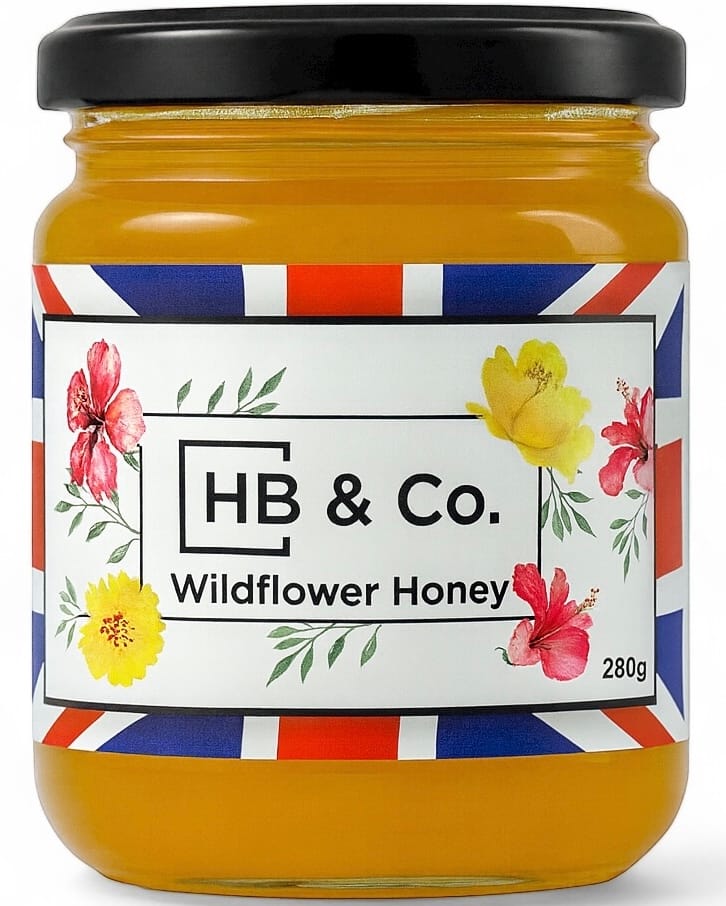
British Wildflower Honey
Raw honey from meadows and hedgerows, the open flowery ground that furrow bees forage. Our British honey supplier holds SALSA Certification. 280g.
Shop Wildflower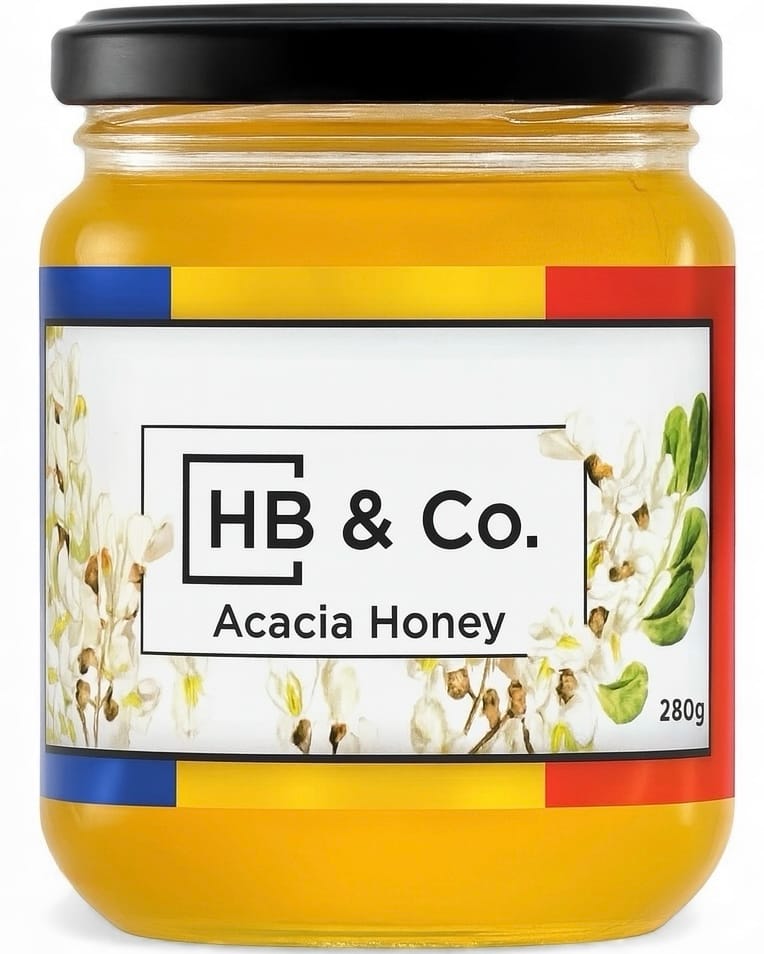
Raw Acacia Honey
Our flagship raw Acacia: pale, delicate and slow to crystallise, from six generations of family beekeeping. 280g.
Shop Acacia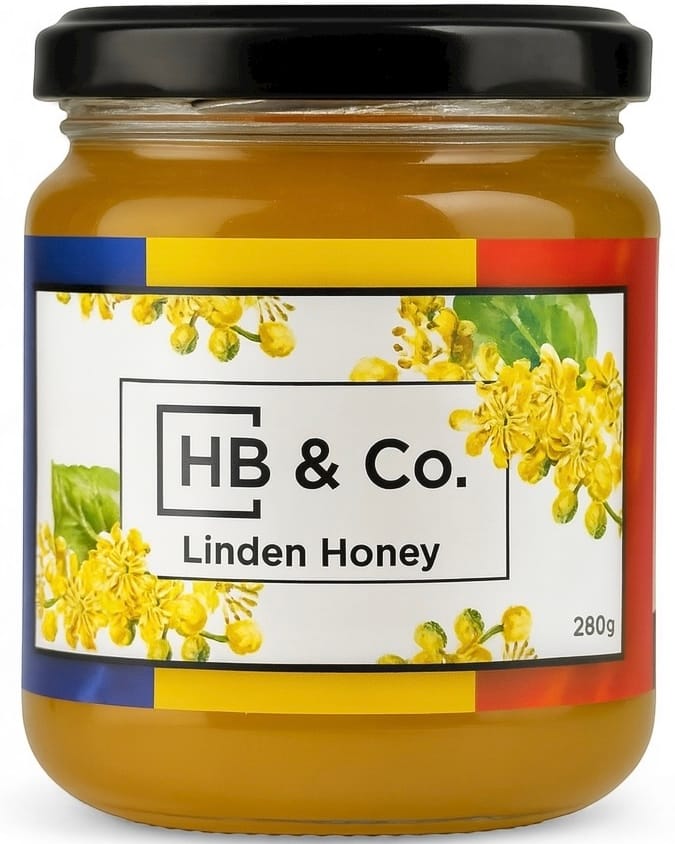
Raw Linden Honey
Herbal and faintly minty, from lime blossom worked by our family's hives. Free UK delivery on orders of 3 or more jars, on any order type. 280g.
Shop LindenBrowse all six raw honeys in the shop, take any single honey on subscription, or start at the HoneyBee & Co. homepage.
Frequently asked questions
Why is it called a blood bee?
For the colour. Bees in the genus Sphecodes have a black head and thorax and a bright red abdomen, which gives the group its English name. The bare-saddled part refers to the almost hairless front face of the first abdominal segment, one of the characters used to separate this species from its relatives.
Does the bare-saddled blood bee sting?
Females have a sting and will use it if handled, but they are small, unaggressive and have no colony to defend. In practice they are harmless to people, pets and children, and the great majority of people who have one in the garden never know it is there.
Does it make honey?
No. It collects no pollen at all and takes nectar only for its own flight, so there is nothing to store and no surplus. Honey in any quantity comes only from honeybees. Compare the bee families in the World Bee Atlas.
What is a cuckoo bee?
A bee that lays its eggs in another bee's nest instead of building one. The cuckoo's larva eats the pollen store the host gathered, and usually the host's own offspring does not survive. Blood bees do this to furrow bees, nomad bees do it to mining bees, and cuckoo bumblebees do it to bumblebees. About a quarter of British bee species live this way.
Which bees does it target?
Furrow bees, principally Lasioglossum species including L. leucozonium, L. lativentre and L. quadrinotatum, plus Halictus tumulorum. Less common furrow bees are used as well, and a mining bee, Andrena chrysosceles, has occasionally been implicated.
How do I tell it from other blood bees?
With difficulty, and usually not from a photograph. The species is separated from the red-tailed blood bee by its black fourth abdominal segment and by the incomplete band of punctures at the base of the second segment. Males normally need examination of the genitalia. If you are submitting a record, expect to provide face, side, top and wing views.
Is it rare?
No. It is not regarded as scarce or threatened, and it is the most frequently encountered blood bee across much of southern Britain. Its apparent scarcity in records has more to do with how hard the genus is to identify than with how many there are.
Should I remove it from my garden?
No, and there would be nothing to remove. A blood bee in the garden is evidence that a healthy furrow bee population is nesting nearby, since a cuckoo cannot persist without plenty of hosts. Leaving sunny bare ground undisturbed and letting dandelions, hogweed and thistles flower supports both bees at once.
Related species
Sources and references
- BWARS (Bees, Wasps and Ants Recording Society). Species account: Sphecodes ephippius (Linnaeus, 1767). Distribution, habitats, univoltine flight period, status, host list, nectar-only flower use, and the statement that the parasitic behaviour has not been observed in detail and no rearing records exist. bwars.com
- Falk, S. Species account for Sphecodes ephippius, accompanying the Field Guide to the Bees of Great Britain and Ireland. Separation characters against S. rubicundus, the bare basal tergite, male genitalia, British range and the note that it is the first Sphecodes to appear in most areas. Steven Falk collection
- The Irish Naturalist. Bare-saddled Blood Bee (Sphecodes ephippius): size, the hairless saddle, Irish distribution and flight period, brownfield habitat, and observations at host burrows. irishnaturalist.com
- NatureSpot. Species page and recording guidance for the bare-saddled blood bee, including the standard that solitary bees and wasps can rarely be identified from field photographs and what a verifiable record must show. naturespot.org
- BWARS host species accounts: Lasioglossum leucozonium, L. lativentre and L. quadrinotatum, each recording Sphecodes ephippius as a cleptoparasite. bwars.com
Dragos NistorFounder, HoneyBee & Co. · Guest Lecturer, University of GreenwichHoneyBee & Co. draws on six generations of family beekeeping heritage, with honey from the Nistor family apiaries in Transylvania and from carefully chosen British producers. Our British honey supplier holds SALSA Certification, and we offer a 15% NHS Discount. Every jar is raw, unfiltered and traceable to the hive.
Published 16 September 2026. Questions are answered on our FAQ page.