

 한국어
한국어  English (UK)
  Italiano
  Français
  简体中文
简体中文 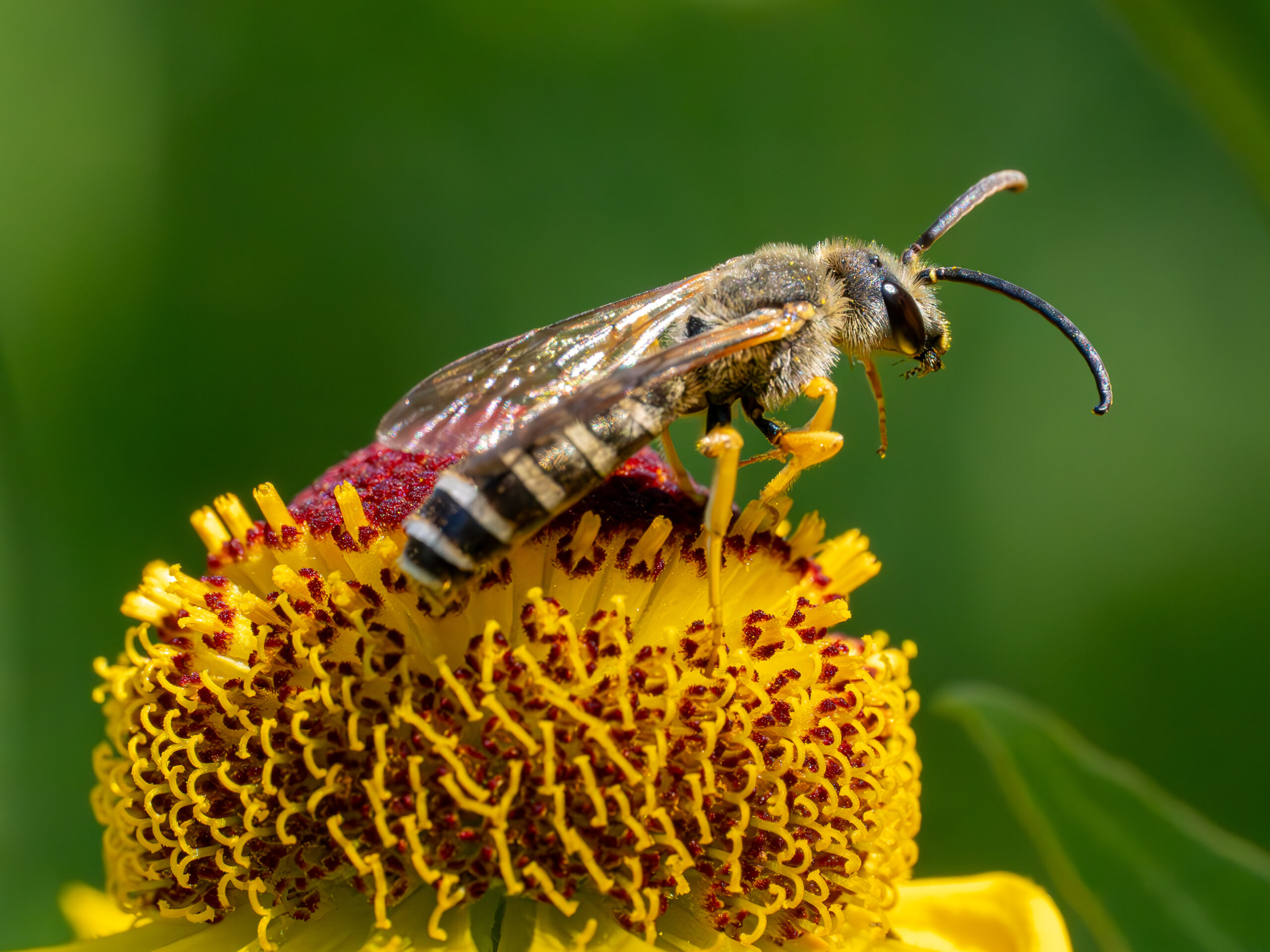 Halictus rubicundus, the orange-legged furrow bee. Reinhold Moller (Ermell), CC BY-SA 4.0, 위키미디어 공용에서.
영국의 벌 종류
주황색 다리를 가진 고랑벌 (Halictus rubicundus)
Halictus rubicundus (Christ, 1791) · family Halictidae
The orange-legged furrow bee is a small, ground-nesting sweat bee with a remarkable trick: in the warm south it lives socially, with a queen and workers, but in the cool north the very same species nests alone. That flexibility has made it one of the most studied bees in the world for understanding how social life evolves. Look for it on bare, sunny banks from spring to autumn. Place it among Britain's bees on the 영국 토종 벌 종 분포 지도, 혹은 전 세계의 꿀벌들 중에서 세계 꿀벌 지도집.
한눈에 보는 정보
| 킹덤 | 동물계 |
| 문 | 절지동물 |
| 수업 | 곤충문 |
| 주문 | 막시류 |
| 가족 | 할릭티과 |
| 속 | 할릭투스 |
| 종 | Halictus rubicundus |
A sweat bee with orange legs
The orange-legged furrow bee is a member of the Halictidae, the sweat bees, so named because some are drawn to perspiration on warm days. Furrow bees take their name from a fine groove down the tip of the female's abdomen.[1] This is a fairly small bee, around a centimetre long, dark brown rather than metallic, with neat pale hair bands across the hind margins of the abdominal segments and, as the name promises, reddish-orange hind legs.[2] Fresh females show a reddish-brown pile on top of the thorax.
In the warmer south of its range the orange-legged furrow bee is eusocial, with a foundress queen and a brood of workers. In the cooler north the same species nests solitarily, each female working alone. This switch makes it a living model for how social behaviour evolves.[4]
How to identify the orange-legged furrow bee
Look for a small, striped, brownish bee with thin pale bands at the rear edges of the abdominal segments and rusty-orange hind legs.[2] Females are most easily confused with the larger furrow bee Lasioglossum xanthopum, but on that species the pale bands sit at the front of each segment rather than the rear.[1] Males are slimmer, with longer antennae and yellow markings on the face and legs; they can be separated from the very rare Halictus eurygnathus by their entirely dark antennae.[1] As with most small solitary bees, certain identification can require a close look at a specimen.
Nesting, lifecycle and society
Nests are dug in bare or sparsely vegetated ground, typically in light soils on warm, south-facing banks and slopes, either singly or in loose aggregations.[1] In social populations a mated queen emerges from hibernation in spring and founds a nest, rears a first brood of mostly small workers, and the colony then produces males and new queens towards the end of summer.[3] Those new queens mate, overwinter, and begin the cycle again. In solitary populations there are no workers at all; each female provisions her own cells.[4]
Adults are on the wing from April to October. The bee visits a wide range of flowers but shows a clear preference for the daisy family, including ragworts, thistles, knapweeds, mayweeds and dandelions.[3]
Whether a population is social or solitary is not fixed by geography alone. Transplant experiments have shown that orange-legged furrow bees retain the flexibility to switch strategy with local conditions, so the simple north-equals-solitary, south-equals-social picture is a useful generalisation rather than a hard rule. There is also long-standing debate over whether a second generation is produced in some warm years.[3][4]
그것이 중요한 이유
The orange-legged furrow bee is both a useful generalist pollinator of meadow and verge flowers and a scientific treasure. Because the same species can be social or solitary, biologists use it to test ideas about why animals live in groups at all. Practically, it needs two simple things: open, flower-rich grassland for forage, and patches of bare, sunny, well-drained ground to nest in. Leaving a south-facing bank or path edge unplanted, and letting daisies, knapweeds and dandelions flower, gives this bee exactly what it needs.
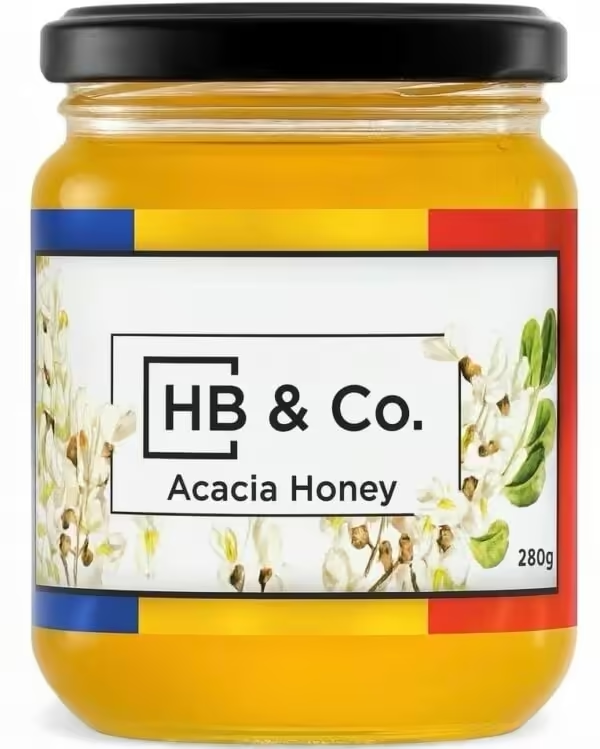
생 아카시아 꿀
당사의 대표 제품인 아카시아 생꿀: 색이 옅고 은은하며 결정화가 느리게 이루어집니다. 280g 용기 하나하나에는 6대에 걸친 가족의 양봉 전통이 담겨 있습니다. £10.99.
아카시아 꿀 쇼핑하기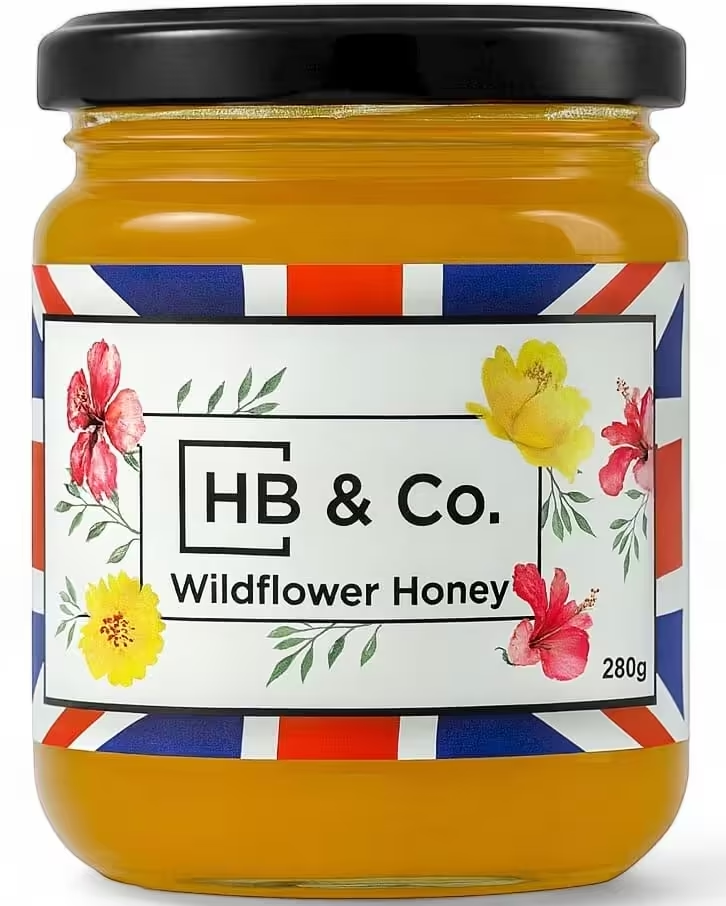
영국산 야생화 꿀
Raw honey from flower-rich Midlands meadows, the same daisy-and-knapweed grassland furrow bees forage. Our British honey supplier holds SALSA Certification. 280g. £10.99.
야생화 꿀 쇼핑하기
구독하고 할인받기 20%
원하는 꿀 한 가지를 선택하시면 매 배송 시 20%를 절약하실 수 있으며, 정기 구독 주문 시 영국 내 무료 배송 혜택을 받으실 수 있습니다.
구독 시작하기자주 묻는 질문
How do I identify an orange-legged furrow bee?
What is a furrow bee or sweat bee?
Is the orange-legged furrow bee social or solitary?
어디에 둥지를 틀까요?
언제 활성화되나요?
Do orange-legged furrow bees sting?
어떤 꽃을 찾아다니나요?
Does the orange-legged furrow bee make honey?
관련 종
황갈색 채굴벌
안드레나 풀바더 보기 → Ground-nesting bee재빛 채굴벌
안드레나 시네라리아더 보기 → 독거벌붉은 벽돌벌
Osmia bicornis더 보기 →출처 및 참고 문헌
- Falk, S. 영국과 아일랜드의 벌에 관한 현장 가이드, 블룸즈버리, 다음 작품에 대한 해설이 수록되어 있음: Halictus rubicundus (size, hair bands, separation from Lasioglossum xanthopum 그리고 Halictus eurygnathus). 스티븐 포크의 플리커 컬렉션.
- BWARS (꿀벌·말벌·개미 기록 협회). 종 설명: Halictus rubicundus (Christ, 1791), eusocial biology, nesting and flight period. bwars.com.
- NatureSpot 및 BWARS의 현장 기록에 따르면 Halictus rubicundus: habitat, forage (Asteraceae) and colony cycle.
- Field, J. et al. Studies on social plasticity in Halictus rubicundus, including transplant experiments showing climate-linked switching between social and solitary nesting (University of Sussex / published research on social plasticity).
- GBIF 사무국. Halictus rubicundus (Christ, 1791): Holarctic distribution and taxonomy. gbif.org.
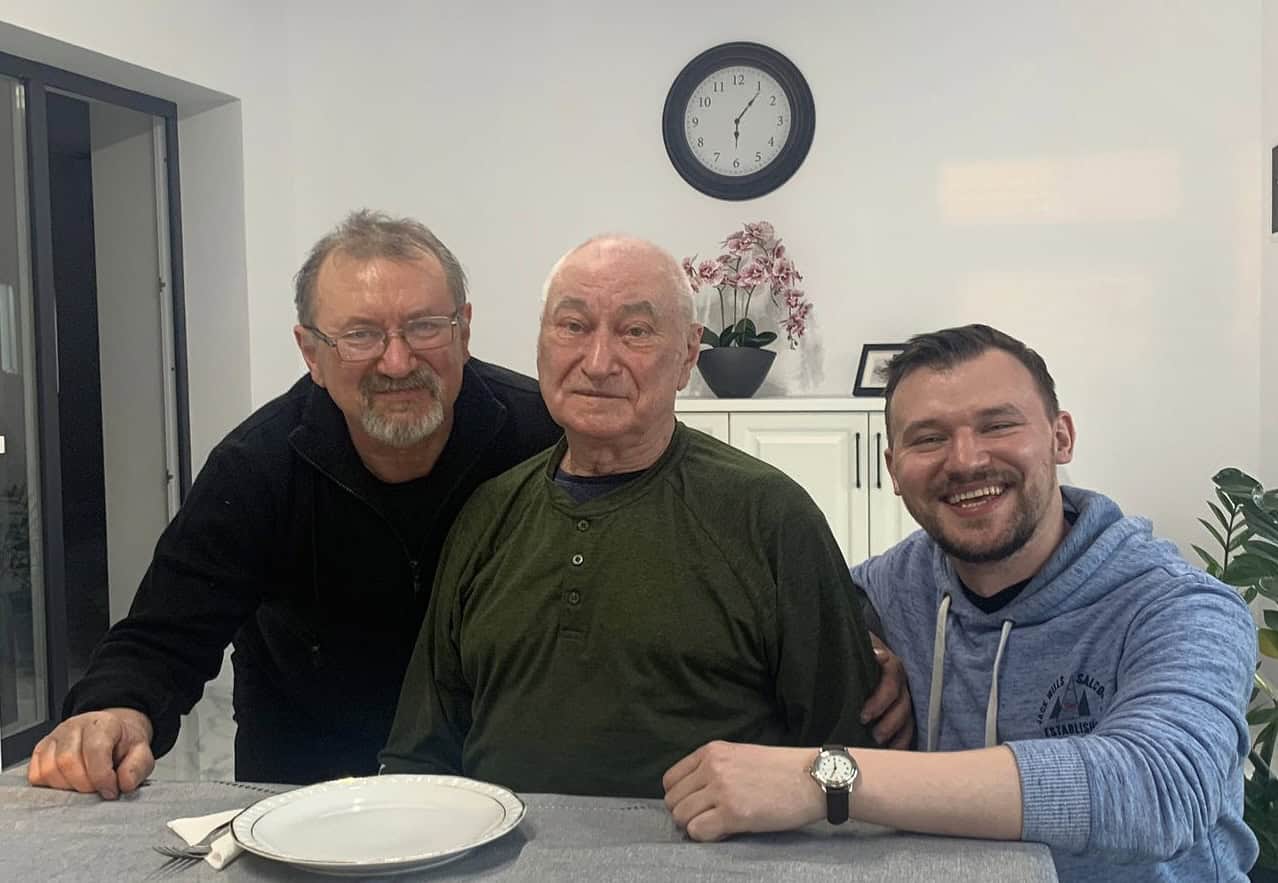
Dragos Nistor
HoneyBee & Co. 설립자 · 그리니치 대학교 객원 강사
HoneyBee & Co.는 6대에 걸쳐 이어져 온 가족의 양봉 전통을 바탕으로, 니스토르(Nistor) 가문의 양봉장과 엄선된 영국 생산자들로부터 공급받은 꿀을 사용합니다. 당사의 영국산 꿀 공급업체는 SALSA 인증을 보유하고 있으며, 15% NHS 할인을 제공합니다. 모든 병은 가공되지 않은 생꿀로, 여과 과정을 거치지 않았으며, 어느 벌통에서 생산되었는지 추적할 수 있습니다.