

 Français
  English (UK)
  Italiano
  简体中文
简体中文  한국어
한국어 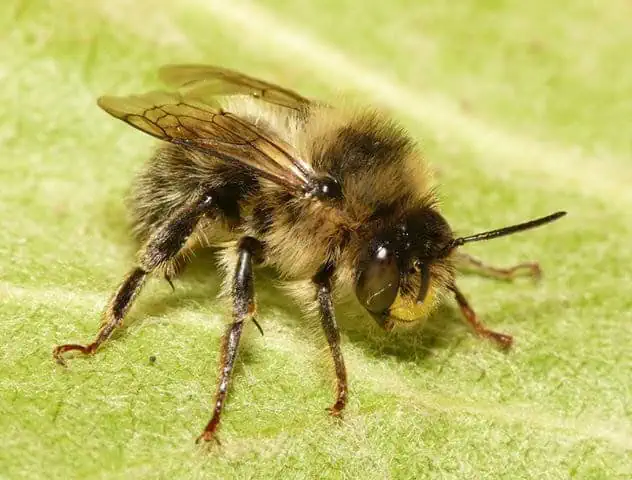
Anthophora furcata, the fork-tailed flower bee. Dick Belgers, CC BY 1.0, via Wikimedia Commons.
Espèces d'abeilles au Royaume-Uni
Abeille à queue fourchue des fleurs (Anthophora furcata)
Anthophora furcata (Panzer, 1798) · family Apidae
Most people who meet this bee think they have seen a small ginger bumblebee. They have not. It is a flower bee, it flies in fast darting bursts with a high shrill buzz, and it does something no other British flower bee does: it chews its nest out of rotten wood instead of digging it in the ground.[1] It also carries a tongue nearly as long as its own body, which decides almost everything about where it feeds.[3] Découvrez où elle se situe parmi les abeilles britanniques sur le Carte des espèces d'abeilles indigènes du Royaume-Uni, ou parmi les abeilles du monde entier dans la catégorie Atlas mondial des abeilles.
En bref
| Classement | Classification |
|---|---|
| Royaume | Animalia |
| Embranchement | Arthropodes |
| Classe | Insectes |
| Commande | Hyménoptères |
| Famille | Apidae |
| Genre | Anthophora |
| Espèces | Anthophora furcata |
The flower bee that gave up digging
Flower bees are ground bees. Most British species tunnel into soil, cliffs, banks and soft mortar, sometimes in noisy aggregations of hundreds. This one does not. It excavates its burrows in rotten wood, in dead trees, fence posts and driftwood on the coast, and a nest generally runs as two or more parallel tunnels. The cells are oval widenings of the burrow, each lined with compacted wood dust.[1]
There is a second oddity that fits the first. This is the only British Anthophora with three teeth on the mandible rather than two, with an inner and an outer subapical tooth.[1][2]
Known, and inferred
On sait que : it nests in rotten wood, alone among British flower bees. It has a third mandibular tooth, alone among British flower bees. Both facts are in the standard accounts.
Déduit : that the jaw exists because of the wood. It is an obvious reading and very likely right, since chewing timber asks more of a mandible than shifting soil does, but we have not found a study that tests it. Treat the connection as a good hypothesis rather than a fact, which is more than most pages will tell you.
How to tell it from a bumblebee
The confusion is almost always with the abeille cardeuse commune, which is a similar size and a similar gingery brown.[4] Three things separate them, and none needs a hand lens.
The flight
Flower bees move in fast darting bursts, hover, then vanish. Carder bumblebees trundle. Once you have watched both, the difference is unmistakable at ten paces, and the sound helps too: flower bees carry a high shrill buzz where bumblebees hum lower.[4]
The face
Males have a bright yellow face with very little hair on it.[3] No British bumblebee looks like that. If you see the yellow mask, you have a male flower bee.
The tail
Females are brown all over with a small orange-red tip to the abdomen, and dense brown hair on the hind legs.[3][4] The name comes from the males, whose abdomen tip carries two projections. Two other flower bees have that character but far less developed.[2]
A note on records. Solitary bees can rarely be named from a field photograph, and verification for this group normally asks for face, side, top and wing views, the sex, and which key characters were matched.[3] The flight and the yellow face will tell you it is a flower bee. Species-level certainty asks for more.
The tongue decides the menu
An extended tongue around 12mm long, on a bee of 10 to 14mm, is a specialised instrument.[3][5] It buys access to flowers where the nectar sits at the bottom of a deep tube, which most short-tongued bees cannot reach, and the plants that offer it are largely one family: the dead-nettles.
Pollen comes chiefly from hedge woundwort, black horehound, wood sage and their relatives, along with garden sages and lamb's ear.[2][5] Those are high-reward flowers, and this bee needs them, because a fast darting flight is expensive to run.[5]
Which gives the only garden advice that matters for this species, and it comes in two parts that must both be true. Plant woundworts, wood sage or black horehound, in a patch rather than as single specimens.[5] And leave a pile of old soft logs somewhere out of the way. Flowers without dead wood, or dead wood without those flowers, and it has no reason to stay. Our guide to attirer les abeilles dans votre jardin and the one on which flowers bees actually use cover the wider version of this.
Où vit-il ?
It is the most widespread British flower bee, recorded north to the Moray Firth in Scotland, and effectively ubiquitous in lowland Britain: gardens, woodland, grassland, moors, heaths and fens.[1][2] There are no records from Ireland or the Channel Islands.[1] Beyond Britain it is a Eurasian bee whose range reaches Kashmir.[1]
It is not scarce or threatened, but it is inconspicuous and quick, and it is widely thought to be under-recorded simply because people see a small brown bumblebee and stop looking.[4]
Its own cuckoos are sharp-tail bees, Coelioxys rufescens et C. quadridentata.[2] The same genus appears on our brown-footed leafcutter bee page, attacking a different host in a different family, which is a good illustration of how these cuckoos work across the bee world rather than within one branch of it.
Miel de fleurs sauvages britannique
Raw honey from mixed summer flowers, the hedge banks and rough margins where woundworts grow. Our British honey supplier holds SALSA Certification. 280g.
Boutique Wildflower
Miel de bruyère brut
Dark and bold, from the late summer moors where this bee is also recorded. 280g.
Boutique Heather
Miel d'acacia brut
De couleur pâle, délicat et à cristallisation lente. Livraison gratuite au Royaume-Uni pour toute commande de 3 pots ou plus, quel que soit le type de commande. 280g.
Boutique AcaciaDécouvrez les six miels bruts proposés dans la boutique, ou commencer par le Page d'accueil de HoneyBee & Co..
Questions fréquemment posées
Est-ce un bourdon ?
Non, bien qu'on la confonde souvent avec une abeille, généralement l'abeille cardeuse commune. Les abeilles butineuses volent par saccades rapides en émettant un bourdonnement aigu et stationnent entre les fleurs, tandis que les bourdons se déplacent de manière plus régulière en émettant un bourdonnement plus grave. Les mâles ont également un visage jaune vif, ce qui n'est le cas d'aucun bourdon britannique.
Pourquoi l'appelle-t-on « à queue fourchue » ?
Chez le mâle, l'extrémité de l'abdomen présente deux petites protubérances. Deux autres espèces d'abeilles florifères britanniques présentent la même caractéristique, mais de manière beaucoup moins marquée. Les femelles, quant à elles, ont l'extrémité de l'abdomen de couleur rouge-orange et ne présentent aucune trace de jaune sur le visage.
Où fait-il son nid ?
Dans le bois pourri. C'est la seule abeille butineuse britannique à procéder ainsi : elle creuse des galeries dans le bois mort, les poteaux de clôture et le bois flotté des côtes, plutôt que de creuser dans le sol ou les talus. Un nid se compose généralement de deux tunnels parallèles ou plus, comportant des alvéoles ovales tapissées de sciure compactée.
Quelles fleurs devrais-je y planter ?
Les plantes de la famille des lamier, aux fleurs en profondeur : l'herbe-à-pierre, la marrubie noire, la sauge des bois, les sauges potagères et l'oreille-d'agneau. Plantez-les en massif plutôt qu'isolées. Les fleurs seules ne suffisent toutefois pas. Sans bois mort tendre à proximité pour nicher, rien ne retient ces oiseaux.
Quelle est la longueur de sa langue ?
Environ 12 mm lorsqu'elle est déployée, sur une abeille mesurant entre 10 et 14 mm, soit une longueur proche de celle de son propre corps. Cette portée lui permet d'atteindre le nectar situé au fond des fleurs tubulaires, ce qui explique pourquoi elle se spécialise dans la famille des lamier plutôt que dans les fleurs ouvertes telles que les marguerites.
Cela pique-t-il ?
Les femelles peuvent le faire, mais uniquement si on les manipule. C’est une abeille solitaire qui n’a pas de colonie à défendre, et elle s’intéresse bien plus à la « woundwort » qu’à vous. Les mâles n’ont pas de dard du tout.
Est-ce qu'il produit du miel ?
No. Each female provisions her own cells for her own larvae, with nothing stored and no surplus. Only honeybees produce honey in quantity. Compare the bee families in the Atlas mondial des abeilles.
En trouve-t-on en Irlande ?
No. There are no records from Ireland or the Channel Islands. In Britain it is the most widespread of our flower bees, reaching as far north as the Moray Firth, and it is thought to be under-recorded because it is quick, inconspicuous and easily written off as a small bumblebee.
Espèces apparentées
Sources et références
- BWARS (Association pour le recensement des abeilles, des guêpes et des fourmis). Fiche d'espèce : Anthophora furcata (Panzer, 1798). Nesting in rotten wood, parallel burrows and wood-dust-lined cells, tridentate mandible, distribution including the absence of Irish and Channel Island records, Eurasian range, habitats, univoltine flight period and status. bwars.com
- Falk, S. Fiche descriptive de l'espèce Anthophora furcata, en annexe au Guide de terrain des abeilles de Grande-Bretagne et d'Irlande. Male yellow face and paired abdominal projections, female orange-tipped abdomen, the three apical mandibular teeth, range to the Moray Firth, pollen sources among the lamiates, and the Coelioxys cuckoos. Collection Steven Falk
- NatureSpot. Species page for the fork-tailed flower bee: size, tridentate mandible, tongue length relative to the body, brown eyes, sexual differences, flight period, and the recording standard for solitary bees. naturespot.org
- Natural History Society of Northumbria. Species profile: separation from the common carder bee by flight behaviour and sound, the yellow male face, dense hind-leg hair, dead-wood nesting and the likelihood of under-recording. nhsn.org.uk
- Field observations of nesting and foraging in a wildlife garden, including tongue length of about 12mm, use of hedge woundwort, black horehound and wood sage, the high nectar reward these flowers offer, and planting in quantity rather than singly. My Biodiversity Garden
Dragos NistorFondateur, HoneyBee & Co. - Conférencier invité, Université de GreenwichHoneyBee & Co. s'appuie sur six générations d'expérience familiale en apiculture, avec du miel provenant des ruchers de la famille Nistor à Transylvania et de producteurs britanniques soigneusement sélectionnés. Notre fournisseur de miel britannique est titulaire de la certification SALSA, et nous proposons une remise de 15% NHS. Chaque pot contient du miel brut, non filtré et dont la traçabilité remonte jusqu'à la ruche.
Publié le 16 septembre 2026. Vous trouverez les réponses à vos questions sur notre Page FAQ.