

 简体中文
简体中文  English (UK)
  Italiano
  Français
  한국어
한국어 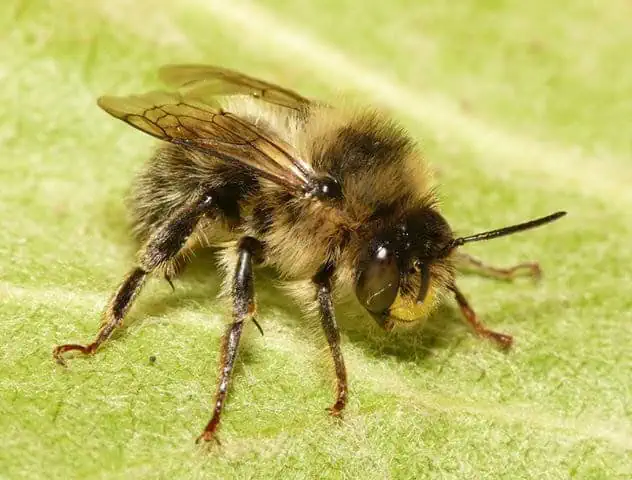
Anthophora furcata, the fork-tailed flower bee. 迪克·贝尔格斯, CC BY 1.0, 通过维基共享资源。.
英国蜜蜂品种
叉尾花蜂 (Anthophora furcata)
Anthophora furcata (Panzer, 1798) · family Apidae
Most people who meet this bee think they have seen a small ginger bumblebee. They have not. It is a flower bee, it flies in fast darting bursts with a high shrill buzz, and it does something no other British flower bee does: it chews its nest out of rotten wood instead of digging it in the ground.[1] It also carries a tongue nearly as long as its own body, which decides almost everything about where it feeds.[3] 在 英国本土蜜蜂物种地图, 的世界蜜蜂中,或在 世界蜜蜂地图集.
简要信息
| 排名 | 分类 |
|---|---|
| 王国 | 动物 |
| 门类 | 节肢动物 |
| 班级 | 昆虫 |
| 订购 | 膜翅目 |
| 家庭 | 蛛形纲 |
| 属 | Anthophora |
| 物种 | Anthophora furcata |
The flower bee that gave up digging
Flower bees are ground bees. Most British species tunnel into soil, cliffs, banks and soft mortar, sometimes in noisy aggregations of hundreds. This one does not. It excavates its burrows in rotten wood, in dead trees, fence posts and driftwood on the coast, and a nest generally runs as two or more parallel tunnels. The cells are oval widenings of the burrow, each lined with compacted wood dust.[1]
There is a second oddity that fits the first. This is the only British Anthophora with three teeth on the mandible rather than two, with an inner and an outer subapical tooth.[1][2]
Known, and inferred
已知: it nests in rotten wood, alone among British flower bees. It has a third mandibular tooth, alone among British flower bees. Both facts are in the standard accounts.
推断: that the jaw exists because of the wood. It is an obvious reading and very likely right, since chewing timber asks more of a mandible than shifting soil does, but we have not found a study that tests it. Treat the connection as a good hypothesis rather than a fact, which is more than most pages will tell you.
How to tell it from a bumblebee
The confusion is almost always with the 胡蜂, which is a similar size and a similar gingery brown.[4] Three things separate them, and none needs a hand lens.
The flight
Flower bees move in fast darting bursts, hover, then vanish. Carder bumblebees trundle. Once you have watched both, the difference is unmistakable at ten paces, and the sound helps too: flower bees carry a high shrill buzz where bumblebees hum lower.[4]
The face
Males have a bright yellow face with very little hair on it.[3] No British bumblebee looks like that. If you see the yellow mask, you have a male flower bee.
The tail
Females are brown all over with a small orange-red tip to the abdomen, and dense brown hair on the hind legs.[3][4] The name comes from the males, whose abdomen tip carries two projections. Two other flower bees have that character but far less developed.[2]
A note on records. Solitary bees can rarely be named from a field photograph, and verification for this group normally asks for face, side, top and wing views, the sex, and which key characters were matched.[3] The flight and the yellow face will tell you it is a flower bee. Species-level certainty asks for more.
The tongue decides the menu
An extended tongue around 12mm long, on a bee of 10 to 14mm, is a specialised instrument.[3][5] It buys access to flowers where the nectar sits at the bottom of a deep tube, which most short-tongued bees cannot reach, and the plants that offer it are largely one family: the dead-nettles.
Pollen comes chiefly from hedge woundwort, black horehound, wood sage and their relatives, along with garden sages and lamb's ear.[2][5] Those are high-reward flowers, and this bee needs them, because a fast darting flight is expensive to run.[5]
Which gives the only garden advice that matters for this species, and it comes in two parts that must both be true. Plant woundworts, wood sage or black horehound, in a patch rather than as single specimens.[5] And leave a pile of old soft logs somewhere out of the way. Flowers without dead wood, or dead wood without those flowers, and it has no reason to stay. Our guide to 为您的花园吸引蜜蜂 and the one on which flowers bees actually use cover the wider version of this.
栖息地
It is the most widespread British flower bee, recorded north to the Moray Firth in Scotland, and effectively ubiquitous in lowland Britain: gardens, woodland, grassland, moors, heaths and fens.[1][2] There are no records from Ireland or the Channel Islands.[1] Beyond Britain it is a Eurasian bee whose range reaches Kashmir.[1]
It is not scarce or threatened, but it is inconspicuous and quick, and it is widely thought to be under-recorded simply because people see a small brown bumblebee and stop looking.[4]
Its own cuckoos are sharp-tail bees, Coelioxys rufescens 和 C. quadridentata.[2] The same genus appears on our brown-footed leafcutter bee page, attacking a different host in a different family, which is a good illustration of how these cuckoos work across the bee world rather than within one branch of it.
英国野花蜂蜜
Raw honey from mixed summer flowers, the hedge banks and rough margins where woundworts grow. Our British honey supplier holds SALSA Certification. 280g.
野花商店
浏览本店全部六款原生态蜂蜜, ,或者从 HoneyBee & Co. 主页.
常见问题
这是一只大黄蜂吗?
不,尽管它常被误认为是蜂,通常是常见的采蜜蜂。采蜜蜂飞行时动作迅捷、突兀,伴随着高亢刺耳的嗡嗡声,并在花间悬停;而大黄蜂的飞行则更为平稳,发出低沉的嗡嗡声。雄性采蜜蜂的面部呈鲜黄色,而英国的大黄蜂中没有这种特征。.
为什么叫“叉尾”呢?
雄蜂的腹部末端有两个小突起。另外两种英国花蜂也具有这一特征,但不那么明显。雌蜂的腹部末端则呈橙红色,且面部无黄色。.
它在哪里筑巢?
在腐木中。这是英国唯一一种在腐木中筑巢的花蜂,它们会在枯木、围栏柱和沿海的漂流木上啃出洞穴,而不是在土壤或河岸中挖掘。一个巢穴通常由两条或更多条平行的隧道组成,其中椭圆形的蜂房内壁铺满了压实的木屑。.
我应该种什么花呢?
死荨麻科中花朵深陷的植物:篱笆伤草、黑马鞭草、林地鼠尾草、园艺鼠尾草和羊耳草。应成片种植,而非单独种植。不过,光有花是不够的。如果附近没有供筑巢用的柔软枯木,就无法留住它们。.
它的舌头有多长?
伸展后约为12毫米,而这种蜜蜂的体长为10至14毫米,因此伸展长度几乎与它自身的体长相当。凭借这样的伸展范围,它能够触及管状花深处的花蜜,这也正是它专攻死荨麻科植物而非雏菊等开放花朵的原因。.
刺痛吗?
雌蜂可以蜇人,但仅限于被触碰时。这是一种独居蜂,没有蜂群需要守护,而且它对伤草的兴趣远大于对你。雄蜂则完全没有螫针。.
它会产蜜吗?
No. Each female provisions her own cells for her own larvae, with nothing stored and no surplus. Only honeybees produce honey in quantity. Compare the bee families in the 世界蜜蜂地图集.
Is it found in Ireland?
No. There are no records from Ireland or the Channel Islands. In Britain it is the most widespread of our flower bees, reaching as far north as the Moray Firth, and it is thought to be under-recorded because it is quick, inconspicuous and easily written off as a small bumblebee.
相关物种
来源与参考文献
- BWARS(蜜蜂、黄蜂和蚂蚁记录协会)。物种简介: Anthophora furcata (Panzer, 1798). Nesting in rotten wood, parallel burrows and wood-dust-lined cells, tridentate mandible, distribution including the absence of Irish and Channel Island records, Eurasian range, habitats, univoltine flight period and status. bwars.com
- Falk, S. 物种描述 Anthophora furcata, ,随同 大不列颠及爱尔兰蜜蜂实地指南. Male yellow face and paired abdominal projections, female orange-tipped abdomen, the three apical mandibular teeth, range to the Moray Firth, pollen sources among the lamiates, and the Coelioxys cuckoos. 史蒂文·福尔克收藏
- NatureSpot. Species page for the fork-tailed flower bee: size, tridentate mandible, tongue length relative to the body, brown eyes, sexual differences, flight period, and the recording standard for solitary bees. naturespot.org
- Natural History Society of Northumbria. Species profile: separation from the common carder bee by flight behaviour and sound, the yellow male face, dense hind-leg hair, dead-wood nesting and the likelihood of under-recording. nhsn.org.uk
- Field observations of nesting and foraging in a wildlife garden, including tongue length of about 12mm, use of hedge woundwort, black horehound and wood sage, the high nectar reward these flowers offer, and planting in quantity rather than singly. My Biodiversity Garden
Dragos NistorHoneyBee & Co. 创始人 - 格林威治大学客座讲师HoneyBee & Co. 承袭了六代家族养蜂传统,所用蜂蜜源自 Transylvania 地区的尼斯特家族蜂场以及精心挑选的英国生产商。我们的英国蜂蜜供应商持有 SALSA 认证,我们提供 15% NHS 折扣。 每罐蜂蜜均为原生态、未经过滤,且可追溯至具体蜂箱。.
发布于2026年9月16日。相关问题请访问我们的 FAQ 页面.