

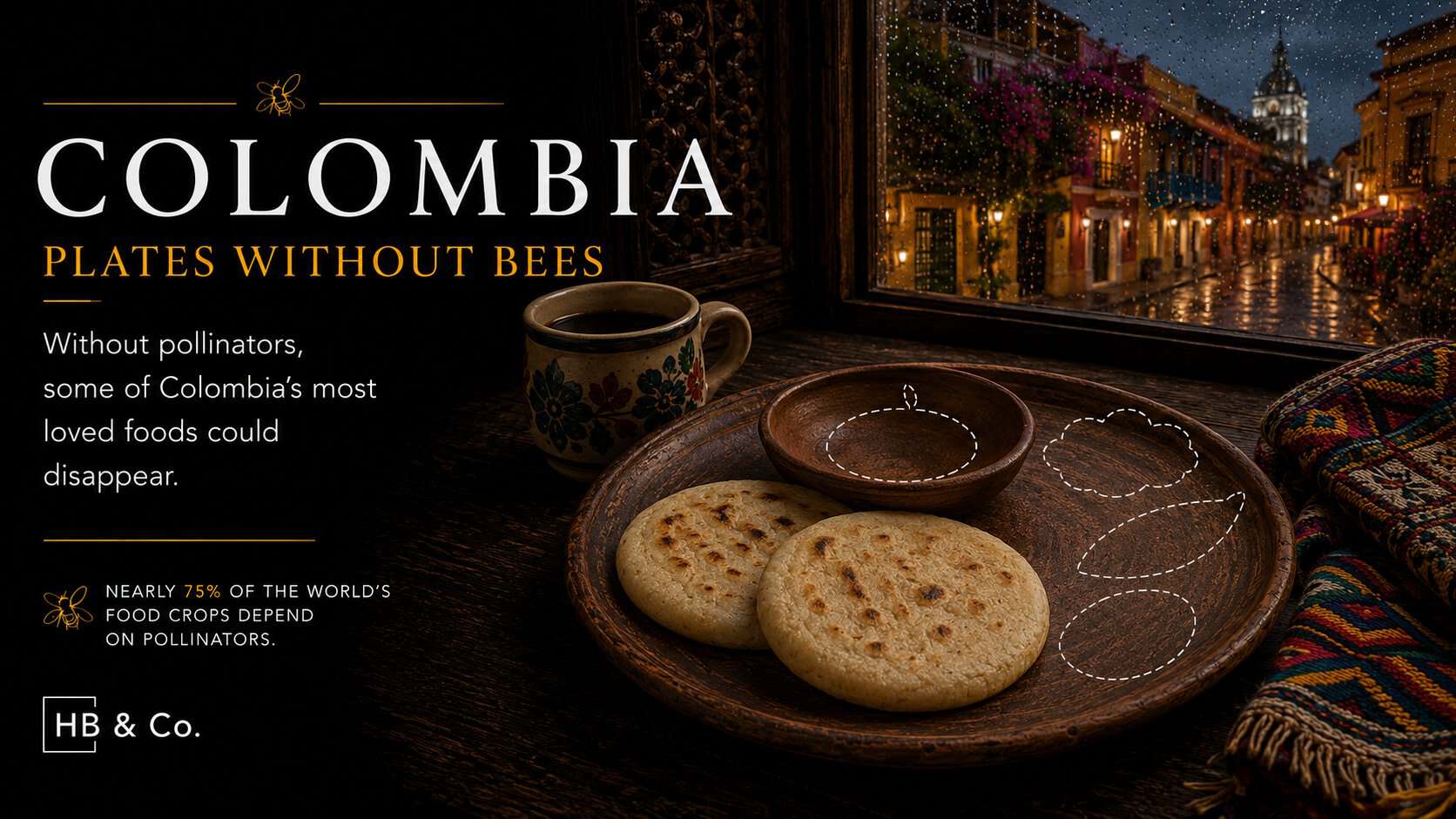
Colombia's Plate Sans abeilles
Six iconic Colombian dishes. Over 1,500 native bee species. What vanishes from the plate when the pollinators disappear.
 Royaume-Uni
 Italie
 France
 Espagne
 Allemagne
 Grèce
Grèce
 Portugal
 Roumanie
 Turquie
 États-Unis
 Mexique
 Brésil
 Argentine
 Pérou
Pérou
 Colombie
 Chine
Chine
 Japon
Japon
 Corée du Sud
 Thaïlande
 Vietnam
 Indonésie
 Philippines
 Inde
Inde
 Pakistan
 Maroc
Maroc
 Égypte
 Liban
Liban
 Arabie Saoudite
 Éthiopie
 Nigéria
- 87 des principales cultures vivrières du monde dépendent, dans une certaine mesure, de la pollinisation animale (Klein et al., 2007).
- Without bees, Colombian Arepas con Hogao lose their tomato-onion sauce entirely - both primary hogao ingredients are pollinator-dependent
- Colombia has over 1,500 native bee species - the third-highest bee diversity in the Americas
- Colombia is the world's second-largest coffee producer; bee cross-pollination increases Colombian Arabica yields by 15-20% in field studies
- Colombian avocado Hass production in Antioquia and the Eje Cafetero depends on managed honeybee colonies during flowering
Why Colombian Cuisine Depends on Bees
Colombian food is the cuisine of hogao - the tomato and spring onion sauce accompanying everything from rice to eggs to Bandeja Paisa. Hogao contains tomatoes (65%) and spring onion (65%) as its two primary ingredients, both pollinator-dependent. Without bees, hogao cannot be made. Arepas, Colombia's most eaten food, are made from corn (wind-pollinated, unaffected). But the avocado (95%), tomato (65%), and hogao sauce that accompany them are all pollinator-dependent. Bandeja Paisa loses its avocado slice and tomato salsa. Cholado loses mango (25%), strawberries (95%), passion fruit (95%), lychee (95%), and pineapple (25%) - five fruit toppings, all pollinator-dependent. Without bees, Colombian tropical fruit culture disappears entirely.
Colombia is the world's second-largest coffee producer, and bee cross-pollination has been shown to increase Colombian Arabica yields by 15-20% in field studies. At the scale of Colombia's coffee industry - worth over 2 billion dollars in annual exports - a 20% yield benefit from bee pollination represents enormous economic value. Colombian coffee-growing regions from Huila to Nariño to Antioquia support native bee populations in the shade-grown forest margins that many traditional Colombian coffee farms maintain.
The Science Behind Colombian Crop Pollination
Key Colombian pollinator dependencies: tomatoes (65%), spring onions (65%), avocado (95%), passion fruit (95%), mango (25%), cucumber (95%), lemon (65%), coriander (65%), and coffee (25% modest). Our Miel d'acacia provient des forêts des Carpates Transylvanian. Pour en savoir plus A propos de la page, essayez notre abonnement au miel et économiser 20%, ou explorer les Atlas mondial des abeilles. Pour le déclin des abeilles, lisez notre article sur pourquoi les populations d'abeilles diminuent.
Miel brut. Magasin HoneyBee & Co.
Miel brut d'origine unique provenant de ruchers familiaux Transylvanian et d'un fournisseur britannique certifié SALSA. Six variétés, toutes extraites à froid et entièrement traçables. Livraison gratuite au Royaume-Uni à partir de trois pots.
Questions fréquemment posées
Which Colombian foods disappear without bees?
Tomatoes, spring onions, avocado, passion fruit, mango, cucumber, lemon, and coriander are all significantly pollinator-dependent. Rice, beans, corn, pork, and plantain are largely unaffected. Colombian hogao sauce and the tropical fruit tradition disappear without pollinators.
How many bee species live in Colombia?
Colombia has over 1,500 native bee species - the third-highest bee diversity in the Americas after Brazil and Mexico. The Colombian Andes cloud forests are particularly species-rich. Approximately 70% are at risk.
Does Colombian coffee depend on bees?
Yes, at 25% modest dependency. Bee cross-pollination increases Colombian Arabica yields by 15-20% in field studies. At over 2 billion dollars in annual exports, this represents enormous economic value. Colombian shade-grown coffee farms support native bee populations in forest margins.
What is hogao and why does it depend on bees?
Hogao is Colombia's defining cooked tomato and spring onion sauce served with almost every Colombian meal. Its two primary ingredients - tomatoes (65%) and spring onions (65%) - are both pollinator-dependent. Without bees, hogao cannot be made.
Is Colombia a major avocado producer?
Yes. Colombia is one of the fastest-growing avocado exporters globally, with Hass avocado production expanding in Antioquia and the Eje Cafetero. Avocado carries 95% essential pollinator dependency and the industry deploys managed honeybee colonies during flowering.
What percentage of Colombian food requires pollinators?
Colombian cuisine's defining condiments and fresh ingredients - tomatoes (65%), spring onion (65%), avocado (95%), passion fruit (95%), and coriander (65%) - are all significantly pollinator-dependent under Klein et al. (2007). Rice, beans, corn, pork, and plantain are largely unaffected.