

 English (UK)
  Italiano
  Français
  简体中文
简体中文  한국어
한국어 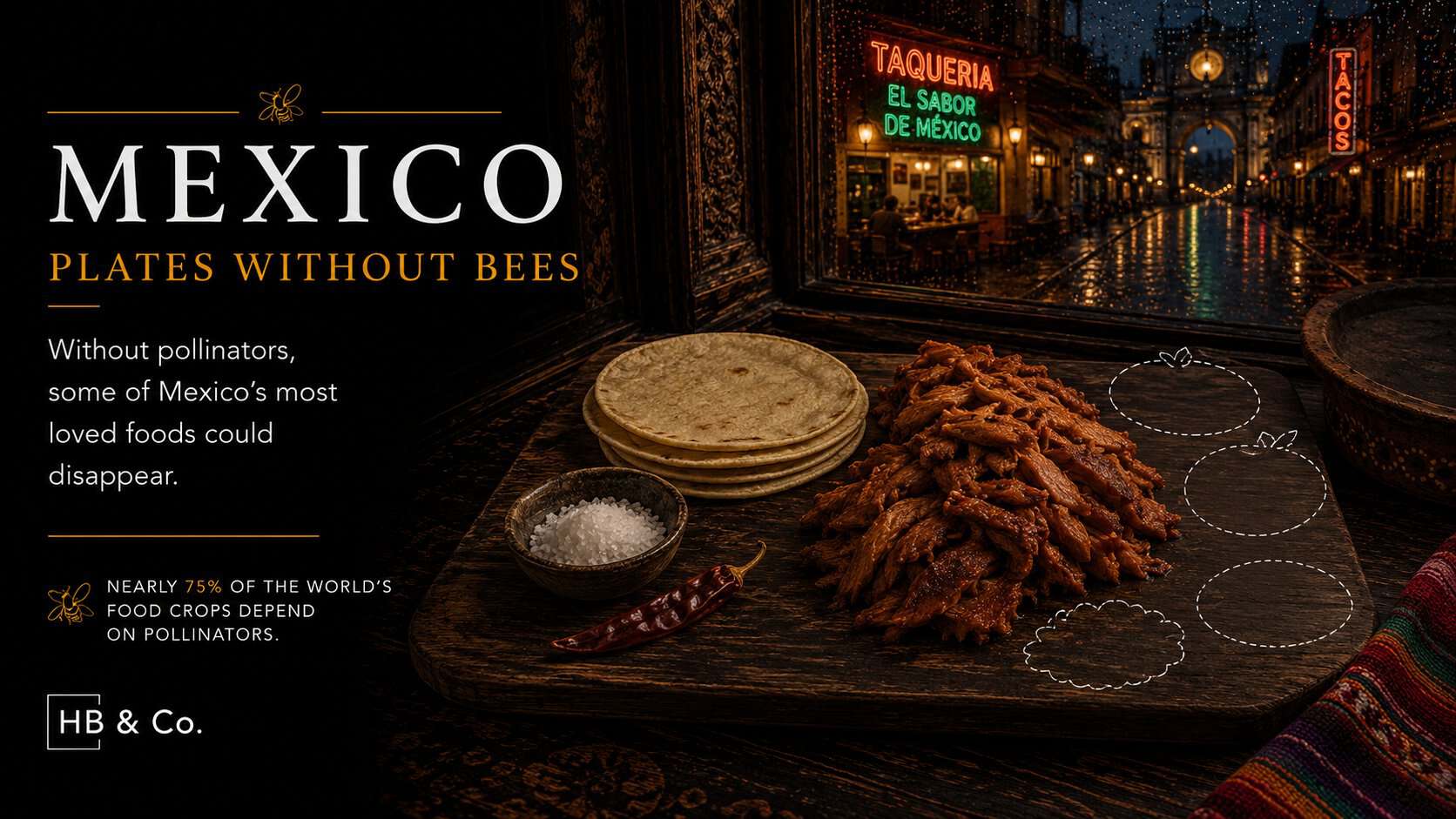
Mexico's Plate Without Bees
Six iconic Mexican dishes. Over 1,600 native bee species. What vanishes from the plate when the pollinators disappear.
 United Kingdom
 Italy
Italy
 France
 Spain
Spain
 Germany
 Greece
 Portugal
 Romania
 Turkey
 United States
 Mexico
 Brazil
 Argentina
 Peru
Peru
 Colombia
 China
China
 Japan
Japan
 South Korea
 Thailand
 Vietnam
 Indonesia
 Philippines
 India
India
 Pakistan
 Morocco
 Egypt
Egypt
 Lebanon
 Saudi Arabia
 Ethiopia
 Nigeria
- 87 of the world's leading food crops depend on animal pollination to some degree (Klein et al., 2007)
- Without bees, Guacamole cannot exist - avocado (95%), tomatoes (65%), onion (65%), lime (65%), and coriander (65%) are all pollinator-dependent
- Mexico has over 1,600 native bee species - more than any other North American country
- The Mayan stingless bee Melipona beecheii has been managed for honey production for over 3,000 years
- Mexico is the world's second-largest avocado producer; orchards depend entirely on honeybee pollination during flowering
Why Mexican Cuisine Depends on Bees
Mexican food is the cuisine of the avocado, tomato, chilli, lime, and coriander. Without pollinators, this sentence becomes almost meaningless. Avocado carries 95% essential pollinator dependency. Tomatoes carry 65%. Lime carries 65%. Coriander carries 65%. Guacamole - five of six primary ingredients dependent on pollinators - is perhaps the clearest illustration of total pollinator dependency in any national dish. Without bees, Guacamole is a bowl of salt. Mexico is also home to the 3,000-year-old Mayan stingless bee tradition, keeping Melipona beecheii in hollow log hives called jobones - a UNESCO-recognised practice still active in Yucatan today.
Mexico is the world's second-largest avocado producer at over 2 million tonnes annually. The Michoacan orchards depend on managed honeybee colonies during flowering. Without those bees, there is no avocado. Tacos al Pastor lose their pineapple (25%), Mole Poblano loses its tomatoes and chilli base, and Chiles Rellenos loses both its stuffed pepper and tomato sauce.
The Science Behind Mexican Crop Pollination
Key Mexican pollinator dependencies: avocado (95%), cucumbers (95%), tomatoes (65%), lime (65%), coriander (65%), onion (65%), red peppers (65%), pineapple (25%), and mango (25%). Our Acacia Honey comes from Transylvanian Carpathian forests. Read more on the About page, try our honey subscription and save 20%, or explore the World Bee Atlas. For bee decline, read our article on why bee populations are declining.
Raw Honey. Shop HoneyBee & Co.
Single-origin raw honey from Transylvanian family apiaries and a SALSA-certified British supplier. Six varieties, all cold-extracted and fully traceable. Free UK delivery on three or more jars.
Frequently Asked Questions
Which Mexican foods disappear without bees?
Avocado, tomatoes, lime, coriander, onion, chilli peppers, pineapple, and mango are all significantly pollinator-dependent. Corn, rice, beans, and pork are largely unaffected. Without bees, guacamole, salsa, and most Mexican condiments cannot be made.
How many bee species live in Mexico?
Mexico has over 1,600 native bee species - the highest of any North American country. Mexico is the centre of stingless bee diversity in the Americas with over 46 native Meliponini species. Approximately 70% are at risk.
What is Mayan beekeeping?
Mayan meliponiculture is the 3,000-year-old tradition of keeping stingless bees (Melipona beecheii) in hollow logs called jobones. The honey Xunan Kab was sacred in Mayan religion. This UNESCO-recognised practice is still active in Yucatan today.
Why does avocado depend so much on bees?
Avocado flowers are female in the morning and male in the afternoon (or vice versa), requiring bees to cross-pollinate between trees at specific times. Klein et al. (2007) rates avocado at 95% pollinator dependency. Without managed honeybee colonies, commercial avocado production collapses.
What percentage of Mexican food requires pollinators?
Mexico's defining ingredients - avocado (95%), tomatoes (65%), lime (65%), coriander (65%), and chillies (25-65%) - are all pollinator-dependent under Klein et al. (2007). Mexican cuisine's reliance on fresh produce places it among the most pollinator-dependent food cultures in the Americas.
How can I help protect bees in Mexico?
Support organisations protecting Mayan meliponiculture and native Mexican bee populations. Choose food products from supply chains committed to pollinator health. Explore the World Bee Atlas to learn which species are native to Mexico.