

 English (UK)
  Italiano
  Français
  简体中文
简体中文  한국어
한국어 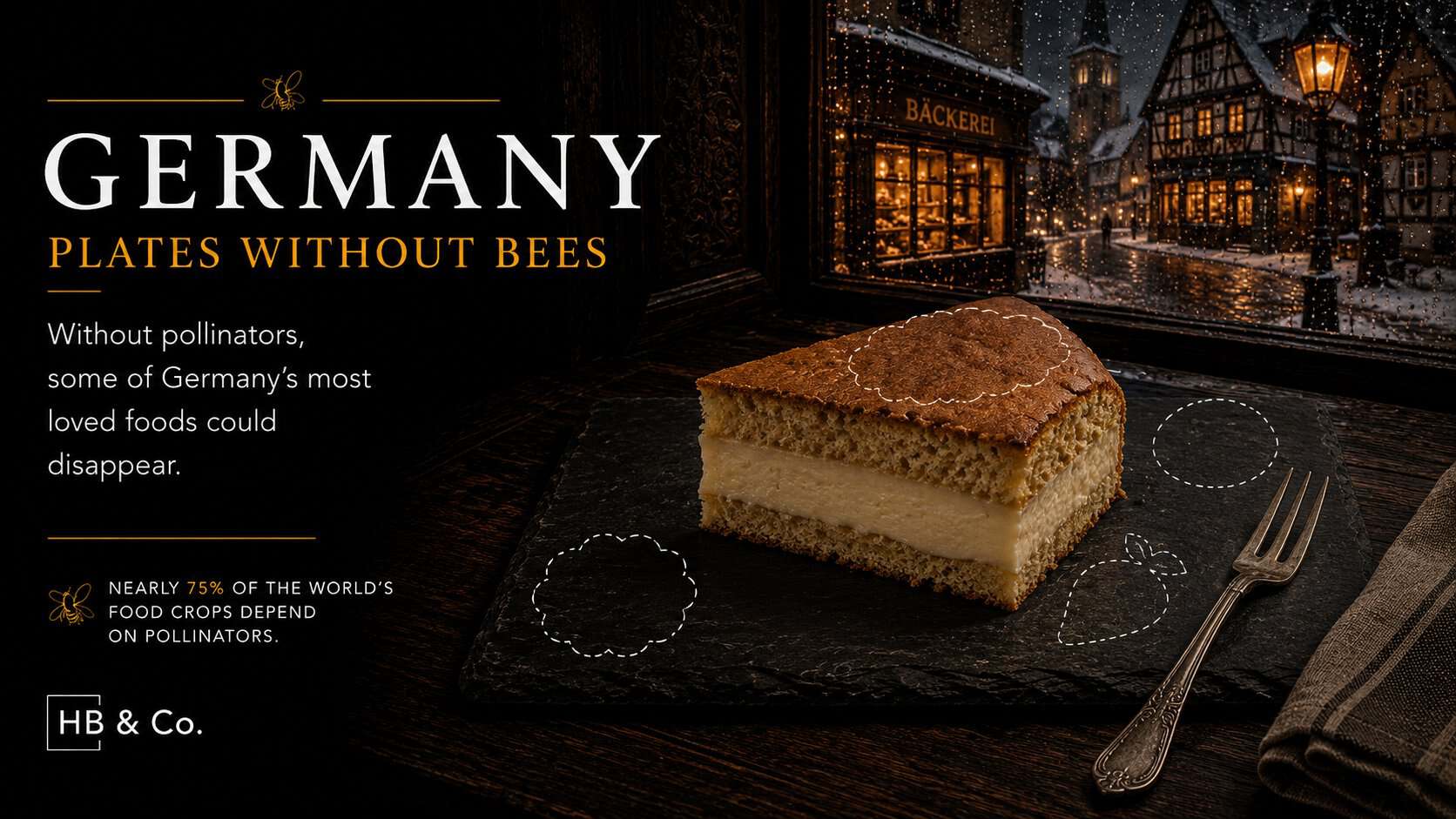
Germany's Plate Without Bees
Six iconic German dishes. Over 550 native bee species. What vanishes from the plate when the pollinators disappear.
 United Kingdom
 Italy
Italy
 France
 Spain
Spain
 Germany
 Greece
 Portugal
 Romania
 Turkey
 United States
 Mexico
 Brazil
 Argentina
 Peru
Peru
 Colombia
 China
China
 Japan
Japan
 South Korea
 Thailand
 Vietnam
 Indonesia
 Philippines
 India
India
 Pakistan
 Morocco
 Egypt
Egypt
 Lebanon
 Saudi Arabia
 Ethiopia
 Nigeria
- 87 of the world's leading food crops depend on animal pollination to some degree (Klein et al., 2007)
- Without bees, the German Schwarzwalder Kirschtorte loses its cherries, raspberries, and strawberries - all three are pollinator-dependent
- Germany has over 550 native bee species; Bombus subterraneus was declared extinct in Germany in the 1990s
- The Bienenstich (bee sting cake) is literally named after bees and would lose its almond-honey topping without pollinators
- Germany is a significant European producer of apples, cherries, and strawberries - all significantly pollinator-dependent
Why German Cuisine Depends on Bees
German food has a reputation for heartiness - pork, potato, cabbage, bread. The core of the German diet is largely independent of bee pollination. But the fruit and dessert layer that gives German cooking its character is deeply pollinator-dependent. Cherries for Schwarzwalder Kirschtorte (65%). Apples for Apfelstrudel (65%). Strawberries and raspberries for summer desserts (95%). Cucumbers for the pickles that accompany almost every plate (95%). Without bees, German cuisine retains its grain and meat foundation but loses much of its fruit and sweetness.
The Bienenstich - bee sting cake - is one of the great ironies of German baking. Named after the bees that stung the bakers who stole their honey, it is topped with an almond-honey caramel glaze. Both almonds (65%) and honey (95%) are pollinator-dependent. Without bees, the Bienenstich topping cannot be made. The bee that names the cake is the bee without which the cake cannot exist. The Carniolan honeybee, native to the same Carpathian mountain range as our Transylvanian apiaries, is particularly common in German commercial beekeeping.
The Science Behind German Crop Pollination
Key German pollinator dependencies: apples (65%), cherries (65%), strawberries (95%), raspberries (95%), cucumbers (95%), and almonds (65%). Our Acacia Honey comes from Transylvanian Carpathian forests where the Carniolan bee forages. Read more on the About page, try our honey subscription and save 20%, or explore the World Bee Atlas. For bee decline, read our article on why bee populations are declining.
Raw Honey. Shop HoneyBee & Co.
Single-origin raw honey from Transylvanian family apiaries and a SALSA-certified British supplier. Six varieties, all cold-extracted and fully traceable. Free UK delivery on three or more jars.
Frequently Asked Questions
Which German foods disappear without bees?
Cherries, strawberries, raspberries, apples, almonds, cucumbers, onions, and honey are all significantly pollinator-dependent. Pork, potatoes, wheat, and cabbage are largely unaffected. German dessert culture depends heavily on pollinator-dependent fruits.
How many bee species live in Germany?
Germany has over 550 native bee species including 15 native bumblebee species. Approximately 52% are at risk. Bombus subterraneus was declared extinct in Germany in the 1990s.
What is the Carniolan honeybee?
Apis mellifera carnica is a honeybee subspecies native to the Alpine and Carpathian regions. It is widely used in German commercial beekeeping due to its gentleness and efficient cold-climate foraging, and is one of the most exported honeybee subspecies globally.
Why is the Bienenstich connected to bee decline?
Bienenstich (bee sting cake) is topped with almond-honey caramel. Both almonds (65%) and honey (95%) are pollinator-dependent. Without bees, the defining topping of Germany's most bee-named cake cannot be produced.
Is Germany a major fruit producer?
Yes. Germany is a significant European producer of apples, sour cherries, and strawberries from the Bodensee, Rhineland, and Niedersachsen regions respectively. All three crops depend on managed and wild bee colonies during spring flowering.
What percentage of German food requires pollinators?
German staples like pork, potato, and wheat are largely unaffected. But the fruit and dessert layer - cherries (65%), apples (65%), strawberries (95%), raspberries (95%), almonds (65%), and honey (95%) - is all significantly pollinator-dependent under Klein et al. (2007).