
 English (UK)
  Italiano
  Français
  简体中文
简体中文  한국어
한국어 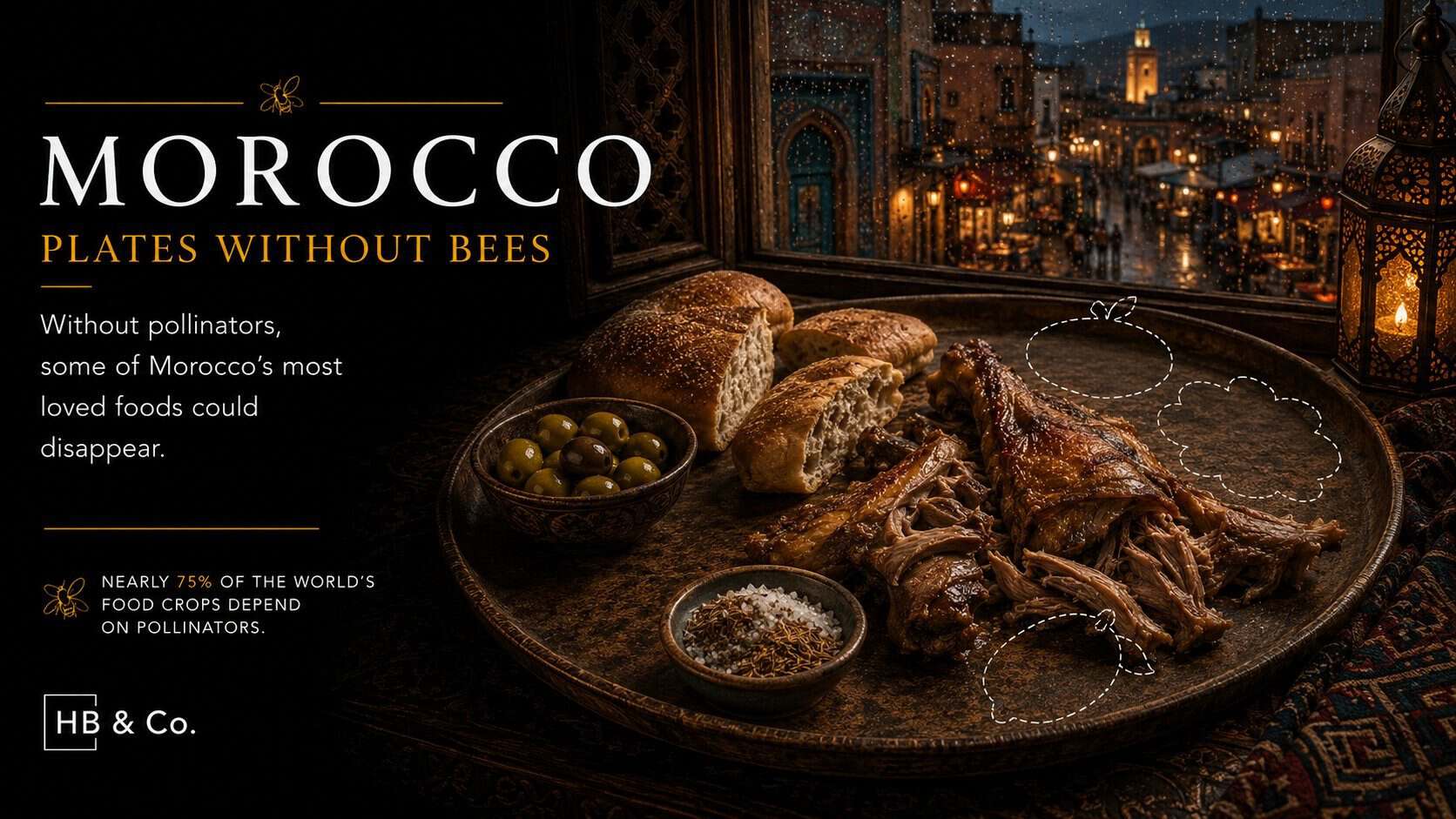
Morocco's Plate Without Bees
Six iconic Moroccan dishes. Over 700 native bee species. What vanishes from the plate when the pollinators disappear.
 United Kingdom
 Italy
Italy
 France
 Spain
Spain
 Germany
 Greece
 Portugal
 Romania
 Turkey
 United States
 Mexico
 Brazil
 Argentina
 Peru
Peru
 Colombia
 China
China
 Japan
Japan
 South Korea
 Thailand
 Vietnam
 Indonesia
 Philippines
 India
India
 Pakistan
 Morocco
 Egypt
Egypt
 Lebanon
 Saudi Arabia
 Ethiopia
 Nigeria
- 87 of the world's leading food crops depend on animal pollination to some degree (Klein et al., 2007)
- Without bees, a Moroccan Lamb Tagine loses its almonds, honey glaze, prunes, onion, and sesame - five of six ingredients are pollinator-dependent
- Morocco is home to over 700 native bee species including endemic North African subspecies of Apis mellifera
- The argan tree, unique to Morocco and the source of the country's prized argan oil, depends on bee pollination for fruit set
- Buying raw honey from ethical beekeepers directly supports the colonies that pollinate Morocco's food landscape
Why Moroccan Cuisine Depends on Bees
Moroccan food is one of the world's most layered culinary traditions, built on a combination of spices, preserved and fresh ingredients, and slow-cooked preparations that draw their character from the landscape of North Africa. Preserved lemon in every tagine. Almonds in bastilla and tagines with prunes. Sesame seeds in chebakia and countless other pastries. Honey as a glaze, a sweetener, and a finishing note across both savoury and sweet dishes. Pomegranate seeds as a garnish across the Moroccan table. These are not minor ingredients. They are structural to Moroccan cooking, and almost all of them depend significantly on animal pollination.
The Lamb Tagine with prunes, almonds, and honey illustrates this dependency with particular force. Of its six primary ingredients - lamb, prunes (65% dependent), almonds (65%), raw honey (95%), onion (65%), and sesame seeds (65%) - five depend directly on pollinators. The lamb is the only ingredient that survives. The defining character of the dish - its sweetness, its texture, its almond crunch, its honey finish - is entirely pollinator-dependent.
Zaalouk, the roasted aubergine and tomato salad eaten across Morocco, loses both its primary vegetables without bees. Aubergines carry a 65% dependency rating and require buzz-pollination - the same technique that only bumblebees can perform - for effective fruit set. Tomatoes carry 65% dependency for the same reason. Zaalouk without aubergines and tomatoes is oil and garlic.
The Science Behind Moroccan Crop Pollination
The Klein et al. (2007) dependency ratings used throughout this tool come from field exclusion experiments conducted across multiple crop types and countries. For Moroccan agriculture, the most commercially significant dependencies include almonds (65%), citrus and preserved lemon (65%), tomatoes (65%), aubergines (65%), sesame (65%), pomegranate (65%), and honey itself (95%). Together these form the flavour backbone of Moroccan cooking from the Atlas Mountains to the Atlantic coast.
Morocco is one of the world's largest producers of argan oil, an ingredient unique to the country and harvested from the argan tree (Argania spinosa). Argan trees depend on bees for cross-pollination to produce the fruit from which oil is extracted. The argan forest ecosystem of southwest Morocco - a UNESCO Biosphere Reserve - supports a complex of native bee species that cannot be replaced by managed colonies. The health of Morocco's argan economy depends directly on the health of its wild bee populations.
North African Honeybees and the European Connection
The honeybees that pollinate Moroccan crops - principally Apis mellifera intermissa and Apis mellifera major - are closely related to but distinct from the European Apis mellifera subspecies that produce our Transylvanian honey. All belong to the same species. All perform the same essential pollination services. The geographic separation reflects thousands of years of evolutionary adaptation to different landscapes, not a different relationship with flowers.
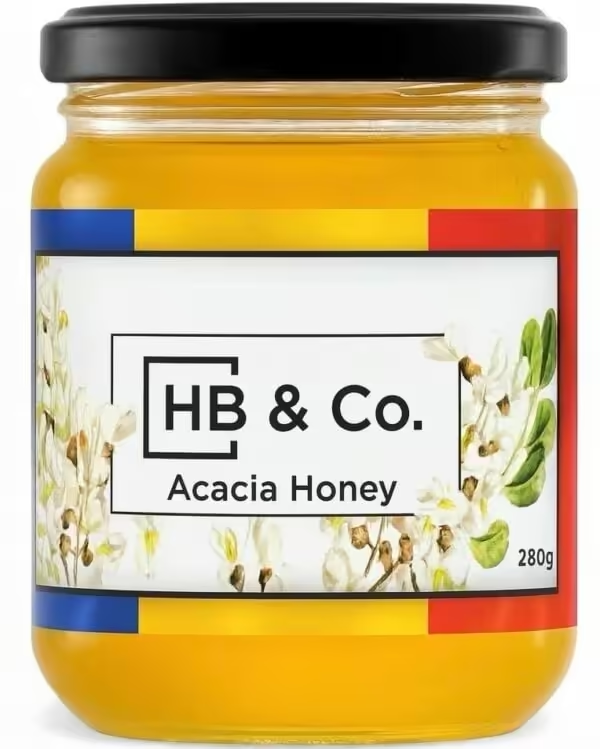
Our Acacia Honey is drawn from European Apis mellifera colonies foraging in the Carpathian Mountains of Transylvania. Dragos Nistor's family has kept these colonies for six generations using the same principles of minimal intervention and landscape respect that characterise traditional Moroccan beekeeping. Read more about the family on the About page, or explore our raw honey subscription and save 20% on every delivery.
What You Can Do
Plant flowering herbs and Mediterranean plants in any available outdoor space. Support beekeepers who practise ethical, traceable beekeeping with full transparency about origin. Explore the World Bee Atlas to discover which bee species are native to Morocco and North Africa. To understand more about why bee populations are declining globally, read our article on why bee populations are declining.
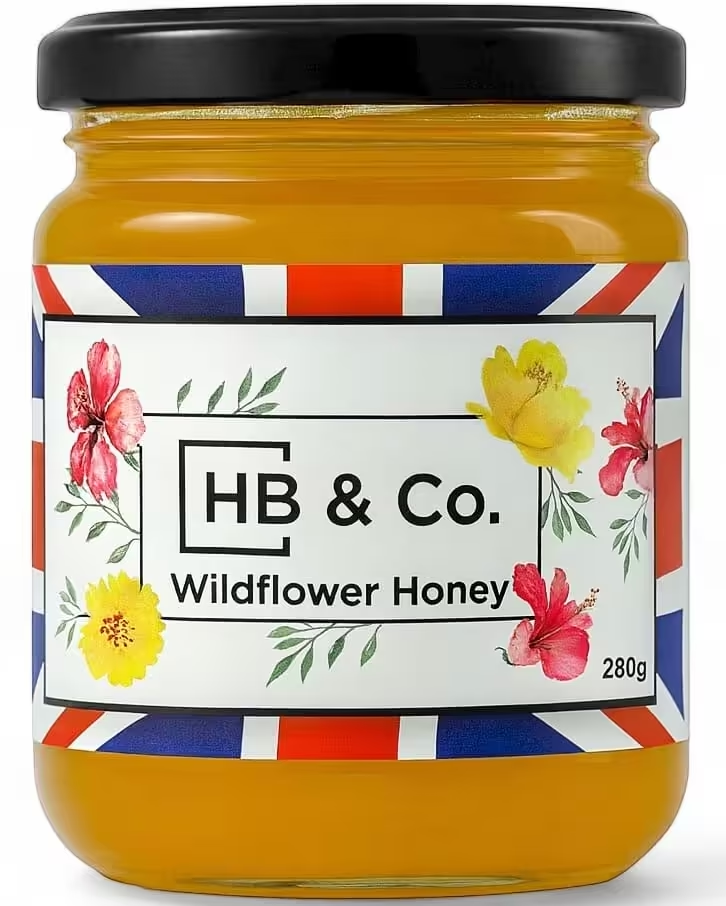
Raw Honey. Shop HoneyBee & Co.
Single-origin raw honey from Transylvanian family apiaries and a SALSA-certified British supplier. Six varieties, all cold-extracted and fully traceable. Free UK delivery on three or more jars.
Frequently Asked Questions
Which Moroccan foods disappear without bees?
Almonds, preserved lemon, tomatoes, aubergines, onions, pomegranate, sesame seeds, apricots, prunes, and honey are all significantly pollinator-dependent. These are core ingredients across tagines, salads, pastries, and sweet preparations. Lamb, bread, couscous, olive oil, and salt are largely unaffected.
How many bee species live in Morocco?
Morocco is home to over 700 native bee species, including two endemic North African honeybee subspecies: Apis mellifera intermissa and Apis mellifera major. These subspecies have evolved specific adaptations to the Moroccan landscape over thousands of years. Approximately 68% of Moroccan bee species are at risk according to regional Red List assessments.
Does argan oil production depend on bees?
Yes. The argan tree (Argania spinosa), native exclusively to Morocco's Sous-Massa region, depends on bee cross-pollination for the fruit set that produces the nuts from which argan oil is extracted. The argan forest ecosystem - a UNESCO Biosphere Reserve - supports a complex of native bee species essential to the tree's reproductive cycle. Morocco's argan oil economy depends directly on the health of its wild bee populations.
Why are almonds so important to Moroccan cooking?
Almonds are a structural ingredient across Moroccan cuisine, appearing in bastilla, tagines with prunes, chebakia pastries, and numerous other preparations. Klein et al. (2007) rates almonds at 65% pollinator dependency, meaning yields drop by 40 to 90% without animal pollinators. Morocco is a significant almond producer in the Mediterranean region, and almond orchards in the Atlas Mountains and Sous Valley depend on managed and wild bee colonies for pollination during the February to March flowering window.
What is Apis mellifera intermissa?
Apis mellifera intermissa is a honeybee subspecies endemic to North Africa, found in Morocco, Algeria, and Tunisia. It has evolved specific adaptations to the hot, dry conditions of North Africa, including heat tolerance and efficient foraging in arid landscapes. It is the primary managed honeybee in Morocco and the principal pollinator of Moroccan almond, argan, and citrus crops. Like all Apis mellifera subspecies, it is closely related to the European bees that produce our Transylvanian honey.
What percentage of Moroccan food requires pollinators?
Morocco's most characteristic ingredients - almonds, preserved lemon, tomatoes, aubergines, sesame, pomegranate, apricots, and honey - are all between 65% and 95% pollinator-dependent under Klein et al. (2007). Moroccan cuisine's heavy use of these ingredients across both savoury and sweet preparations places it among the most pollinator-dependent food cultures in the Mediterranean world.
How can I help protect bees in Morocco?
Support organisations working to protect argan forest ecosystems and native North African bee populations. Choose food products sourced from supply chains committed to pollinator health. Explore the World Bee Atlas on honeybeeandco.uk to learn which species are native to Morocco. Buying raw honey from ethical, transparent beekeepers helps sustain the commercial viability of sustainable beekeeping globally.