

 English (UK)
  Italiano
  Français
  简体中文
简体中文  한국어
한국어 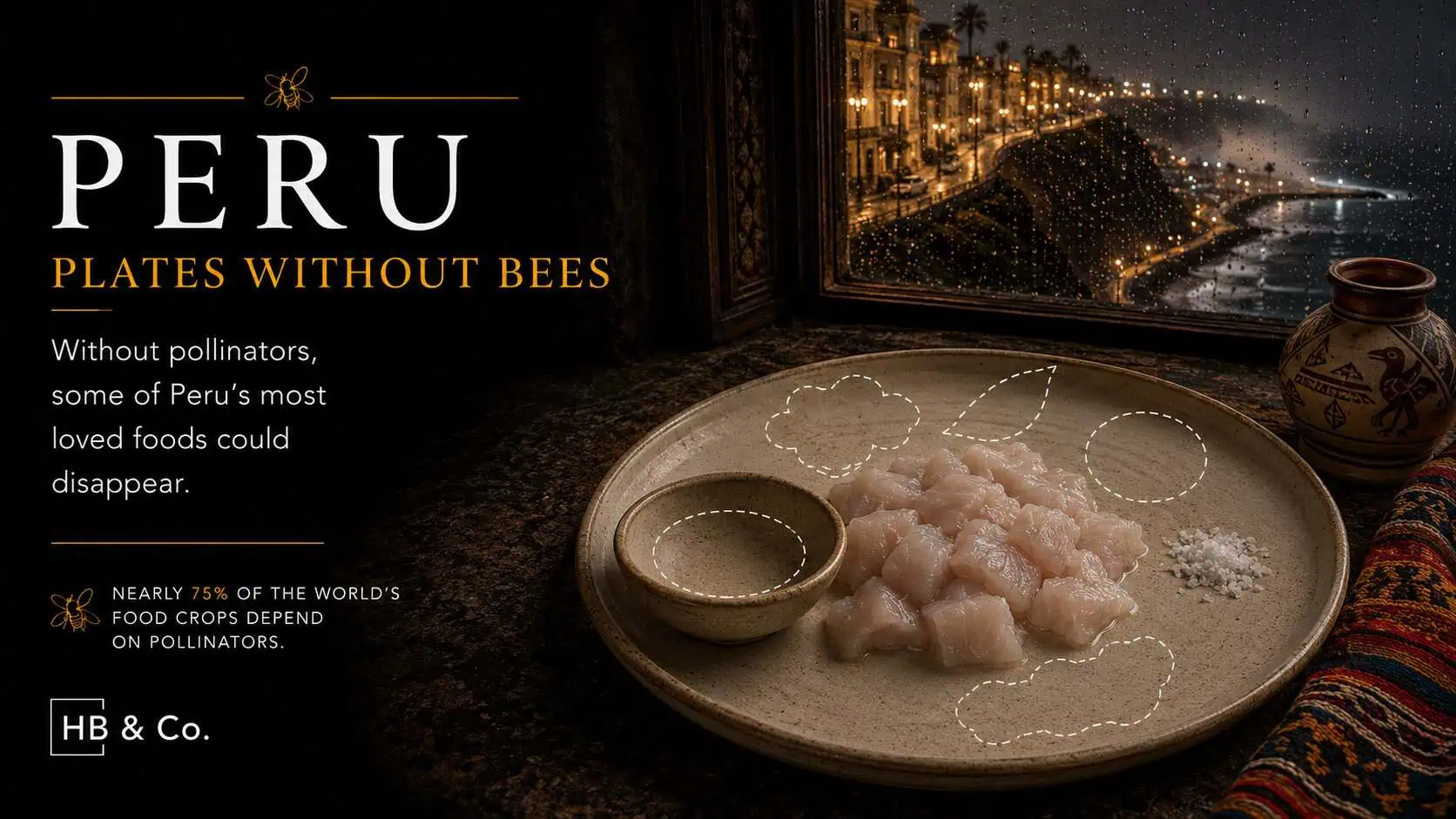
Peru's Plate Without Bees
Six iconic Peruvian dishes. Over 2,000 native bee species. What vanishes from the plate when the pollinators disappear.
 United Kingdom
 Italy
Italy
 France
 Spain
Spain
 Germany
 Greece
 Portugal
 Romania
 Turkey
 United States
 Mexico
 Brazil
 Argentina
 Peru
Peru
 Colombia
 China
China
 Japan
Japan
 South Korea
 Thailand
 Vietnam
 Indonesia
 Philippines
 India
India
 Pakistan
 Morocco
 Egypt
Egypt
 Lebanon
 Saudi Arabia
 Ethiopia
 Nigeria
- 87 of the world's leading food crops depend on animal pollination to some degree (Klein et al., 2007)
- Without bees, Peruvian Ceviche loses its leche de tigre entirely - lemon, onion, and coriander are all pollinator-dependent
- Peru has over 2,000 native bee species - one of the highest diversities on earth, spanning Amazon, Andes, and Pacific coast
- Aji amarillo, the defining flavour of Peruvian cooking, carries a 65% pollinator dependency rating
- Peru is the world's second-largest avocado exporter; avocado carries a 95% essential pollinator dependency
Why Peruvian Cuisine Depends on Bees
Peruvian food has undergone a global renaissance in the 21st century. Much of what makes it extraordinary is its pollinator-dependent ingredients. Aji amarillo pepper, the defining flavour of Peruvian cooking, carries 65% dependency. The leche de tigre in Ceviche - the citrus-coriander-onion marinade that defines the dish - is built entirely on pollinator-dependent ingredients: lemon (65%), onion (65%), and coriander (65%). Avocado, which appears in Causa Limena and dozens of other preparations, carries 95% essential dependency. Peru is the world's second-largest avocado exporter, worth over 800 million dollars annually. The entire industry depends on managed honeybee colonies during flowering. Without bees, that industry collapses.
Peru's extraordinary bee diversity - over 2,000 species spanning Amazon basin, Andean cloud forest, and Pacific desert coast - directly underpins its extraordinary food diversity. Amazon stingless bees pollinate the tropical fruits of Peruvian Amazon cuisine. Andean bumblebees pollinate the aji peppers that define highland cooking. Coastal wild bees pollinate the tomatoes, onions, and cucumbers of ceviche culture. Indigenous communities across the Peruvian Amazon have harvested stingless bee honey for thousands of years. The honey known as miel de abejas nativas carries distinctive sour and herbal notes from the Amazon's extraordinary floral diversity.
The Science Behind Peruvian Crop Pollination
Key Peruvian pollinator dependencies: aji amarillo (65%), lemon (65%), onions (65%), cucumbers (95%), avocado (95%), coriander (65%), tomatoes (65%), passion fruit (95%), and strawberries (95%). Our Acacia Honey comes from Transylvanian Carpathian forests. Read more on the About page, try our honey subscription and save 20%, or explore the World Bee Atlas. For bee decline, read our article on why bee populations are declining.
Raw Honey. Shop HoneyBee & Co.
Single-origin raw honey from Transylvanian family apiaries and a SALSA-certified British supplier. Six varieties, all cold-extracted and fully traceable. Free UK delivery on three or more jars.
Frequently Asked Questions
Which Peruvian foods disappear without bees?
Aji amarillo peppers, lemon and lime, onions, cucumbers, avocado, coriander, tomatoes, passion fruit, and strawberries are all significantly pollinator-dependent. Fish, potato, rice, and plain meat are largely unaffected.
How many bee species live in Peru?
Peru has over 2,000 native bee species spanning Amazon rainforest, Andean highlands, and Pacific coast desert - one of the highest bee diversities of any country on earth. Approximately 72% are at risk.
Why is Ceviche so pollinator-dependent?
Peruvian Ceviche's leche de tigre marinade contains lemon or lime (65%), onion (65%), and coriander (65%). Three of three primary marinade ingredients depend on pollinators. The aji amarillo seasoning is 65% dependent. Without bees, the entire flavour architecture of Ceviche disappears. Only the raw fish and salt survive.
What is the aji amarillo pepper?
Aji amarillo is a bright orange-yellow chilli native to Peru and the defining flavour ingredient of Peruvian cuisine. It appears in Causa Limena, Aji de Gallina, and dozens of other preparations. It carries 65% pollinator dependency under Klein et al. (2007).
Is Peru a major avocado producer?
Yes. Peru is the world's second-largest avocado exporter, worth over 800 million dollars annually. Avocado carries 95% essential pollinator dependency. The entire industry depends on managed honeybee colonies being deployed in orchards during the flowering season.
What percentage of Peruvian food requires pollinators?
Peruvian cuisine's defining ingredients - aji amarillo (65%), lemon (65%), onions (65%), avocado (95%), and coriander (65%) - are all significantly pollinator-dependent under Klein et al. (2007). Fish, potato, and rice are unaffected.