
 English (UK)
  Italiano
  Français
  简体中文
简体中文  한국어
한국어 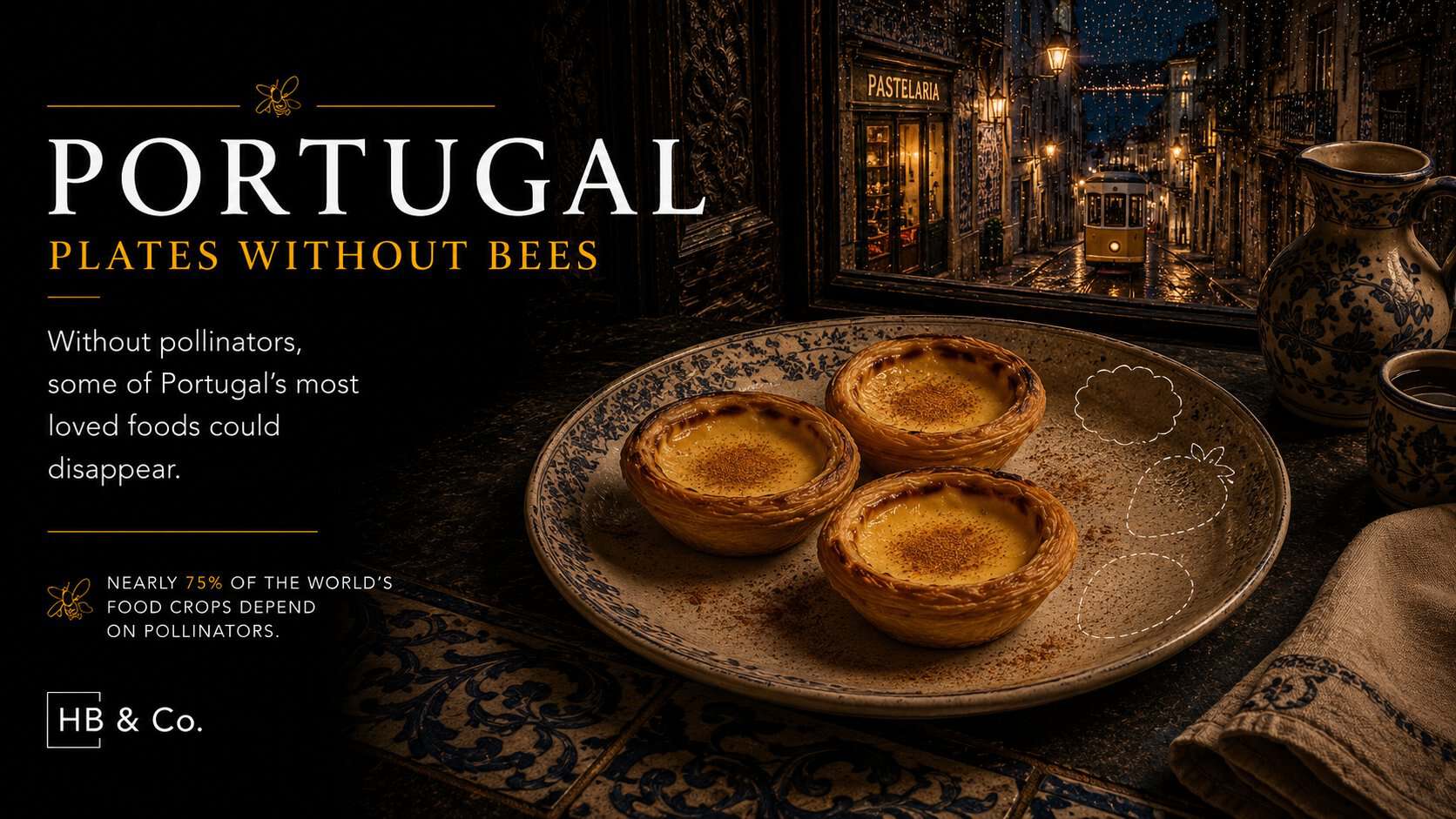
Portugal's Plate Without Bees
Six iconic Portuguese dishes. Over 750 native bee species. What vanishes from the plate when the pollinators disappear.
 United Kingdom
 Italy
Italy
 France
 Spain
Spain
 Germany
 Greece
 Portugal
 Romania
 Turkey
 United States
 Mexico
 Brazil
 Argentina
 Peru
Peru
 Colombia
 China
China
 Japan
Japan
 South Korea
 Thailand
 Vietnam
 Indonesia
 Philippines
 India
India
 Pakistan
 Morocco
 Egypt
Egypt
 Lebanon
 Saudi Arabia
 Ethiopia
 Nigeria
- 87 of the world's leading food crops depend on animal pollination to some degree (Klein et al., 2007)
- Without bees, a Pastel de Nata dessert plate loses its strawberries, raspberries, and honey accompaniments
- Portugal has over 750 native bee species including the Iberian honeybee Apis mellifera iberiensis
- Portugal's Algarve and Alentejo almond orchards flower in February and depend on managed honeybee colonies during this window
- The February almond bloom across Portugal is one of Europe's most spectacular and most pollinator-dependent agricultural events
Why Portuguese Cuisine Depends on Bees
Portuguese cuisine shares its Mediterranean foundations with Spain - olive oil, garlic, onions, tomatoes, and seafood. The garlic in amêijoas à Bulhão Pato (d:5), the tomatoes in tomato rice (65%), the onions in every cataplana (65%), the lemon over bacalhau (65%) - Portuguese cooking's bee-dependent ingredients are fundamental rather than decorative. The Algarve and Alentejo almond orchards that carpet the landscape white every February depend entirely on managed honeybee colonies during a narrow flowering window. Portugal is a significant European almond producer and this industry would collapse first in any sustained pollinator decline.
The Pastel de Nata, Portugal's national pastry, depends on eggs and cream for its custard - relatively pollinator-independent. But the strawberry (95%), raspberry (95%), and honey (95%) accompaniments that define a proper pastelaria display are all pollinator-dependent. The pastry survives. The fruit table around it does not. Portuguese beekeepers produce distinctive monofloral honeys from eucalyptus, rosemary, and orange blossom using the endemic Iberian honeybee Apis mellifera iberiensis.
The Science Behind Portuguese Crop Pollination
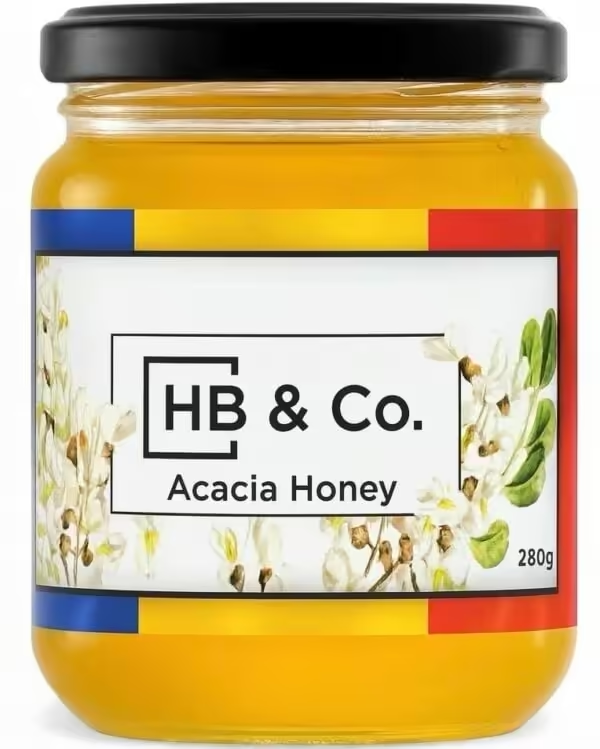
Key Portuguese pollinator dependencies: almonds (65%), tomatoes (65%), cucumbers (95%), onions (65%), lemon (65%), coriander (65%), and strawberries (95%). Our Acacia Honey comes from Transylvanian Carpathian forests. Read more on the About page, try our honey subscription and save 20%, or explore the World Bee Atlas. For bee decline, read our article on why bee populations are declining.
Raw Honey. Shop HoneyBee & Co.
Single-origin raw honey from Transylvanian family apiaries and a SALSA-certified British supplier. Six varieties, all cold-extracted and fully traceable. Free UK delivery on three or more jars.
Frequently Asked Questions
Which Portuguese foods disappear without bees?
Almonds, tomatoes, onions, lemon, coriander, cucumbers, strawberries, and honey are all significantly pollinator-dependent. Salt cod, potatoes, and olive oil are largely unaffected.
How many bee species live in Portugal?
Portugal has over 750 native bee species including the Iberian honeybee Apis mellifera iberiensis. Approximately 63% are at risk. Portugal's Atlantic and Mediterranean climate zones support diverse bee populations.
Does Portugal's almond production depend on bees?
Yes. Portugal's Algarve and Alentejo almond orchards carry a 65% pollinator dependency rating and require cross-pollination during the February flowering window. The February almond bloom is one of Europe's earliest and most visually dramatic agricultural pollination events.
What is the Iberian honeybee?
Apis mellifera iberiensis is the honeybee subspecies native to the Iberian Peninsula, adapted to both Atlantic and Mediterranean conditions. Portuguese beekeepers produce distinctive monofloral honeys from eucalyptus, rosemary, and orange blossom.
What percentage of Portuguese food requires pollinators?
Portuguese cuisine's defining fresh ingredients - almonds (65%), tomatoes (65%), onions (65%), and lemon (65%) - are all significantly pollinator-dependent under Klein et al. (2007). Salt cod, potatoes, and olive oil are unaffected.
How can I help protect bees in Portugal?
Support organisations protecting Mediterranean wildflower habitats. Choose food products from supply chains committed to pollinator health. Explore the World Bee Atlas to learn which species are native to Portugal.