
 English (UK)
  Italiano
  Français
  简体中文
简体中文  한국어
한국어 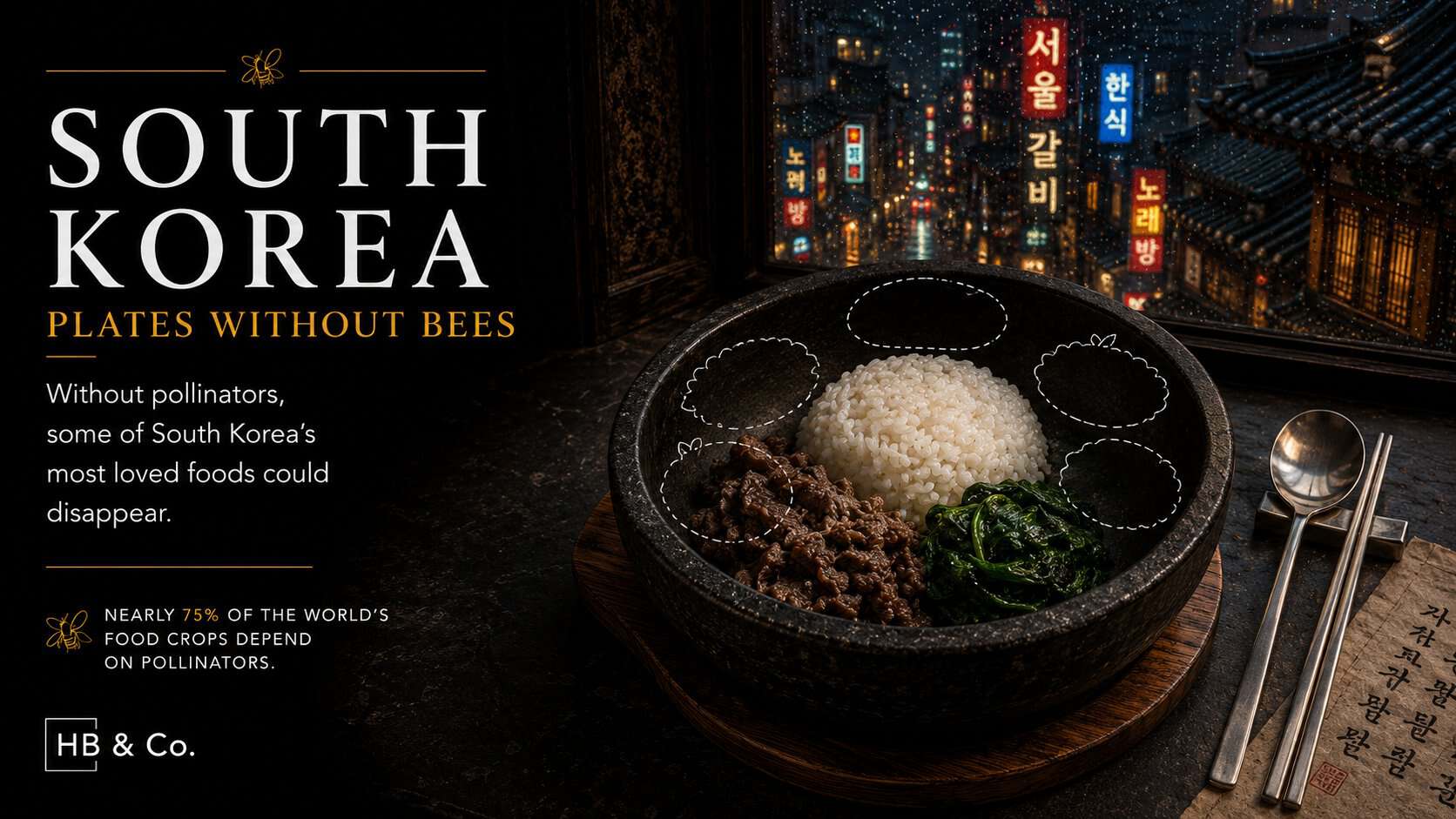
South Korea's Plate Without Bees
Six iconic Korean dishes. Over 500 native bee species. What vanishes from the plate when the pollinators disappear.
 United Kingdom
 Italy
Italy
 France
 Spain
Spain
 Germany
 Greece
 Portugal
 Romania
 Turkey
 United States
 Mexico
 Brazil
 Argentina
 Peru
Peru
 Colombia
 China
China
 Japan
Japan
 South Korea
 Thailand
 Vietnam
 Indonesia
 Philippines
 India
India
 Pakistan
 Morocco
 Egypt
Egypt
 Lebanon
 Saudi Arabia
 Ethiopia
 Nigeria
- 87 of the world's leading food crops depend on animal pollination to some degree (Klein et al., 2007)
- Without bees, Korean Bingsu loses every fruit topping - strawberries, raspberries, lychee, and mango are all pollinator-dependent
- South Korea has over 500 native bee species including the Asian honeybee Apis cerana managed in Korean beekeeping for over 2,000 years
- Sesame oil and sesame seeds, which appear in almost every Korean dish, carry a 65% pollinator dependency rating
- Korean strawberry cultivars are among the most prized in Asia and carry a 95% pollinator dependency requiring bumblebee buzz-pollination
Why Korean Cuisine Depends on Bees
Korean food is the cuisine of sesame, spring onion, cucumber, and fermented vegetables. Sesame oil and sesame seeds appear in virtually every Korean dish as a finishing note - from bibimbap to kimchi to japchae - and carry 65% pollinator dependency. Spring onion garnishes every savoury dish at 65% dependency. Cucumber appears in kimchi, pickles, and fresh banchan side dishes and carries 95% dependency. Korean cuisine's characteristic flavours depend on bees. Bingsu, the celebrated Korean shaved ice dessert, loses all five fruit toppings without pollinators - strawberries (95%), raspberries (95%), lychee (95%), mango (25%), and honey (95%) are all pollinator-dependent. Ice and red bean paste remain.
South Korea produces some of the world's most prized strawberry cultivars - Seolhyang, Maehyang, and Benihoppe - in heated greenhouses that deploy native Bombus hypocrita bumblebees for buzz-pollination. Korean commercial strawberry production, a significant industry, depends entirely on these managed bumblebee colonies. The native Korean honeybee Apis cerana has been kept in traditional wooden hives for over 2,000 years and is considered better adapted to native Korean plants than imported European subspecies.
The Science Behind Korean Crop Pollination
Key Korean pollinator dependencies: cucumbers (95%), strawberries (95%), lychee (95%), sesame (65%), spring onions (65%), edamame (65%), broccoli (65%), and mango (25%). Our Acacia Honey comes from European Apis mellifera in Transylvania. Read more on the About page, try our honey subscription and save 20%, or explore the World Bee Atlas. For bee decline, read our article on why bee populations are declining.
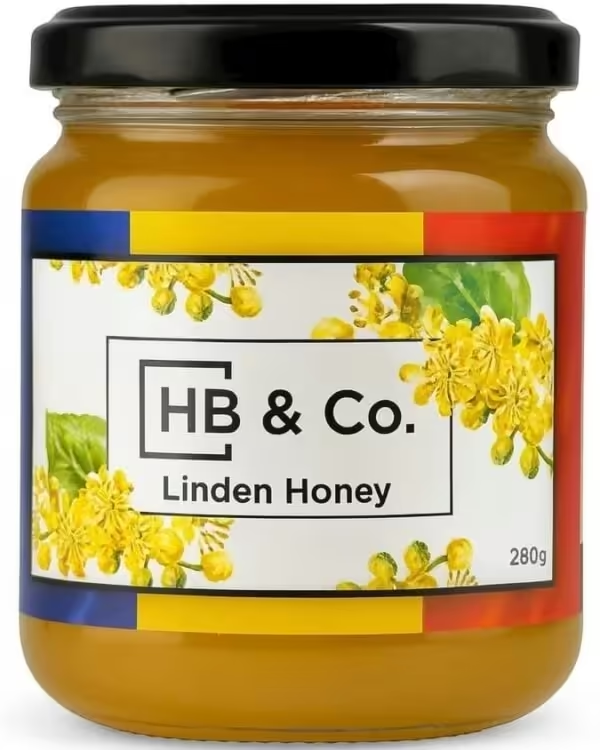
Raw Honey. Shop HoneyBee & Co.
Single-origin raw honey from Transylvanian family apiaries and a SALSA-certified British supplier. Six varieties, all cold-extracted and fully traceable. Free UK delivery on three or more jars.
Frequently Asked Questions
Which Korean foods disappear without bees?
Cucumbers, spring onions, sesame seeds, sesame oil, strawberries, raspberries, lychee, mango, broccoli, and edamame are all significantly pollinator-dependent. Rice, kimchi base, pork, and beef are largely unaffected.
How many bee species live in South Korea?
South Korea has over 500 native bee species. Key species include Apis cerana (managed for over 2,000 years) and Bombus hypocrita, important for greenhouse strawberry and tomato production. Approximately 55% are at risk.
Do Korean strawberries need bees?
Yes, at 95% essential dependency. Korean greenhouse strawberry production deploys managed Bombus hypocrita bumblebee colonies for buzz-pollination that honeybees cannot perform. Cultivars like Seolhyang and Maehyang are considered among the finest in Asia.
What is the Korean native honeybee?
Apis cerana, known as Toong beol, has been managed in traditional Korean wooden hives for over 2,000 years. It is smaller than European Apis mellifera and better adapted to native Korean plants and diseases.
Why does sesame oil matter so much in Korean cooking?
Sesame oil is the defining finishing ingredient across Korean cuisine. Sesame seeds carry 65% pollinator dependency under Klein et al. (2007). Without pollinators, sesame seed production falls significantly, affecting the oil that gives Korean food much of its characteristic aroma and flavour.
What percentage of Korean food requires pollinators?
Korean cuisine's defining flavour ingredients - sesame (65%), spring onion (65%), cucumber (95%) - are all significantly pollinator-dependent under Klein et al. (2007). Rice, pork, beef, and fermented cabbage are largely unaffected. Korean fruit culture is almost entirely pollinator-dependent.