
 English (UK)
  Italiano
  Français
  简体中文
简体中文  한국어
한국어 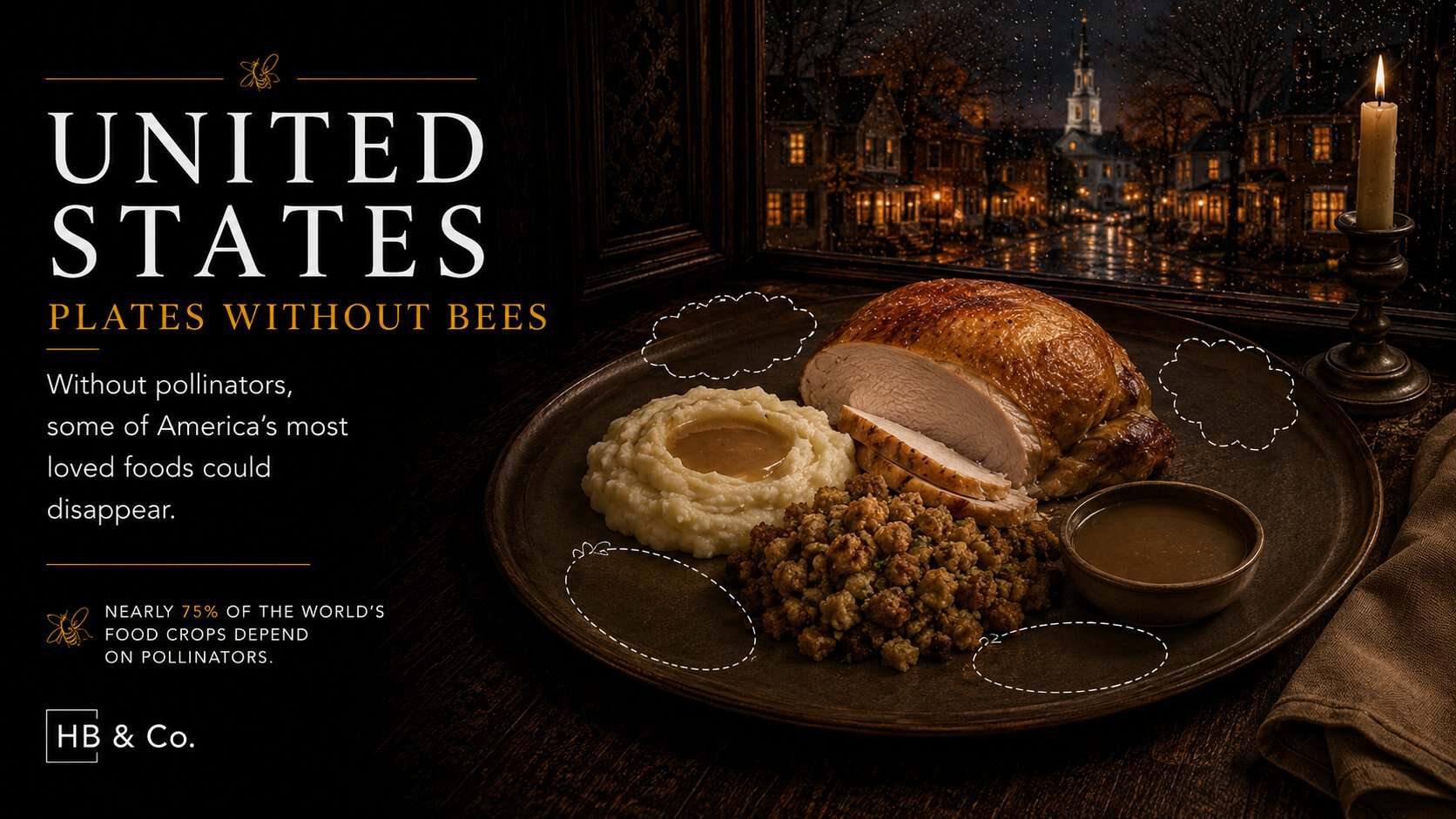
United States Without Bees
Six iconic American dishes. Over 4,000 native bee species. What vanishes from the plate when the pollinators disappear.
 United Kingdom
 Italy
Italy
 France
 Spain
Spain
 Germany
 Greece
 Portugal
 Romania
 Turkey
 United States
 Mexico
 Brazil
 Argentina
 Peru
Peru
 Colombia
 China
China
 Japan
Japan
 South Korea
 Thailand
 Vietnam
 Indonesia
 Philippines
 India
India
 Pakistan
 Morocco
 Egypt
Egypt
 Lebanon
 Saudi Arabia
 Ethiopia
 Nigeria
- 87 of the world's leading food crops depend on animal pollination to some degree (Klein et al., 2007)
- Without bees, an American Breakfast Stack loses every fruit topping - blueberries, strawberries, and raspberries all require buzz-pollination
- California produces over 80% of the world's almonds; over one million honeybee colonies are transported there each February for pollination
- The United States has over 4,000 native bee species - the most of any country in North America
- Blueberries require buzz-pollination that only wild bumblebees can perform - honeybees cannot do it
Why American Food Depends on Bees
American food culture spans everything from New England clam chowder to California avocado toast to Thanksgiving dinner to a Southern BBQ plate. Beneath that diversity, a consistent dependency runs through the most iconic dishes. Pumpkin pie requires bee-pollinated pumpkins. Apple pie requires bee-pollinated apples. Cranberry sauce requires bee-pollinated cranberries. Avocado toast is 95% dependent on pollinators for the avocado alone. A Breakfast Stack of pancakes with blueberries, strawberries, and raspberries loses every fruit topping without bees. The structure of American food is built on pollination.
Blueberries are the clearest illustration of this dependency in American agriculture. The United States produces more blueberries than any other country. They are a defining ingredient in American baking, breakfast culture, and health food. And they require buzz-pollination - the technique performed only by bumblebees, which grip the flower's anther and vibrate their flight muscles at approximately 400 Hz to shake loose pollen that no other mechanism can reach. Honeybees cannot do this. Wind cannot do this. Without wild bumblebee populations, blueberry yields drop by 90% or more regardless of how many managed hives are nearby.
California's almond industry represents the largest single pollination event in the world. The state produces more than 80% of global almond supply. Almond trees cannot self-pollinate and require cross-pollination by honeybees during a narrow two-week flowering window in February. More than one million managed honeybee colonies - roughly half of all managed hives in the United States - are transported to California's Central Valley each February from across the country. Without this annual migration of bees, there are no almonds.
The Science Behind American Crop Pollination
The Klein et al. (2007) dependency ratings used in this tool cover all major American crops. Blueberries and cranberries carry 95% essential dependency ratings. Apples, pumpkins, cucumbers, onions, and almonds carry 65% great dependency. Avocados carry 95% essential dependency. Sweet potatoes and citrus carry 25% modest dependency. These are not niche crops. They represent billions of dollars of American agricultural output and define the character of American food from coast to coast.
The Western bumblebee, Bombus occidentalis, was once one of the most common bumblebees in the American West. Its population collapsed by over 90% between 1998 and 2003, primarily due to pathogen spillover from commercial bumblebee operations. It is now functionally absent from most of its former range. The crops it once pollinated - blueberries, tomatoes, peppers, and squash across the western states - now depend on alternative pollinators or managed colonies that are less efficient substitutes.
American Beekeeping and the Transylvanian Connection
American commercial beekeeping operates at a scale unmatched anywhere in the world. The annual almond pollination alone involves more managed hive movements than the entire European beekeeping industry combined. But American managed beekeeping has a deep cost: Colony Collapse Disorder, first documented in 2006, has resulted in the loss of tens of millions of honeybee colonies. The causes are complex but include pesticide exposure, habitat loss, disease, and the stress of long-distance transport.
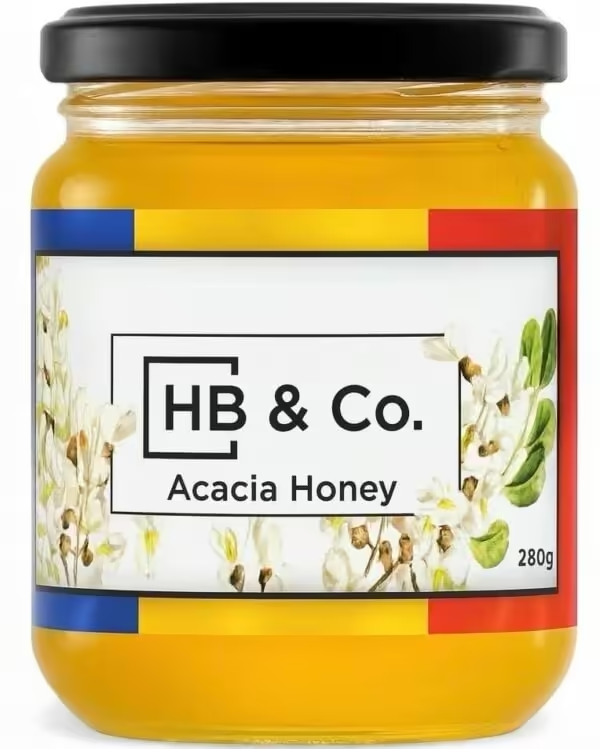
Our Acacia Honey comes from a very different beekeeping tradition. Dragos Nistor's family has kept hives in the Carpathian Mountains of Transylvania for six generations using minimal intervention practices on landscapes that have never been subject to industrial agriculture. The bees forage on uncontaminated wildflower meadows and forest margins. Read more on the About page, or explore our raw honey subscription and save 20% on every delivery.
What You Can Do
Plant native wildflowers in any outdoor space. Eliminate pesticide use from gardens entirely. Support beekeepers who practise ethical, transparent beekeeping with full traceability. Explore the World Bee Atlas to discover which bee species are native to the United States and what habitats they depend on. To read more about why bee populations are declining globally, see our article on why bee populations are declining.
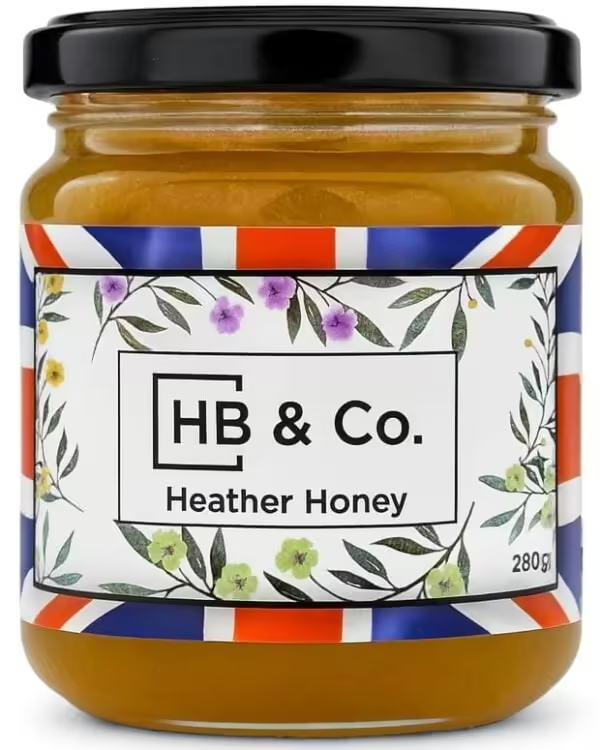
Raw Honey. Shop HoneyBee & Co.
Single-origin raw honey from Transylvanian family apiaries and a SALSA-certified British supplier. Six varieties, all cold-extracted and fully traceable. Free UK delivery on three or more jars.
Frequently Asked Questions
Which American foods disappear without bees?
Avocados, blueberries, strawberries, raspberries, apples, cranberries, pumpkins, tomatoes, cucumbers, and onions are all significantly pollinator-dependent. Meat, wheat, corn, potatoes, and dairy are largely unaffected. The most dramatic losses are in American fruit culture - blueberries, strawberries, and raspberries all require buzz-pollination that only wild bumblebees can perform.
How many bee species live in the United States?
The United States has over 4,000 native bee species - more than any other country in North America. The Sonoran Desert of Arizona and California is the richest region for bee diversity on earth. The genus Perdita, which includes the world's smallest bees at 2mm, is found almost exclusively in the American Southwest. Approximately 65% of US bee species are at risk.
Why do blueberries need bees?
Blueberries require buzz-pollination, or sonication, performed by bumblebees vibrating their flight muscles at approximately 400 Hz. This shakes pollen loose from the flower's anthers in a way that simple contact cannot achieve. Honeybees cannot perform sonication. Without wild bumblebee populations, blueberry fruit set drops by 90% or more regardless of how many managed honeybee hives are present.
How does California's almond industry depend on bees?
California produces over 80% of the world's almonds. Almond trees cannot self-pollinate and require cross-pollination during a narrow two-week flowering window in February. More than one million managed honeybee colonies - roughly half of all US managed hives - are transported to California's Central Valley each February. Without this pollination, there are no almonds.
What is Colony Collapse Disorder?
Colony Collapse Disorder (CCD) is a phenomenon first documented in the United States in 2006 in which worker bees abandon their hive, leaving behind the queen and honey stores. Affected colonies collapse rapidly. The causes are complex and still debated, but contributing factors include pesticide exposure (particularly neonicotinoids), Varroa mite infestation, pathogen stress, and the physiological stress of long-distance transport for commercial pollination. Tens of millions of colonies have been lost since 2006.
What percentage of American food requires pollinators?
The most commercially important US crops by value - almonds, blueberries, strawberries, avocados, cranberries, and apples - are between 65% and 95% pollinator-dependent under Klein et al. (2007). By food crop species count, approximately 75% of globally important crops require animal pollination. The US agricultural economy loses an estimated 15 billion dollars annually if pollination services are valued at market rates.