

 English (UK)
  Italiano
  Français
  简体中文
简体中文  한국어
한국어 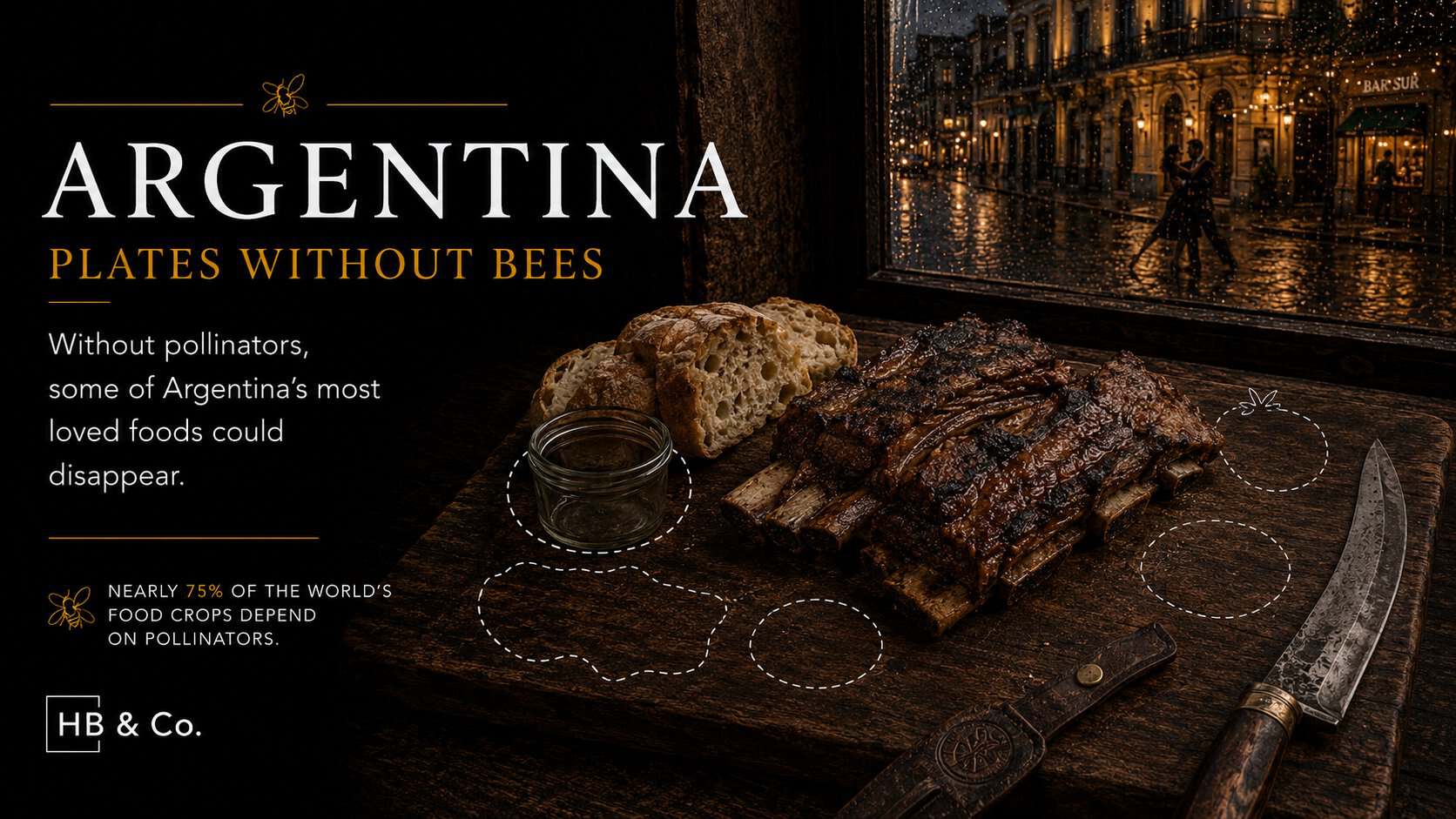
Argentina's Plate Without Bees
Six iconic Argentine dishes. Over 1,000 native bee species. What vanishes from the plate when the pollinators disappear.
 United Kingdom
 Italy
Italy
 France
 Spain
Spain
 Germany
 Greece
 Portugal
 Romania
 Turkey
 United States
 Mexico
 Brazil
 Argentina
 Peru
Peru
 Colombia
 China
China
 Japan
Japan
 South Korea
 Thailand
 Vietnam
 Indonesia
 Philippines
 India
India
 Pakistan
 Morocco
 Egypt
Egypt
 Lebanon
 Saudi Arabia
 Ethiopia
 Nigeria
- 87 of the world's leading food crops depend on animal pollination to some degree (Klein et al., 2007)
- Without bees, Argentine Chimichurri sauce loses its lemon and onion - two of its five flavour components are pollinator-dependent
- Argentina has over 1,000 native bee species and is the world's third-largest honey exporter at over 60,000 tonnes annually
- Argentina is the world's largest lemon producer at over 1.5 million tonnes annually; lemons carry 65% pollinator dependency
- Argentine sunflower honey from the Pampa is one of the world's largest-volume honey exports
Why Argentine Cuisine Depends on Bees
Argentine food culture is dominated by beef - and beef is largely independent of bee pollination. But the accompaniments, sauces, and vegetable dishes that frame Argentine cooking are significantly pollinator-dependent. Chimichurri sauce loses its lemon (65%) and onion (65%). Empanadas are filled with tomatoes (65%), onions (65%), and red peppers (65%). Locro stew depends on pumpkin (65%), tomatoes (65%), and onion (65%). The Argentine asado may survive bee decline. Everything served around it is at risk. Argentina is the world's largest lemon producer at over 1.5 million tonnes annually from Tucuman province - a 65% pollinator-dependent crop representing enormous commercial exposure to bee decline.
Argentina is the world's third-largest honey exporter at over 60,000 tonnes annually. Sunflower honey from the vast Pampa fields, clover honey from Patagonian pastures, and citrus honey from Mesopotamia are major export products supporting over 30,000 Argentine beekeepers. Argentina has no native Apis honeybee species; all commercial honey production uses introduced Apis mellifera. The entire honey export industry depends on European-origin Apis mellifera maintaining population health in Argentine agricultural landscapes.
The Science Behind Argentine Crop Pollination
Key Argentine pollinator dependencies: tomatoes (65%), onions (65%), red peppers (65%), lemons (65%), cucumbers (95%), avocado (95%), strawberries (95%), and pumpkins (65%). Our Acacia Honey comes from Transylvanian Carpathian forests. Read more on the About page, try our honey subscription and save 20%, or explore the World Bee Atlas. For bee decline, read our article on why bee populations are declining.
Raw Honey. Shop HoneyBee & Co.
Single-origin raw honey from Transylvanian family apiaries and a SALSA-certified British supplier. Six varieties, all cold-extracted and fully traceable. Free UK delivery on three or more jars.
Frequently Asked Questions
Which Argentine foods disappear without bees?
Tomatoes, onions, red peppers, lemons, cucumbers, avocado, strawberries, and pumpkins are all significantly pollinator-dependent. Beef, wheat, dairy, and wine grapes are largely unaffected. Argentine asado survives bee decline. Everything served around it is at risk.
How many bee species live in Argentina?
Argentina has over 1,000 native bee species. Argentina has no native Apis honeybee species; all commercial honey production uses introduced Apis mellifera. Approximately 68% are at risk.
Is Argentina a major honey producer?
Yes. Argentina is the world's third-largest honey exporter at over 60,000 tonnes annually to the EU and US. Sunflower honey from the Pampa, clover from Patagonia, and citrus from Mesopotamia are major products supporting over 30,000 beekeepers.
Is Argentina the world's largest lemon producer?
Yes. Argentina produces over 1.5 million tonnes of lemons annually, almost entirely from Tucuman province. Lemon carries 65% pollinator dependency. A pollinator-driven yield reduction would represent enormous commercial impact on Argentina's most significant citrus export.
Does Chimichurri depend on bees?
Partially. Chimichurri contains lemon (65%) and onion (65%) as pollinator-dependent components. Parsley, garlic, and olive oil are largely unaffected. Without bees, Chimichurri loses its acidity and base, becoming a significantly diminished condiment.
What percentage of Argentine food requires pollinators?
Argentine cuisine's cooking base - tomatoes (65%), onions (65%), red peppers (65%), and lemon (65%) - is all significantly pollinator-dependent under Klein et al. (2007). Beef, wheat, dairy, and wine grapes are largely unaffected.