

 English (UK)
  Italiano
  Français
  简体中文
简体中文  한국어
한국어 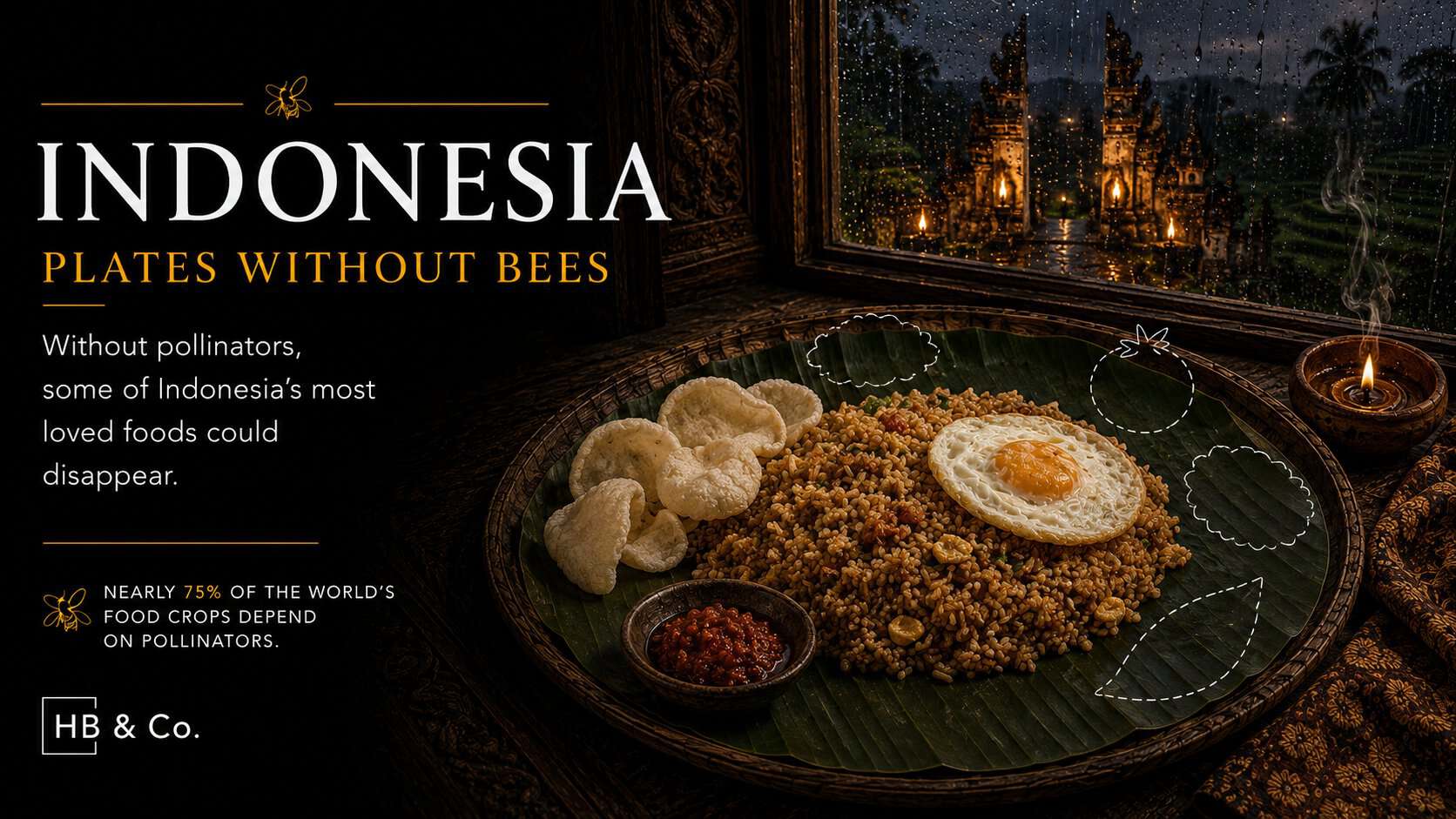
Indonesia's Plate Without Bees
Six iconic Indonesian dishes. Over 600 native bee species. What vanishes from the plate when the pollinators disappear.
 United Kingdom
 Italy
Italy
 France
 Spain
Spain
 Germany
 Greece
 Portugal
 Romania
 Turkey
 United States
 Mexico
 Brazil
 Argentina
 Peru
Peru
 Colombia
 China
China
 Japan
Japan
 South Korea
 Thailand
 Vietnam
 Indonesia
 Philippines
 India
India
 Pakistan
 Morocco
 Egypt
Egypt
 Lebanon
 Saudi Arabia
 Ethiopia
 Nigeria
- 87 of the world's leading food crops depend on animal pollination to some degree (Klein et al., 2007)
- Without bees, an Indonesian Es Teler dessert loses all five of its fruit components - coconut, avocado, lychee, mango, and pineapple are all pollinator-dependent
- Indonesia has over 600 native bee species across 17,000 islands with extraordinary pollinator diversity
- Indonesian stingless bee honey (madu klanceng) is managed in traditional wooden hives across Java and Sulawesi
- Indonesia is the world's largest coconut producer; coconut carries a 25% modest pollinator dependency
Why Indonesian Cuisine Depends on Bees
Indonesian food spans 300 regional cuisines across the world's largest archipelago. Common threads include peanuts in satay sauce and gado-gado (25% modest dependency), coconut milk in rendang and curries (25%), and the tomato-onion base of almost every cooked sauce (65%). Es Teler, Indonesia's most beloved cold dessert, loses all five fruit components without pollinators: coconut (25%), avocado (95%), lychee (95%), mango (25%), and pineapple (25%) are all pollinator-dependent. Without bees, Es Teler is condensed milk over ice. Gado-Gado loses its tofu (65%), cucumber (95%), and peanut sauce (25%). The dishes that define Indonesian food culture are rebuilt from scratch.
Indonesia has a deep stingless bee honey tradition. Tetragonula and Trigona species are managed in traditional wooden hives across Java, Sulawesi, and Kalimantan. Indonesian stingless bee honey, known as madu klanceng, is prized in traditional medicine and commands significant premiums in urban Indonesian markets. The practice represents one of the most ecologically sustainable food production systems in the world, unchanged for centuries.
The Science Behind Indonesian Crop Pollination
Key Indonesian pollinator dependencies: cucumbers (95%), avocado (95%), lychee (95%), tomatoes (65%), onions (65%), coconut (25%), peanuts (25%), mango (25%), and pineapple (25%). Our Acacia Honey comes from European Apis mellifera in Transylvania. Read more on the About page, try our honey subscription and save 20%, or explore the World Bee Atlas. For bee decline, read our article on why bee populations are declining.
Raw Honey. Shop HoneyBee & Co.
Single-origin raw honey from Transylvanian family apiaries and a SALSA-certified British supplier. Six varieties, all cold-extracted and fully traceable. Free UK delivery on three or more jars.
Frequently Asked Questions
Which Indonesian foods disappear without bees?
Cucumbers, avocado, lychee, tomatoes, onions, coconut, peanuts, mango, and pineapple are all significantly pollinator-dependent. Rice, tempeh, chicken, and plain tofu are largely unaffected.
How many bee species live in Indonesia?
Indonesia has over 600 native bee species across its 17,000 islands. Key species include Apis dorsata, Apis cerana, Apis florea, and multiple Trigona and Tetragonula stingless bee species. Approximately 65% are at risk.
What is Indonesian stingless bee honey?
Madu klanceng is produced by Tetragonula and Trigona species in traditional wooden hives across Java, Sulawesi, and Kalimantan. It has a distinctively sour flavour and is prized in Indonesian traditional medicine, commanding significant premiums in urban markets.
Does Indonesian coconut production depend on bees?
Yes, at 25% modest dependency. Indonesia is the world's largest coconut producer at around 18 million tonnes annually. Insect pollination significantly improves fruit set and yield. A 25% reduction from pollinator decline would represent enormous economic impact.
What percentage of Indonesian food requires pollinators?
Indonesia's tropical fruit layer - avocado (95%), lychee (95%), mango (25%), pineapple (25%), and coconut (25%) - is all significantly pollinator-dependent under Klein et al. (2007). Rice, tempeh, and most proteins are unaffected.
How can I help protect bees in Indonesia?
Support organisations protecting tropical rainforest ecosystems across the Indonesian archipelago. Choose food products from supply chains committed to deforestation-free sourcing and pollinator health. Explore the World Bee Atlas to learn which species are native to Indonesia.